
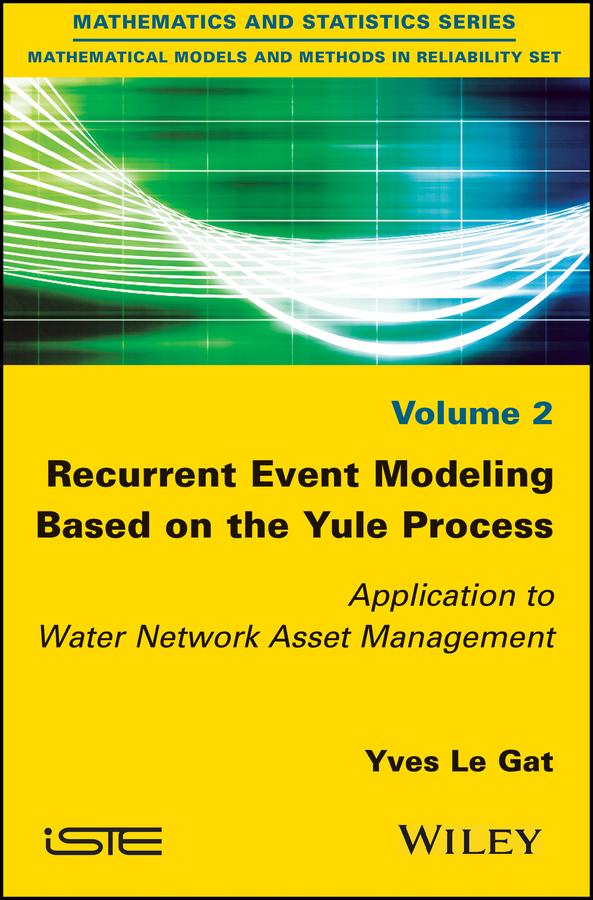
This book presents research work into the reliability of drinking water pipes.
The infrastructure of water pipes is susceptible to routine failures, namely leakage or breakage, which occur in an aggregative manner in pipeline networks. Creating strategies for infrastructure asset management requires accurate modeling tools and first-hand experience of what repeated failures can mean in terms of socio-economic and environmental consequences.
Devoted to the counting process framework when dealing with this issue, the author presents preliminary basic concepts, particularly the process intensity, as well as basic tools (classical distributions and processes).
The introductory material precedes the discussion of several constructs, namely the non-homogeneous birth process, and further as a special case, the linearly extended Yule process (LEYP), and its adaptation to account for selective survival. The practical usefulness of the theoretical results is illustrated with actual water pipe failure data.
Pay easily by card, Klarna, Apple Pay or Google Pay. Not happy? You always have a 14-day money-back guarantee. Read more in our terms. If you have any questions, email us at hello@memmo.org.
Memmo makes studying easier – wherever you are in the world. We bring your course books and smart study tools together in one place: summaries, quizzes, podcasts and flashcards. Plus Ted, your study buddy who answers anything you wonder. Over 75,000 students already study here – built to help you learn faster and stress less.