
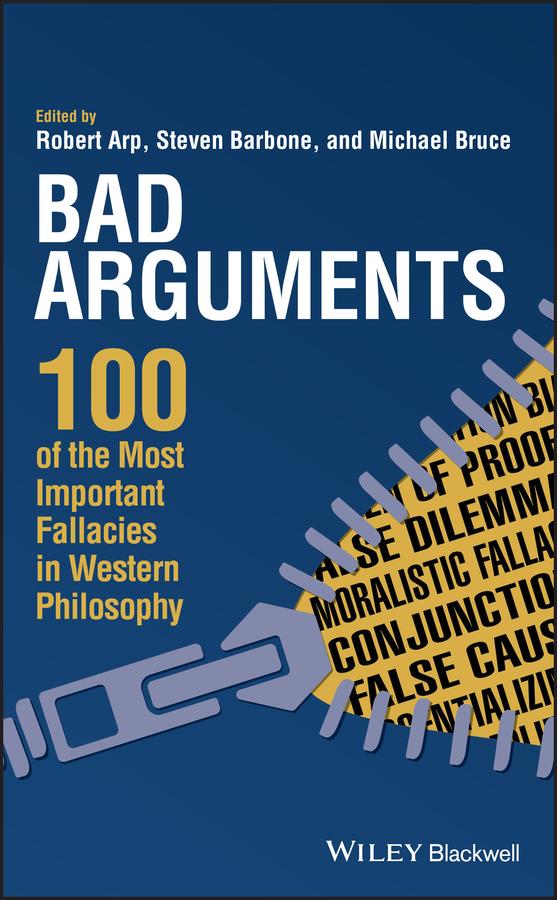
A timely and accessible guide to 100 of the most infamous logical fallacies in Western philosophy, helping readers avoid and detect false assumptions and faulty reasoning
You’ll love this book or you’ll hate it. So, you’re either with us or against us. And if you’re against us then you hate books. No true intellectual would hate this book.
Ever decide to avoid a restaurant because of one bad meal? Choose a product because a celebrity endorsed it? Or ignore what a politician says because she’s not a member of your party? For as long as people have been discussing, conversing, persuading, advocating, proselytizing, pontificating, or otherwise stating their case, their arguments have been vulnerable to false assumptions and faulty reasoning. Drawing upon a long history of logical falsehoods and philosophical flubs, Bad Arguments demonstrates how misguided arguments come to be, and what we can do to detect them in the rhetoric of others and avoid using them ourselves.
Fallacies—or conclusions that don’t follow from their premise—are at the root of most bad arguments, but it can be easy to stumble into a fallacy without realizing it. In this clear and concise guide to good arguments gone bad, Robert Arp, Steven Barbone, and Michael Bruce take readers through 100 of the most infamous fallacies in Western philosophy, identifying the most common missteps, pitfalls, and dead-ends of arguments gone awry. Whether an instance of sunk costs, is ought, affirming the consequent, moving the goal post, begging the question, or the ever-popular slippery slope, each fallacy engages with examples drawn from contemporary politics, economics, media, and popular culture. Further diagrams and tables supplement entries and contextualize common errors in logical reasoning.
At a time in our world when it is crucial to be able to identify and challenge rhetorical half-truths, this bookhelps readers to better understand flawed argumentation and develop logical literacy. Unrivaled in its breadth of coverage and a worthy companion to its sister volume Just the Arguments (2011), Bad Arguments is an essential tool for undergraduate students and general readers looking to hone their critical thinking and rhetorical skills.
Pay easily by card, Klarna, Apple Pay or Google Pay. Not happy? You always have a 14-day money-back guarantee. Read more in our terms. If you have any questions, email us at hello@memmo.org.
Memmo makes studying easier – wherever you are in the world. We bring your course books and smart study tools together in one place: summaries, quizzes, podcasts and flashcards. Plus Ted, your study buddy who answers anything you wonder. Over 50,000 students already study here – built to help you learn faster and stress less.