
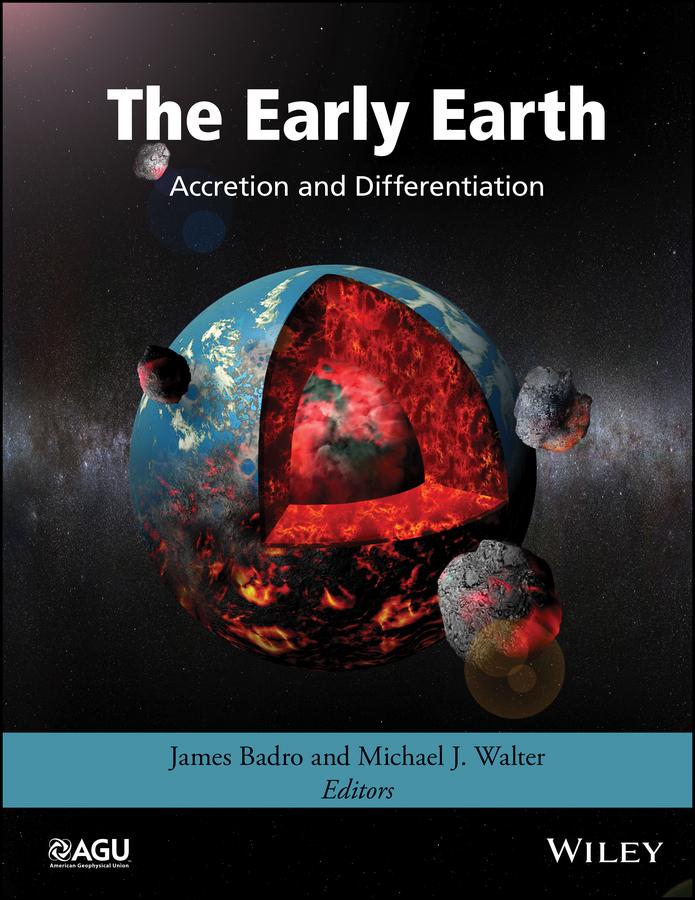
The Early Earth: Accretion and Differentiation provides a multidisciplinary overview of the state of the art in understanding the formation and primordial evolution of the Earth. The fundamental structure of the Earth as we know it today was inherited from the initial conditions 4.56 billion years ago as a consequence of planetesimal accretion, large impacts among planetary objects, and planetary-scale differentiation. The evolution of the Earth from a molten ball of metal and magma to the tectonically active, dynamic, habitable planet that we know today is unique among the terrestrial planets, and understanding the earliest processes that led to Earth’s current state is the essence of this volume. Important results have emerged from a wide range of disciplines including cosmochemistry, geochemistry, experimental petrology, experimental and theoretical mineral physics and geodynamics.
The topics in this volume include:
- Condensation of primitive objects in the solar nebula, planetary building blocks
- Early and late accretion and planetary dynamic modeling
- Primordial differentiation, core formation, Magma Ocean evolution and crystallization
This volume will be a valuable resource for graduate students, academics, and researchers in the fields of geophysics, geochemistry, cosmochemistry, and planetary science.
Pay easily by card, Klarna, Apple Pay or Google Pay. Not happy? You always have a 14-day money-back guarantee. Read more in our terms. If you have any questions, email us at hello@memmo.org.
Memmo makes studying easier – wherever you are in the world. We bring your course books and smart study tools together in one place: summaries, quizzes, podcasts and flashcards. Plus Ted, your study buddy who answers anything you wonder. Over 50,000 students already study here – built to help you learn faster and stress less.