
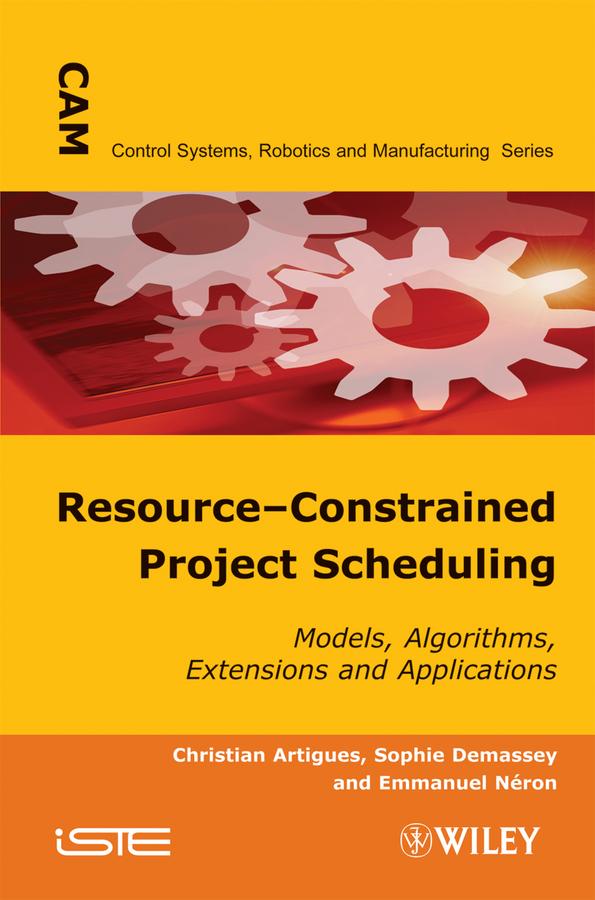
This title presents a large variety of models and algorithms dedicated to the resource-constrained project scheduling problem (RCPSP), which aims at scheduling at minimal duration a set of activities subject to precedence constraints and limited resource availabilities.
In the first part, the standard variant of RCPSP is presented and analyzed as a combinatorial optimization problem. Constraint programming and integer linear programming formulations are given. Relaxations based on these formulations and also on related scheduling problems are presented. Exact methods and heuristics are surveyed. Computational experiments, aiming at providing an empirical insight on the difficulty of the problem, are provided.
The second part of the book focuses on several other variants of the RCPSP and on their solution methods. Each variant takes account of real-life characteristics which are not considered in the standard version, such as possible interruptions of activities, production and consumption of resources, cost-based approaches and uncertainty considerations.
The last part presents industrial case studies where the RCPSP plays a central part. Applications are presented in various domains such as assembly shop and rolling ingots production scheduling, project management in information technology companies and instruction scheduling for VLIW processor architectures.
In the first part, the standard variant of RCPSP is presented and analyzed as a combinatorial optimization problem. Constraint programming and integer linear programming formulations are given. Relaxations based on these formulations and also on related scheduling problems are presented. Exact methods and heuristics are surveyed. Computational experiments, aiming at providing an empirical insight on the difficulty of the problem, are provided.
The second part of the book focuses on several other variants of the RCPSP and on their solution methods. Each variant takes account of real-life characteristics which are not considered in the standard version, such as possible interruptions of activities, production and consumption of resources, cost-based approaches and uncertainty considerations.
The last part presents industrial case studies where the RCPSP plays a central part. Applications are presented in various domains such as assembly shop and rolling ingots production scheduling, project management in information technology companies and instruction scheduling for VLIW processor architectures.
Pay easily by card, Klarna, Apple Pay or Google Pay. Not happy? You always have a 14-day money-back guarantee. Read more in our terms. If you have any questions, email us at hello@memmo.org.
Memmo makes studying easier – wherever you are in the world. We bring your course books and smart study tools together in one place: summaries, quizzes, podcasts and flashcards. Plus Ted, your study buddy who answers anything you wonder. Over 75,000 students already study here – built to help you learn faster and stress less.