
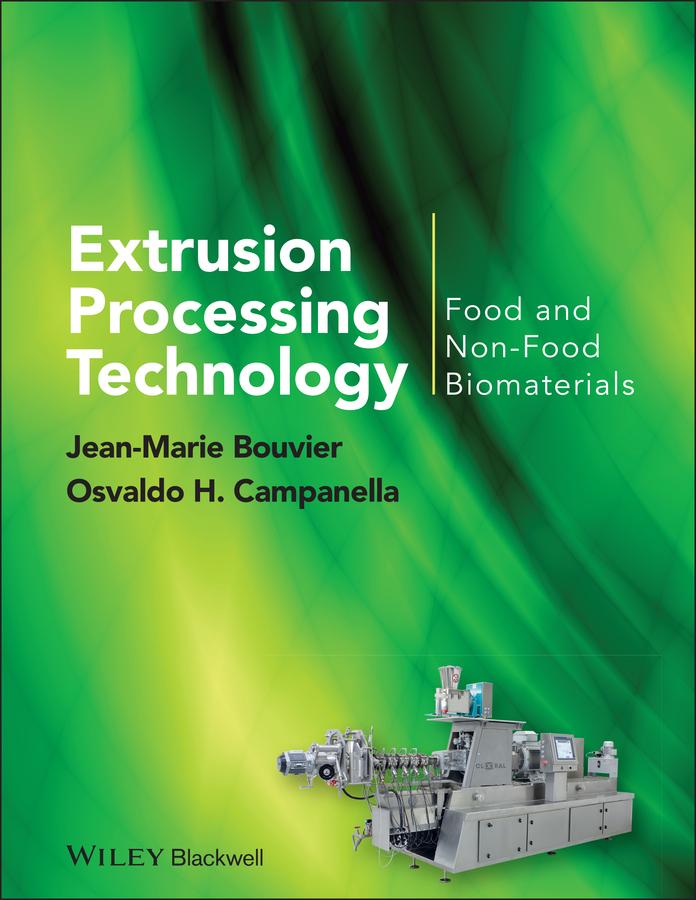
Extrusion is the operation of forming and shaping a molten or dough-like material by forcing it through a restriction, or die. It is applied and used in many batch and continuous processes. However, extrusion processing technology relies more on continuous process operations which use screw extruders to handle many process functions such as the transport and compression of particulate components, melting of polymers, mixing of viscous media, heat processing of polymeric and biopolymeric materials, product texturization and shaping, defibering and chemical impregnation of fibrous materials, reactive extrusion, and fractionation of solid-liquid systems. Extrusion processing technology is highly complex, and in-depth descriptions and discussions are required in order to provide a complete understanding and analysis of this area: this book aims to provide readers with these analyses and discussions.
Extrusion Processing Technology: Food and Non-Food Biomaterials provides an overview of extrusion processing technology and its established and emerging industrial applications. Potency of process intensification and sustainable processing is also discussed and illustrated. The book aims to span the gap between the principles of extrusion science and the practical knowledge of operational engineers and technicians. The authors bring their research and industrial experience in extrusion processing technology to provide a comprehensive, technical yet readable volume that will appeal to readers from both academic and practical backgrounds.
This book is primarily aimed at scientists and engineers engaged in industry, research, and teaching activities related to the extrusion processing of foods (especially cereals, snacks, textured and fibrated proteins, functional ingredients, and instant powders), feeds (especially aquafeeds and petfoods), bioplastics and plastics, biosourced chemicals, paper pulp, and biofuels. It will also be of interest to students of food science, food engineering, and chemical engineering.
Also available
Formulation Engineering of Foods
Edited by J.E. Norton, P.J. Fryer and I.T. Norton ISBN 978-0-470-67290-7
Food and Industrial Bioproducts and Bioprocessing
Edited by N.T. Dunford ISBN 978-0-8138-2105-4
Handbook of Food Process Design
Edited by J. Ahmed and M.S. Rahman ISBN 978-1-4443-3011-3
Pay easily by card, Klarna, Apple Pay or Google Pay. Not happy? You always have a 14-day money-back guarantee. Read more in our terms. If you have any questions, email us at hello@memmo.org.
Memmo makes studying easier – wherever you are in the world. We bring your course books and smart study tools together in one place: summaries, quizzes, podcasts and flashcards. Plus Ted, your study buddy who answers anything you wonder. Over 50,000 students already study here – built to help you learn faster and stress less.