
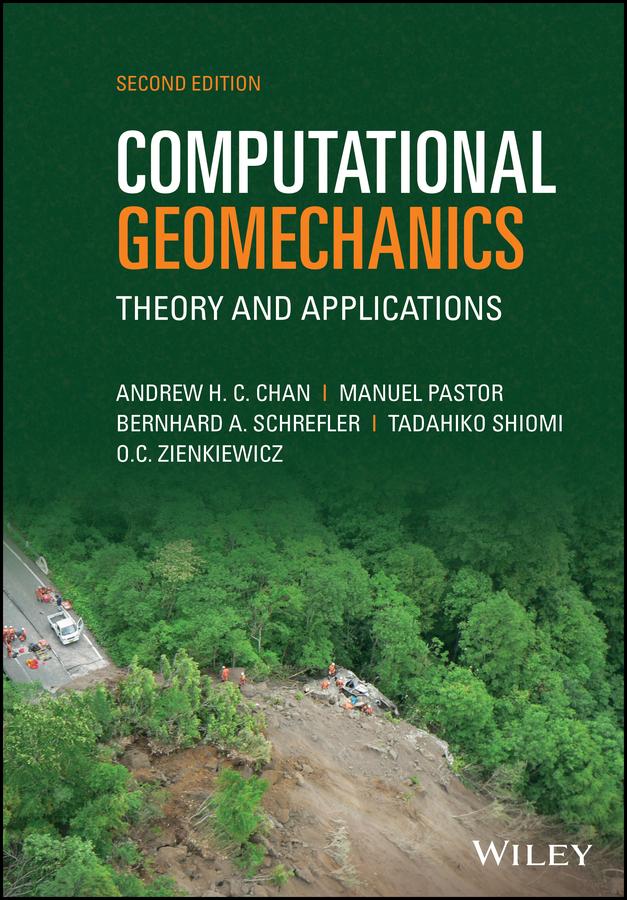
The new edition of the first book to cover the computational dynamic aspects of geomechanics, now including more practical applications and up-to-date coverage of current research in the field
Advances in computational geomechanics have dramatically improved understanding of the behavior of soils and the ability of engineers to design increasingly sophisticated constructions in the ground. When Professor Olek Zienkiewicz began the application of numerical approaches to solid dynamics at Swansea University, it became evident that realistic prediction of the behavior of soil masses could only be achieved if the total stress approaches were abandoned. Computational Geomechanics introduces the theory and application of Zienkiewicz’s computational approaches that remain the basis for work in the area of saturated and unsaturated soil to this day.
Written by past students and colleagues of Professor Zienkiewicz, this extended Second Edition provides formulations for a broader range of problems, including failure load under static loading, saturated and unsaturated consolidation, hydraulic fracturing, and liquefaction of soil under earthquake loading. The internationally-recognized team of authors incorporates current computer technologies and new developments in the field, particularly in the area of partial saturation, as they guide readers on how to properly apply the formulation in their work. This one-of-a-kind volume:
- Explains the Biot-Zienkiewicz formulation for saturated and unsaturated soil
- Covers multiple applications to static and dynamic problems for saturated and unsaturated soil in areas such as earthquake engineering and fracturing of soils and rocks
- Features a completely new chapter on fast catastrophic landslides using depth integrated equations and smoothed particle hydrodynamics with applications
- Presents the theory of porous media in the saturated and unsaturated states to establish the foundation of the problem of soil mechanics
- Provides a quantitative description of soil behavior including simple plasticity models, generalized plasticity, and critical state soil mechanics
- Includes numerous questions, problems, hands-on experiments, applications to other situations, and example code for GeHoMadrid
Computational Geomechanics: Theory and Applications, Second Edition is an ideal textbook for specialist and general geotechnical postgraduate courses, and a must-have reference for researchers in geomechanics and geotechnical engineering, for software developers and users of geotechnical finite element software, and for geotechnical analysts and engineers making use of the numerical results obtained from the Biot-Zienkiewicz formulation.
Pay easily by card, Klarna, Apple Pay or Google Pay. Not happy? You always have a 14-day money-back guarantee. Read more in our terms. If you have any questions, email us at hello@memmo.org.
Memmo makes studying easier – wherever you are in the world. We bring your course books and smart study tools together in one place: summaries, quizzes, podcasts and flashcards. Plus Ted, your study buddy who answers anything you wonder. Over 50,000 students already study here – built to help you learn faster and stress less.