
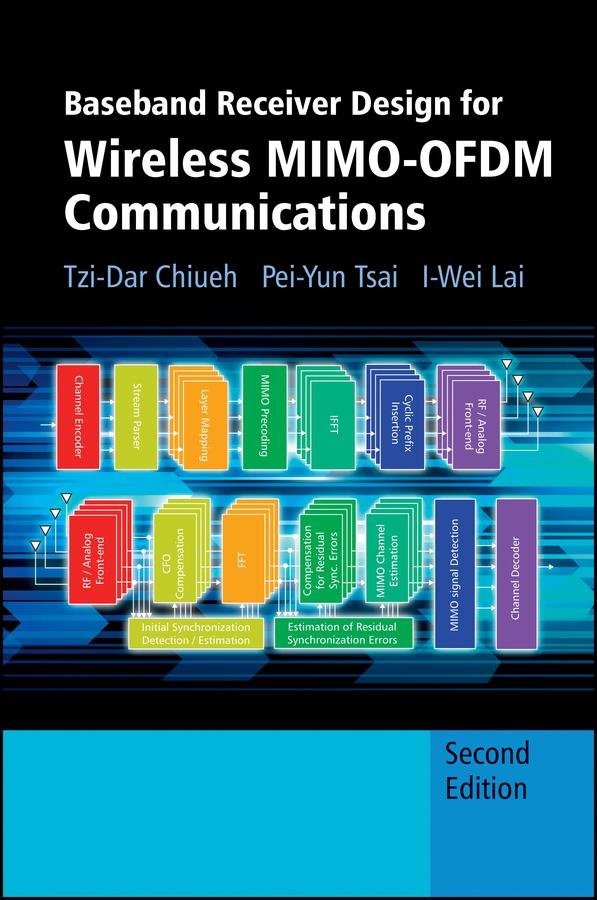
The Second Edition of OFDM Baseband Receiver Design for Wirless Communications, this book expands on the earlier edition with enhanced coverage of MIMO techniques, additional baseband algorithms, and more IC design examples. The authors cover the full range of OFDM technology, from theories and algorithms to architectures and circuits.
The book gives a concise yet comprehensive look at digital communication fundamentals before explaining signal processing algorithms in receivers. The authors give detailed treatment of hardware issues - from architecture to IC implementation.
- Links OFDM and MIMO theory with hardware implementation
- Enables the reader to transfer communication received concepts into hardware; design wireless receivers with acceptable implemntation loss; achieve low-power designs
- Covers the latest standards, such as DVB-T2, WiMax, LTE and LTE-A
- Includes more baseband algorithms, like soft-decoding algorithms such as BCJR and SOVA
- Expanded treatment of channel models, detection algorithms and MIMO techniques
- Features concrete design examples of WiMAX systems and cognitive radio apllications
- Companion website with lecture slides for instructors
Based on materials developed for a course in digital communication IC design, this book is ideal for graduate students and researchers in VLSI design, wireless communications, and communications signal processing. Practicing engineers working on algorithms or hardware for wireless communications devices will also find this to be a key reference.
Pay easily by card, Klarna, Apple Pay or Google Pay. Not happy? You always have a 14-day money-back guarantee. Read more in our terms. If you have any questions, email us at hello@memmo.org.
Memmo makes studying easier – wherever you are in the world. We bring your course books and smart study tools together in one place: summaries, quizzes, podcasts and flashcards. Plus Ted, your study buddy who answers anything you wonder. Over 50,000 students already study here – built to help you learn faster and stress less.