
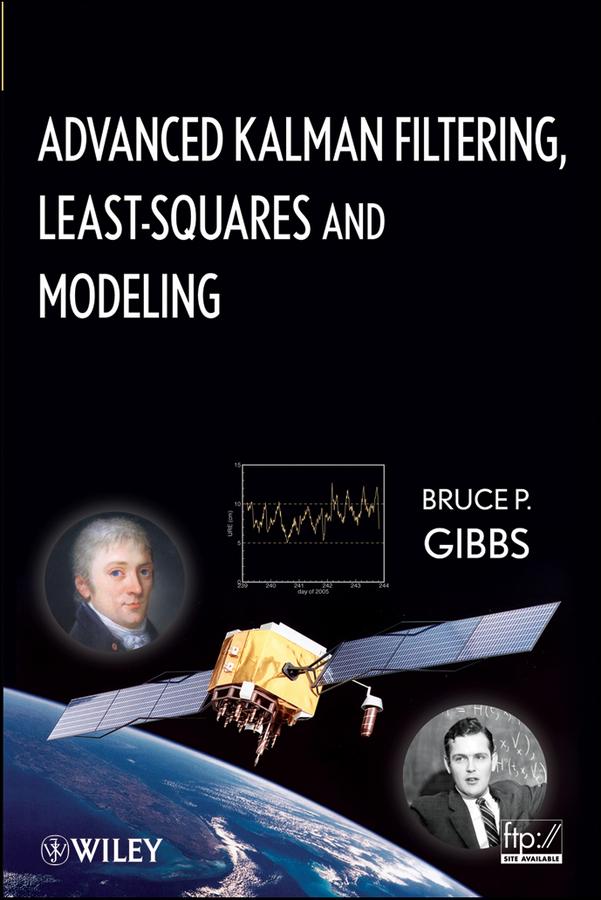
Its primary goal is to discuss model development in sufficient detail so that the reader may design an estimator that meets all application requirements and is robust to modeling assumptions. Since it is sometimes difficult to a priori determine the best model structure, use of exploratory data analysis to define model structure is discussed. Methods for deciding on the “best” model are also presented.
A second goal is to present little known extensions of least squares estimation or Kalman filtering that provide guidance on model structure and parameters, or make the estimator more robust to changes in real-world behavior.
A third goal is discussion of implementation issues that make the estimator more accurate or efficient, or that make it flexible so that model alternatives can be easily compared.
The fourth goal is to provide the designer/analyst with guidance in evaluating estimator performance and in determining/correcting problems.
The final goal is to provide a subroutine library that simplifies implementation, and flexible general purpose high-level drivers that allow both easy analysis of alternative models and access to extensions of the basic filtering.
Supplemental materials and up-to-date errata are downloadable at http://booksupport.wiley.com.
Pay easily by card, Klarna, Apple Pay or Google Pay. Not happy? You always have a 14-day money-back guarantee. Read more in our terms. If you have any questions, email us at hello@memmo.org.
Memmo makes studying easier – wherever you are in the world. We bring your course books and smart study tools together in one place: summaries, quizzes, podcasts and flashcards. Plus Ted, your study buddy who answers anything you wonder. Over 50,000 students already study here – built to help you learn faster and stress less.