
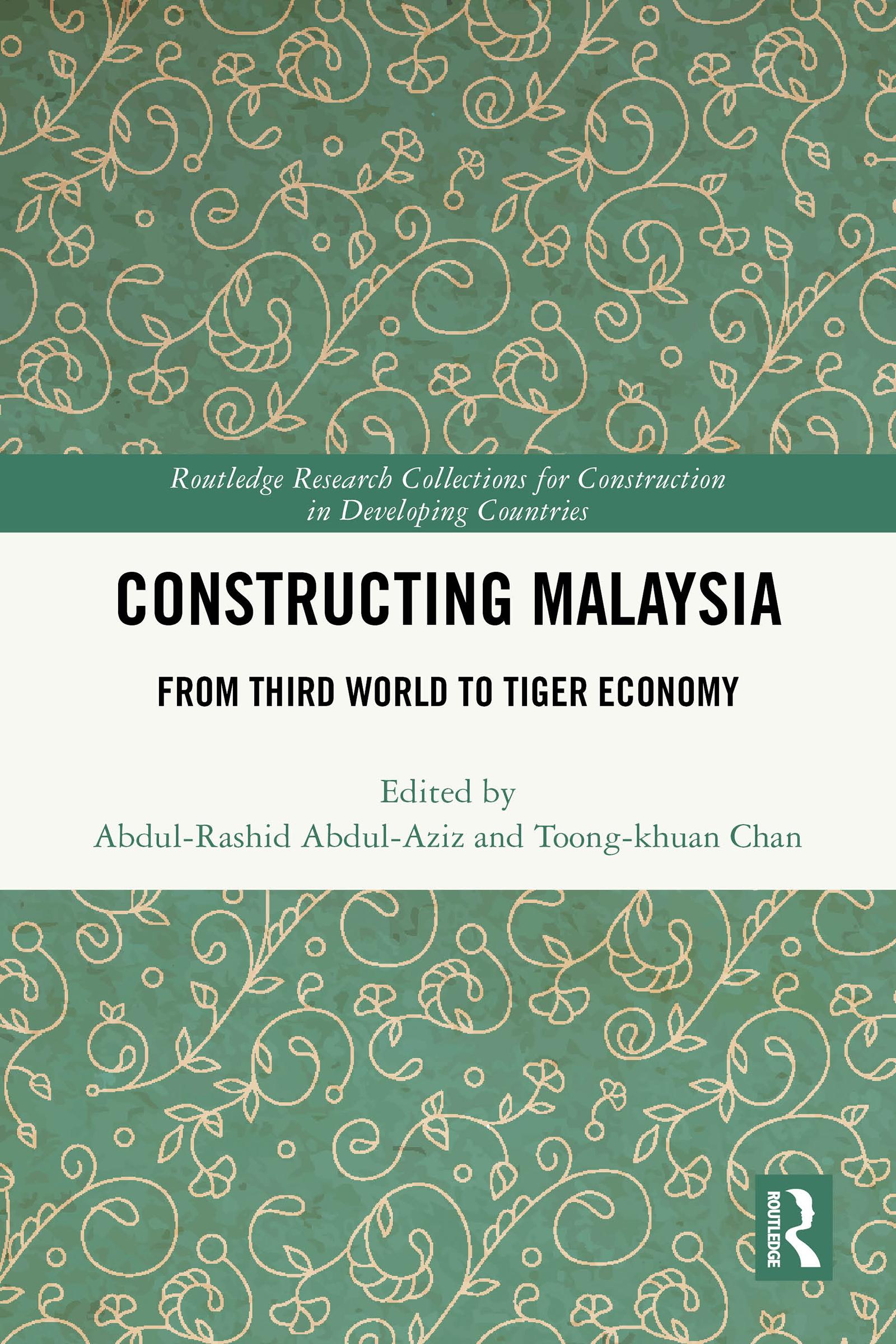
This book addresses the evolution of Malaysia's construction industry from independence in 1957 to the present day. Rather than viewing construction simply as a technical or economic activity, it analyses the sector as a product of historical, political, social and institutional forces that have shaped Malaysia's broader development trajectory. Through a multidisciplinary perspective, the book explores how state policy, market structures, professional institutions, labour systems, technology adoption and infrastructure investment have collectively influenced the industry's transformation.
The chapters examine Malaysia's historical development context, affirmative action policies and their impact on contractors, the role of foreign construction firms, the long-standing reliance on migrant labour and the emergence of the Construction Industry Development Board (CIDB) as the country's principal industry development institution. The book further analyses national construction industry development strategies, the promotion of industrialised building systems and prefabrication, environmental sustainability initiatives and the evolution of green building policies and rating systems.
The book also traces the development of the three principal built-environment professions in Malaysia: architecture, engineering and quantity surveying. It examines the institutionalisation of these professions through legislation, education, professional bodies and their contributions to national development while reflecting on the challenges posed by globalisation, digitalisation and international competition.
A detailed case study of the North-South Expressway illustrates the complex interaction between infrastructure development, privatisation policy, risk allocation, political economy and state intervention. The book concludes by synthesising lessons from six decades of industry development and assesses the extent to which Malaysia has succeeded in creating a productive, competitive, technologically capable and sustainable construction sector.
By combining historical analysis, policy evaluation, institutional review and industry case studies, Constructing Malaysia provides a comprehensive account of one of Southeast Asia's most important construction industries. It will be of interest to researchers, students, policymakers and practitioners in construction management, engineering, architecture, quantity surveying, economic development, public policy, urban studies and infrastructure planning.
Pay easily by card, Klarna, Apple Pay or Google Pay. Not happy? You always have a 14-day money-back guarantee. Read more in our terms. If you have any questions, email us at hello@memmo.org.
Memmo makes studying easier – wherever you are in the world. We bring your course books and smart study tools together in one place: summaries, quizzes, podcasts and flashcards. Plus Ted, your study buddy who answers anything you wonder. Over 50,000 students already study here – built to help you learn faster and stress less.