
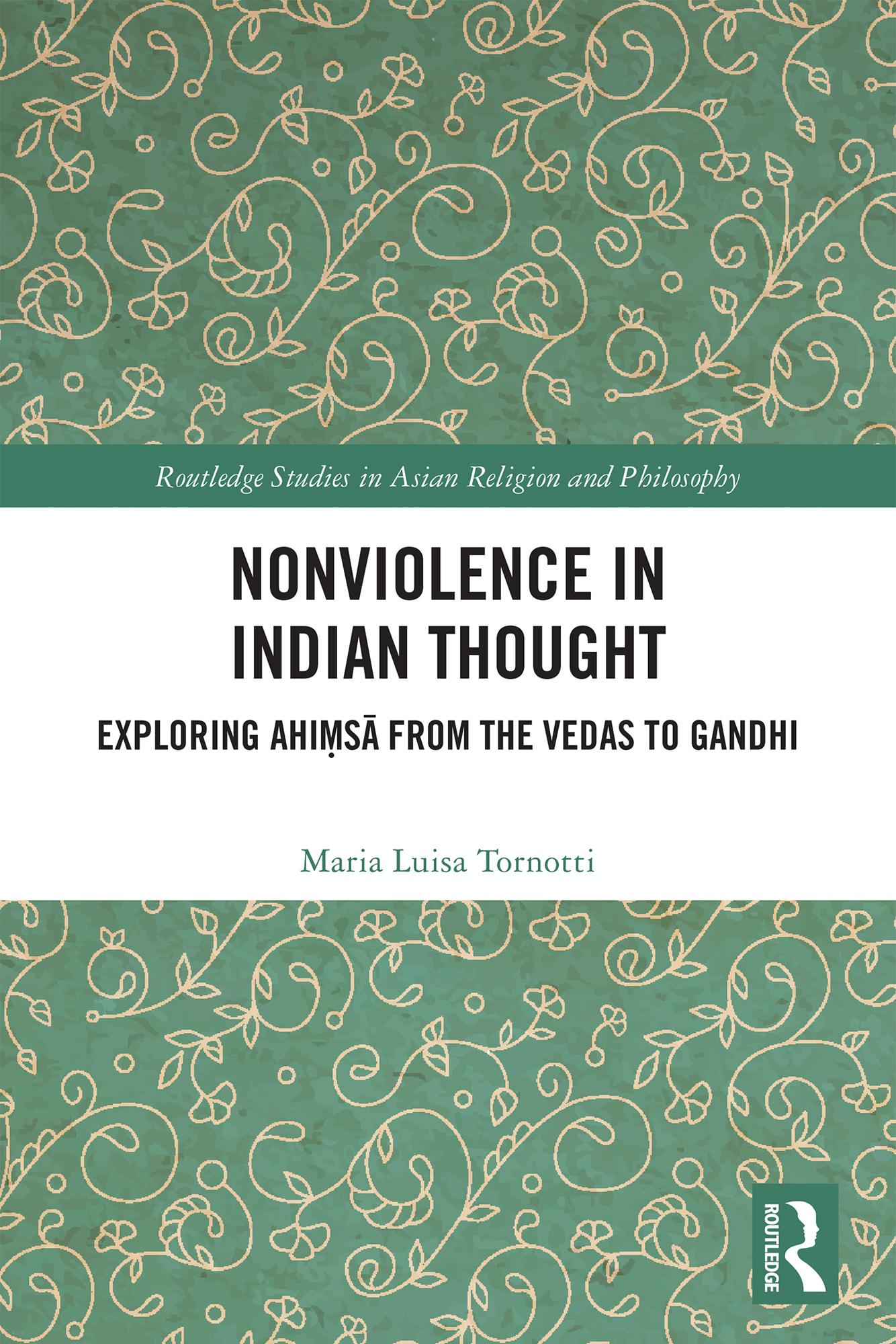
Building on the previous Italian edition, this volume presents a historical narrative and examination of the concept of ahiṃsā (nonviolence) throughout Indian religious and philosophical traditions, tracing its evolution from ancient Vedic texts to Mahatma Gandhi’s modern interpretation and application.
Acknowledging the nuances of the concept of ahiṃsā, the book makes clear that nonviolence in most of the Indic religions is located within a cluster of concepts. Taking a broadly historical and chronological approach, chapters explore the perceptions and understandings of ahiṃsā through the ancient foundational Sanskrit texts of the Vedas and Upanishads, the Hindu texts of the Dharmasutras and Mahabharata, and finally through heterodox traditional texts of Jainism and Buddhism. The book then looks at Gandhi’s comprehensive approach to ahiṃsā, demonstrating that ahiṃsā in Indian thought is not merely passive nonviolence but an active, creative principle.
Ultimately arguing that nonviolence is central to Indian spirituality, around which other ideas can be perceived as responses to this key, guiding principle, this book will be of interest to scholars, researchers and postgraduates in the fields of scriptures of Hinduism, Jainism, Buddhism, and Indian philosophy, religious studies, religion and violence, and peace studies. This book will be also useful to the general reader.
Pay easily by card, Klarna, Apple Pay or Google Pay. Not happy? You always have a 14-day money-back guarantee. Read more in our terms. If you have any questions, email us at hello@memmo.org.
Memmo makes studying easier – wherever you are in the world. We bring your course books and smart study tools together in one place: summaries, quizzes, podcasts and flashcards. Plus Ted, your study buddy who answers anything you wonder. Over 50,000 students already study here – built to help you learn faster and stress less.