
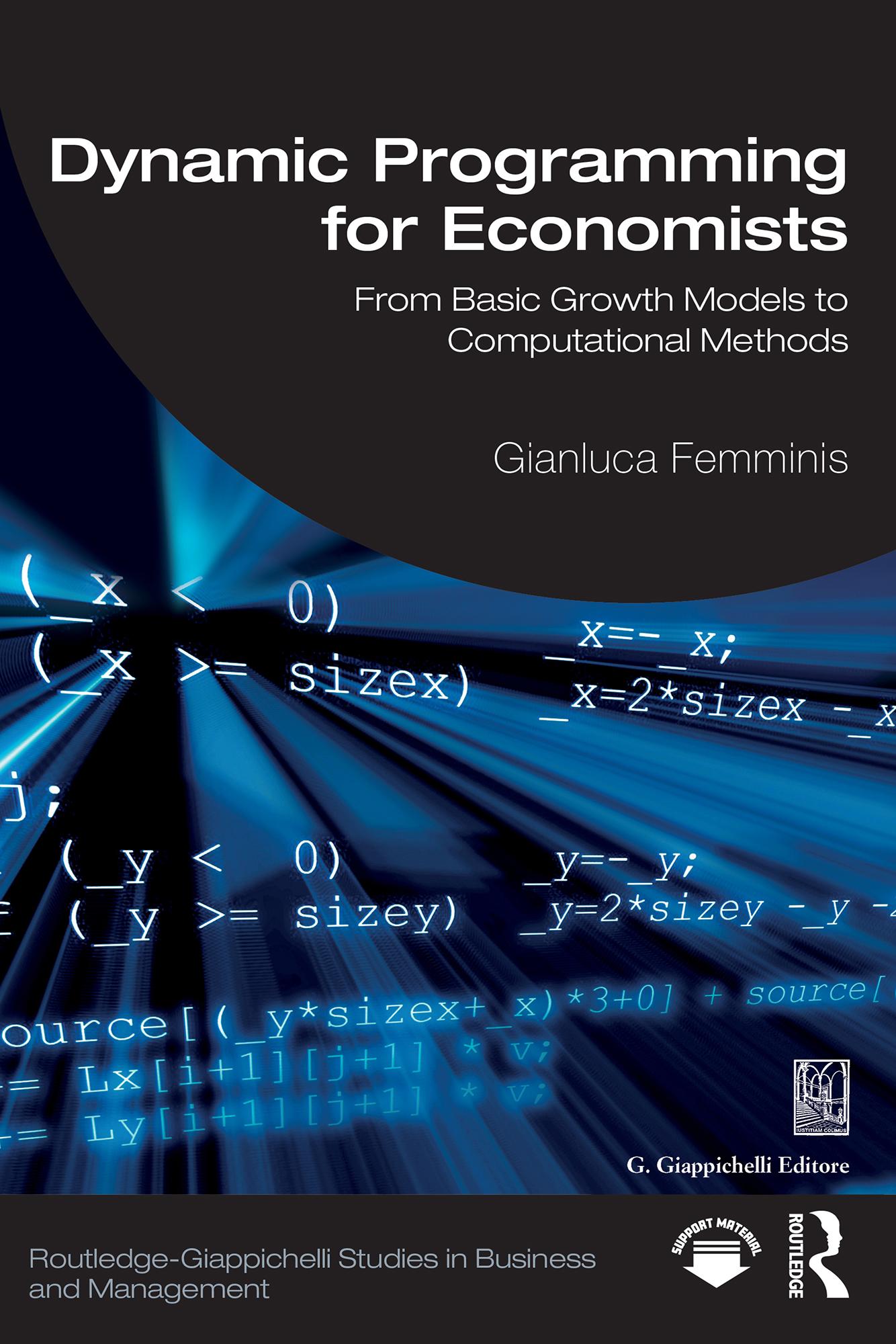
Dynamic programming is a powerful technique for modeling problems requiring sequential decisions in macroeconomics and finance. The drawback is that its analytic foundations are mathematically demanding, making existing textbooks often too technical for beginners. Moreover, dynamic models most often cannot be solved analytically and, therefore, require the use of numerical methods, whose implementation details can be discouraging.
This book is a primer on dynamic programming and related numerical techniques. To assist the reader, the discussion focuses on a specific example: a simple optimal growth model. Once the reader has mastered the most important concepts, these can be easily applied to business cycle models, New Keynesian frameworks, dynamic CAPM, and many other issues.
The deterministic growth model is used to introduce dynamic programming in an intuitive way. Technicalities are reduced to a minimum, though not avoided, to provide a solid foundation for the applications (and to stimulate the interested reader toward further readings). After a discussion of cases where a closed-form solution exists, the most commonly used numerical techniques are introduced. The book considers the value function iteration method, detailing the steps needed to build the pertinent numerical routines using Matlab. The policy function iteration method and the endogenous grid approach are also discussed since—while similar in spirit to value function iteration—they offer ways to save computing time for some applications. Then, collocation methods are used to obtain a ‘global’ solution. Again, the reader is guided step-by-step in building the numerical routines. Finally, the book introduces the perturbation method, emphasizing its nature as an approximation of the ‘true’ solution.
Moving in small steps, and with the aim of keeping the presentation as readable as possible, the book then focuses on stochastic versions of the growth model. The numerical techniques introduced for the deterministic version are used to deal with (persistent) productivity shocks. In addition, the book presents a method—the parameterized expectation approach—that only mildly suffers from the “curse of dimensionality”.
Pay easily by card, Klarna, Apple Pay or Google Pay. Not happy? You always have a 14-day money-back guarantee. Read more in our terms. If you have any questions, email us at hello@memmo.org.
Memmo makes studying easier – wherever you are in the world. We bring your course books and smart study tools together in one place: summaries, quizzes, podcasts and flashcards. Plus Ted, your study buddy who answers anything you wonder. Over 50,000 students already study here – built to help you learn faster and stress less.