
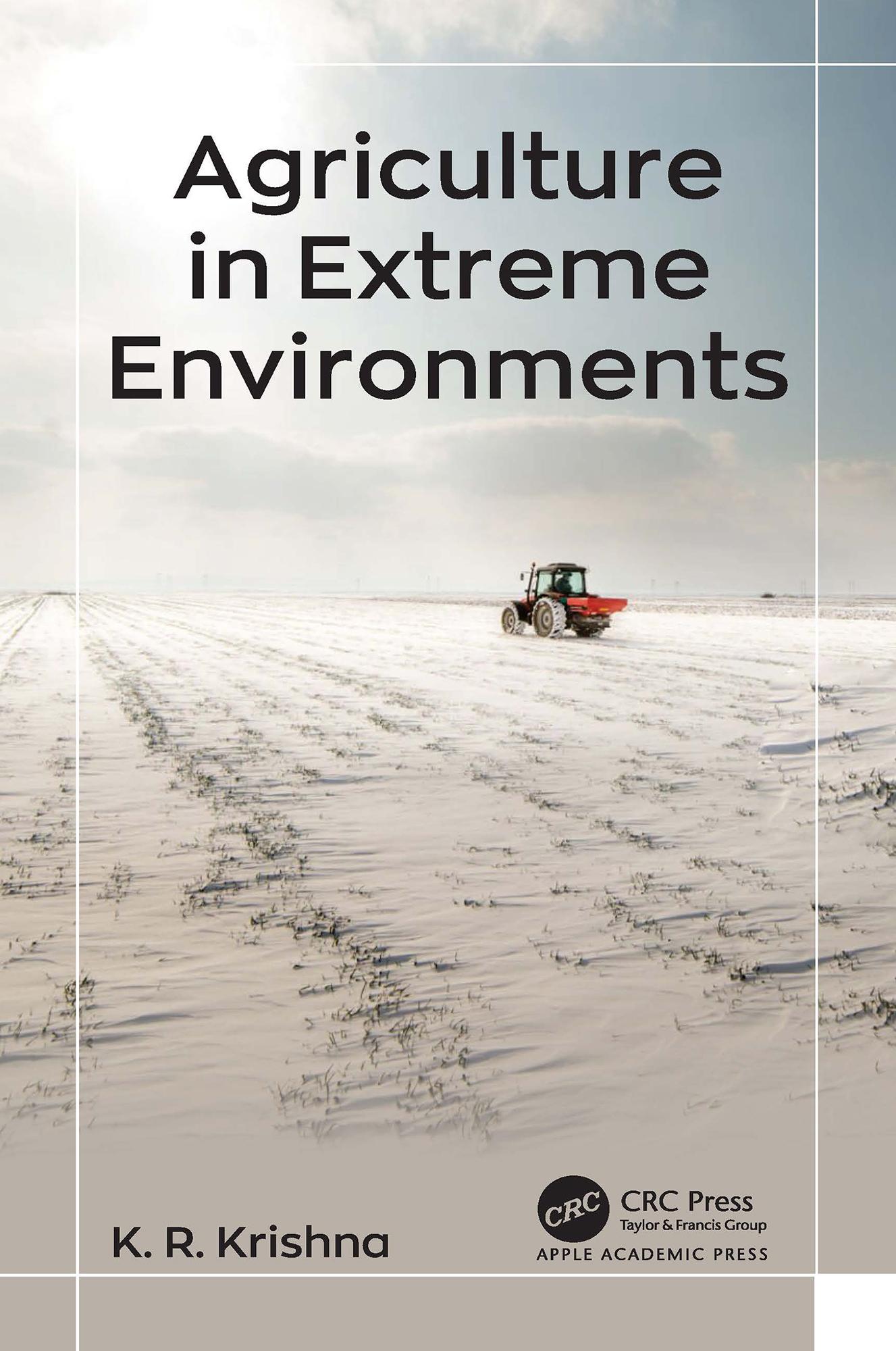
This new volume highlights the present status of farming regions that experience extreme environmental conditions, which pose special challenges to successful agricultural pursuits. These areas include extreme environments such as arid and semi-arid areas in North America, the Northern European Plains, Scandinavia, Patagonia in , West Asia, North Africa, Australia, and Mongolia.
The author discusses how native vegetation and crops have endured harsh conditions, adapted to them, and still yielded grains and fruits in these areas. He relates how ingenious farmers and agencies with expertise can produce richer harvests even in the most difficult terrains and under extreme environments. He explores how agriculture in some areas thrives on harsh, sandy desert terrain with low fertility soil, scanty organic fraction, and low soil/ambient moisture status, also looks at farming areas that suffer due to severe droughts, dust storms, high-speed and hot winds, and incessant desertification trends.
Each chapter covers a specific region that experiences extreme environments, first providing an introduction to the area and then providing detailed information on the natural physiography, climate, native vegetation, and environmental settings as well as the factors that generate the extreme environment and their impact on crops/livestock. The major natural resources are discussed, including topography, landscape and soils, water resources, and atmospheric factors such as gaseous composition, wind, dust photosynthetic radiation, temperature relative humidity, etc. A description of the native vegetation and crops that fit the environment is included also.
The author personally does not advocate for the rampant expansion of agrarian pursuits into these “marvels of nature,” as they are repositories of some of the most valuable exotic as well as useful germplasm of innumerable botanical species and fauna, and disturbing them could be detrimental to the large-scale weather phenomena operating on earth. We perhaps need them, he conjectures, as much as the more fertile and high-input farming zones.
Pay easily by card, Klarna, Apple Pay or Google Pay. Not happy? You always have a 14-day money-back guarantee. Read more in our terms. If you have any questions, email us at hello@memmo.org.
Memmo makes studying easier – wherever you are in the world. We bring your course books and smart study tools together in one place: summaries, quizzes, podcasts and flashcards. Plus Ted, your study buddy who answers anything you wonder. Over 50,000 students already study here – built to help you learn faster and stress less.