
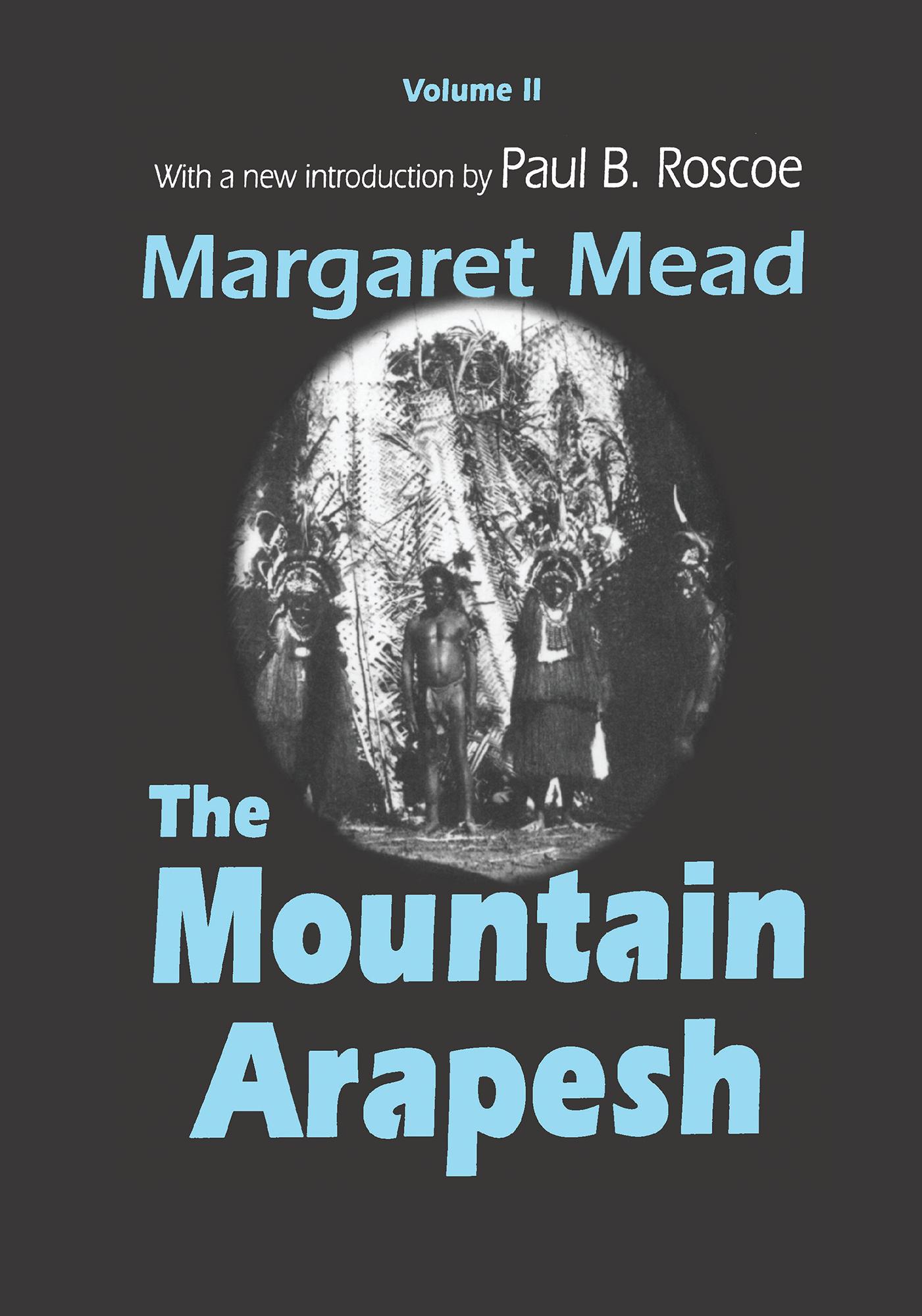
For approximately eight months during 1931-1932, anthropologist Margaret Mead lived with and studied the Mountain Arapesh-a segment of the population of the East Sepik Province, Papua New Guinea. She found a culture based on simplicity, sensitivity, and cooperation. In contrast to the aggressive Arapesh who lived on the plains, both the men and the women of the mountain settlements were found to be, in Mead's word, maternal. The Mountain Arapesh exhibited qualities that many might consider feminine: they were, in general, passive, affectionate, and peaceloving. Though Mead partially explains the male's "femininity" as being due to the type of nourishment available to the Arapesh, she maintains social conditioning to be a factor in the type of lifestyle led by both sexes. Mead's study encapsulates all aspects of the Arapesh culture. She discusses betrothal and marriage customs, sexuality, gender roles, diet, religion, arts, agriculture, and rites of passage. In possibly a portent for the breakdown of traditional roles and beliefs in the latter part of the twentieth century, Mead discusses the purpose of rites of passage in maintaining societal values and social control. Mead also discovered that both male and female parents took an active role in raising their children. Furthermore, it was found that there were few conflicts over property: the Arapesh, having no concept of land ownership, maintained a peaceful existence with each other. In his new introduction to The Mountain Arapesh, Paul B. Roscoe assesses the importance of Mead's work in light of modern anthropological and ethnographic research, as well as how it fits into her own canon of writings. Roscoe discusses findings he culled from a trip to Papua New Guinea in 1991 to clarify some ambiguities in Mead's work. His travels also served to help reconstruct what had happened to the Arapesh since Mead's historic visit in the early 1930s. Margaret Mead (1901-1978) was associated with the American Museum of Natural History in New York for over fifty years, becoming Curator of Ethnology in 1964. She taught at Columbia University and the New School for Social Research as well as a number of other universities. Among her many books is Continuities in Cultural Evolution, available from Transaction Publishers. Paul B. Roscoe is professor of anthropology at the University of Maine. He is a frequent contributor to anthropology journals, including American Anthropologist, American Ethnologist, and Current Anthropology, and is co-editor (with Nancy Lutkehaus) of Gender Rituals: Female Initiation in Melanesia. The 1992 recipient of the Royal Anthropological Institute's Curl Essay Prize, he has an archival specialization in ancient Polynesia.
Pay easily by card, Klarna, Apple Pay or Google Pay. Not happy? You always have a 14-day money-back guarantee. Read more in our terms. If you have any questions, email us at hello@memmo.org.
Memmo makes studying easier – wherever you are in the world. We bring your course books and smart study tools together in one place: summaries, quizzes, podcasts and flashcards. Plus Ted, your study buddy who answers anything you wonder. Over 50,000 students already study here – built to help you learn faster and stress less.
You might also like
Buy the book0