
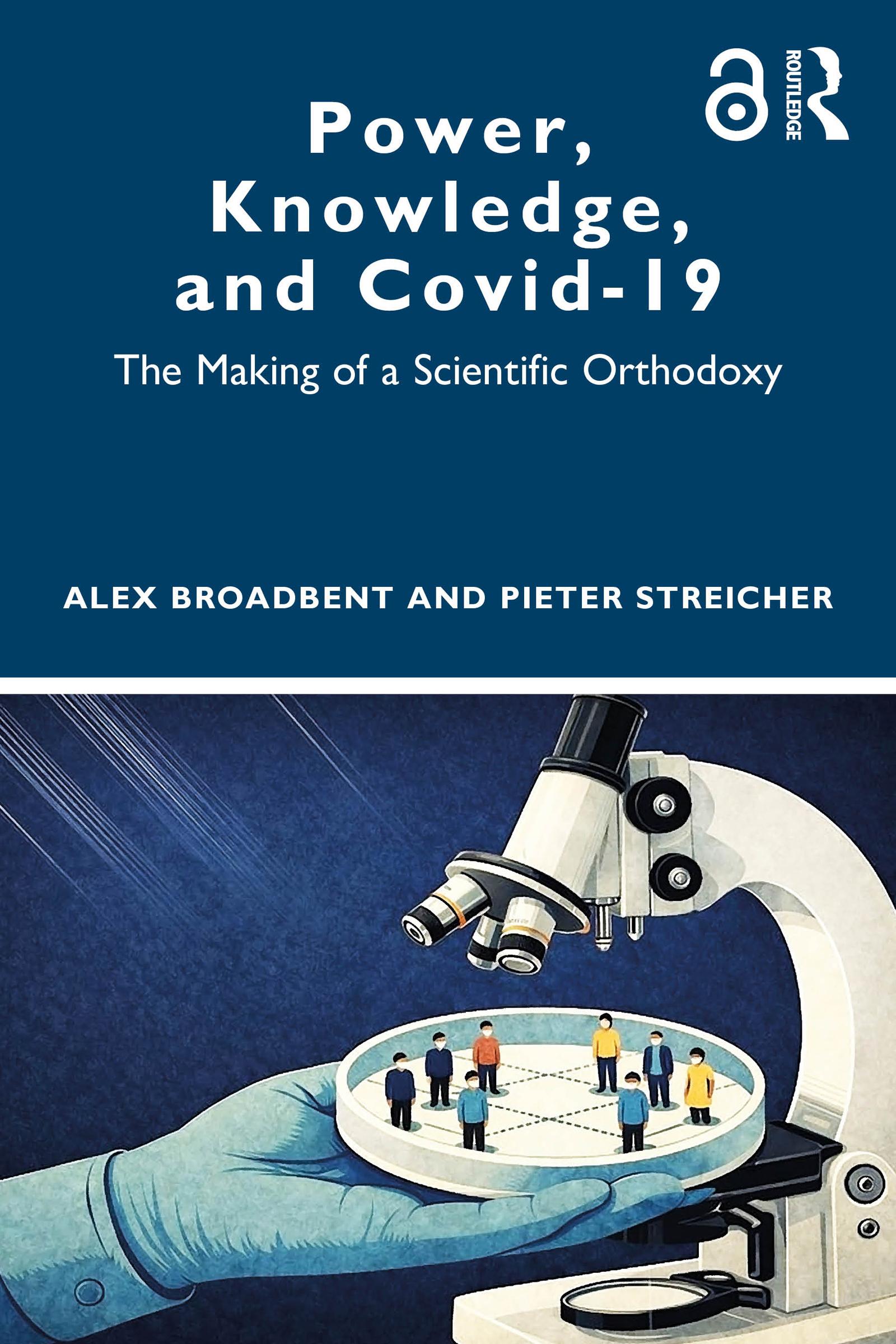
Power, Knowledge, and Covid-19: The Making of a Scientific Orthodoxy shows, step by step, how a dominant scientific line on Covid-19 was built and defended – and what it left out.
Through tightly argued case studies, Alex Broadbent and Pieter Streicher reconstruct how early modelling distinctions (notably the suppression/mitigation frame) and threshold-based reasoning made lockdown the default; how debates on masking and vaccination hardened into dogma; and how rival views were sidelined through credentialing, gatekeeping, and the control of forums. The book names and analyses five recurring features of this orthodoxy – methodological rigidity, scientific dogma, suppression of dissent, indirect political authority (“follow the science”), and scientific injustice – and shows how each shaped decisions across diverse settings.
Pairing clear conceptual analysis with accessible evidence reviews, the authors probe where models misled, where uncertainty was overstated or understated, and where costs, context, and equity were neglected – especially in low-resource settings. Rather than relitigating the pandemic, they offer a practical framework for recognizing when science and policy converge too tightly, how to keep plurality alive under pressure, and how to design governance that preserves expertise without closing down legitimate choice. For readers in philosophy, public health, policy, and beyond, this is a concise, non-polemical account of what went wrong, what went right, and how to do better next time.
The Open Access version of this book, available at http://www.taylorfrancis.com, has been made available under a Creative Commons Attribution-Non Commercial-No Derivatives (CC BY) 4.0 license.
Pay easily by card, Klarna, Apple Pay or Google Pay. Not happy? You always have a 14-day money-back guarantee. Read more in our terms. If you have any questions, email us at hello@memmo.org.
Memmo makes studying easier – wherever you are in the world. We bring your course books and smart study tools together in one place: summaries, quizzes, podcasts and flashcards. Plus Ted, your study buddy who answers anything you wonder. Over 50,000 students already study here – built to help you learn faster and stress less.