
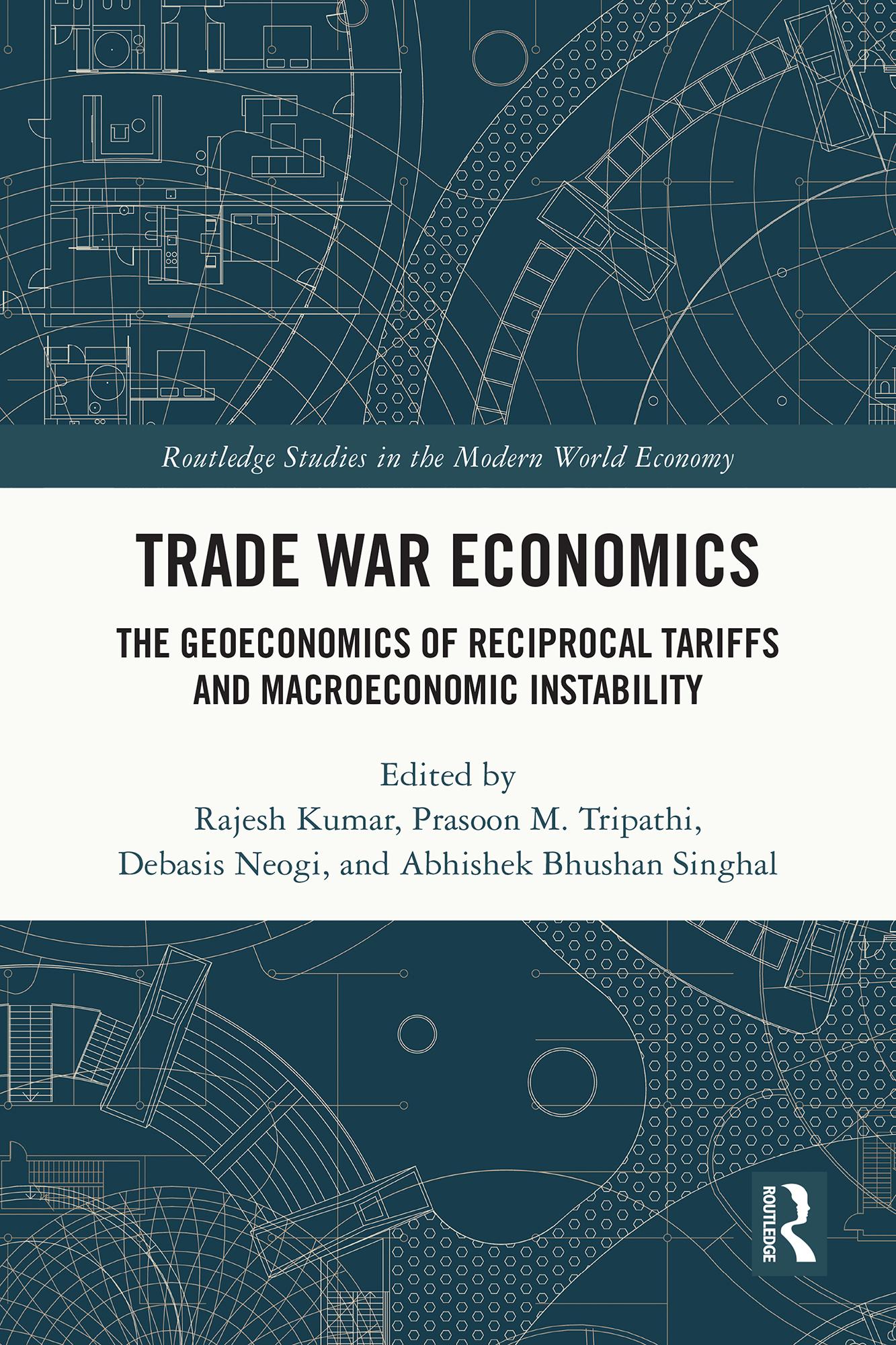
In an era marked by multipolar power rivalries, pandemic-era protectionism, and institutional fragmentation, global trade is undergoing a strategic shift. This book investigates the resurgence of reciprocal tariff wars in the 21st century and assesses their implications for global macroeconomic stability. It is premised on the argument that we have entered a “new geoeconomic paradigm” in which nations increasingly use tariffs and other economic tools as instruments of power, leading to heightened volatility in trade relations and economic performance.
By uniting perspectives from international economics and political economy, the book examines why these retaliatory trade conflicts have resurfaced, how they are unfolding across different regions, and what consequences they hold for the stability of the global economic order. It begins by grounding the reader in foundational theories of trade retaliation and geoeconomics. It then delves into institutional stress points, regional realignments, and systemic shifts—covering both developed and developing economies, including Asia, the West, Africa, and the Global South. Sectoral case studies on high-tech industries, digital trade conflicts, capital flows, and currency tensions illustrate how tariffs ripple through financial systems, reshape supply chains, and spark inflationary shocks. It concludes by offering forward-looking policy scenarios and institutional innovations, including bilateralism, minilateralism, and emerging digital governance frameworks. Further, it focuses on investor sentiment, financial market behaviour, and digital sovereignty conflicts, deepening the analysis beyond traditional trade balances.
By framing tariff wars within a broader geoeconomic paradigm, the book contributes a critical and future-oriented lens to one of the most urgent challenges facing global economic stability today. It will appeal to scholars of international trade, macroeconomic governance, and global politics, as well as policymakers navigating a fractured trade order.
Pay easily by card, Klarna, Apple Pay or Google Pay. Not happy? You always have a 14-day money-back guarantee. Read more in our terms. If you have any questions, email us at hello@memmo.org.
Memmo makes studying easier – wherever you are in the world. We bring your course books and smart study tools together in one place: summaries, quizzes, podcasts and flashcards. Plus Ted, your study buddy who answers anything you wonder. Over 50,000 students already study here – built to help you learn faster and stress less.