
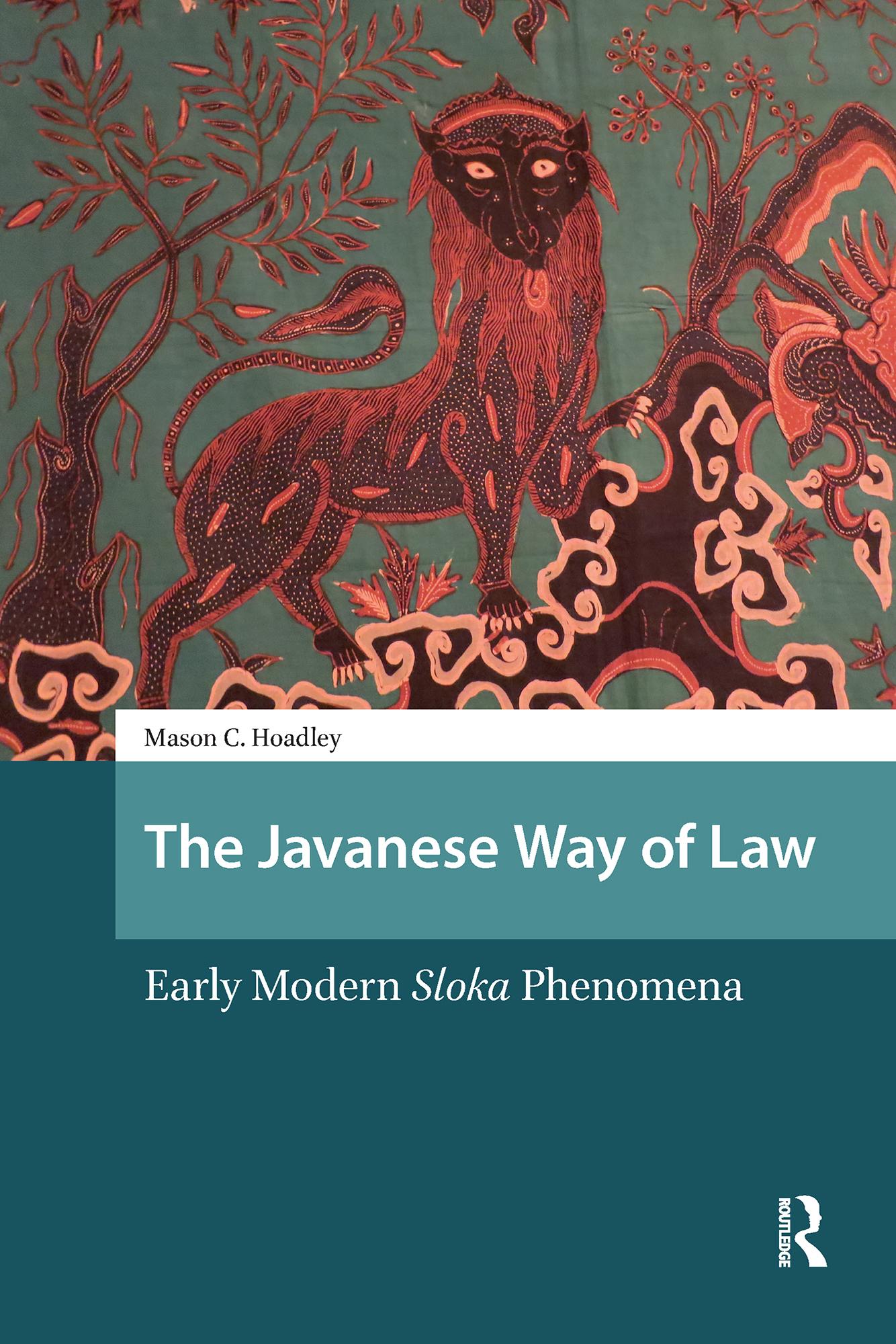
The author's investigation of early-modern Javanese law reveals that judicial authority does not come from the contents of legal titles or juridical texts, but from legal maxims and variations thereof. A century and a half ago Simon Keyzer, a recognized scholar of Javanese law, noted that understanding of that law is dependent upon a grasp of such pithy expressions, which provide the key to the whole body of suits. (Preface, C.F. Winter, Javaansche Zamenspraken, 1858, which examines hundreds of sloka, the majority of which are directed to prevailing legal practice). Drawing upon the contents of 18th century Javanese legal texts, the present work builds upon Keyzer's and Winter's references to 'sloka-phenomena', namely sloka proper (maxims) and its derivatives sinalokan (that made of sloka), aksara here meaning legal principles, and prakara (matter, case). These are usually conveyed in vignettes illustrating their function and as a group, constitute the essence of traditional Javanese written law.
Pay easily by card, Klarna, Apple Pay or Google Pay. Not happy? You always have a 14-day money-back guarantee. Read more in our terms. If you have any questions, email us at hello@memmo.org.
Memmo makes studying easier – wherever you are in the world. We bring your course books and smart study tools together in one place: summaries, quizzes, podcasts and flashcards. Plus Ted, your study buddy who answers anything you wonder. Over 50,000 students already study here – built to help you learn faster and stress less.