
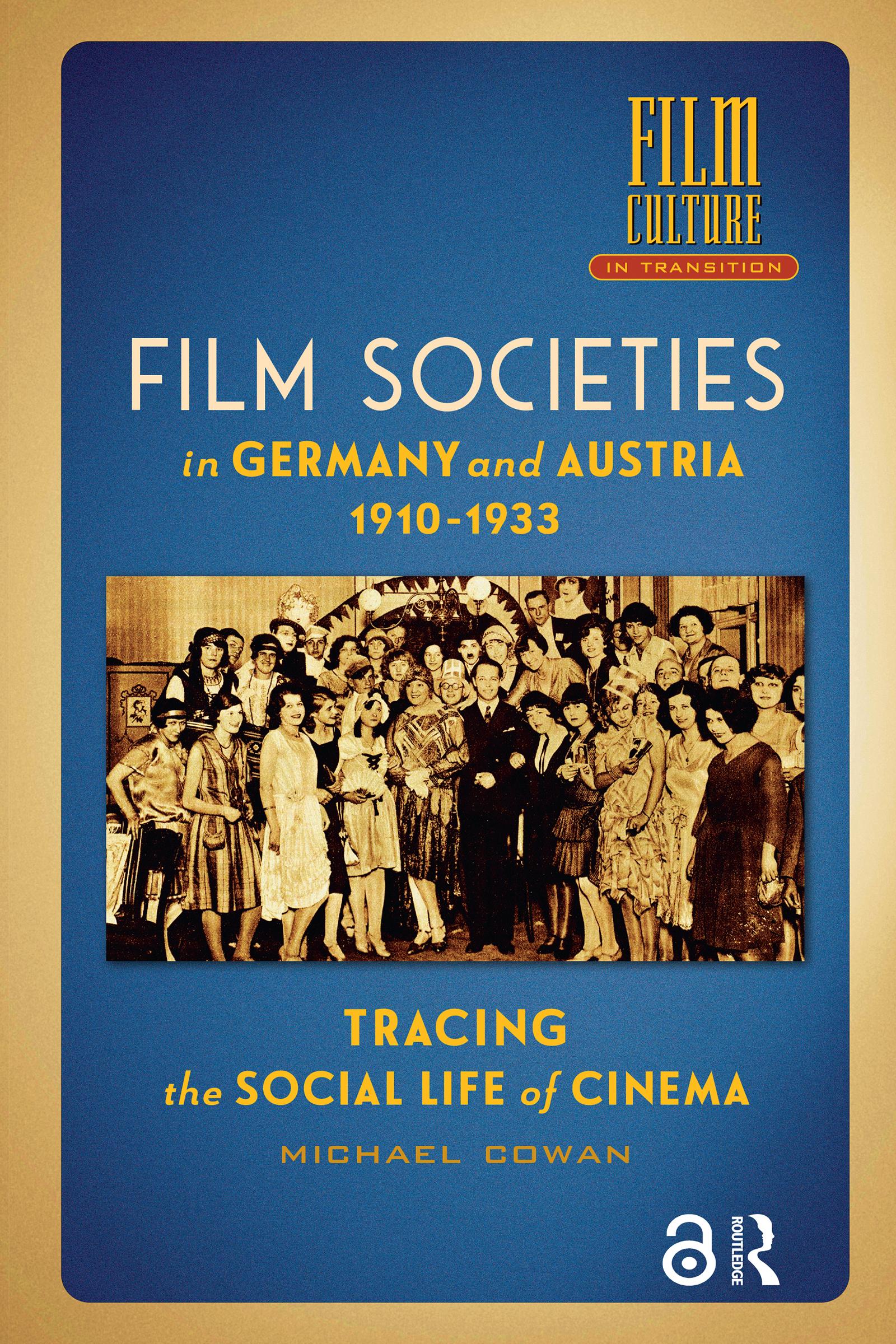
This study traces the evolution of early film societies in Germany and Austria, from the emergence of mass movie theaters in the 1910s to the turbulent years of the late Weimar Republic. Examining a diverse array of groups, it approaches film societies as formations designed to assimilate and influence a new medium: a project emerging from the world of amateur science before taking new directions into industry, art and politics. Through an interdisciplinary approach—in dialogue with social history, print history and media archaeology—it also transforms our theoretical understanding of what a film society was and how it operated. Far from representing a mere collection of pre-formed cinephiles, film societies were, according to the book’s central argument, productive social formations, which taught people how to nurture their passion for the movies, how to engage with cinema, and how to interact with each other. Ultimately, the study argues that examining film societies can help to reveal the diffuse agency by which generative ideas of cinema take shape.
Pay easily by card, Klarna, Apple Pay or Google Pay. Not happy? You always have a 14-day money-back guarantee. Read more in our terms. If you have any questions, email us at hello@memmo.org.
Memmo makes studying easier – wherever you are in the world. We bring your course books and smart study tools together in one place: summaries, quizzes, podcasts and flashcards. Plus Ted, your study buddy who answers anything you wonder. Over 50,000 students already study here – built to help you learn faster and stress less.