
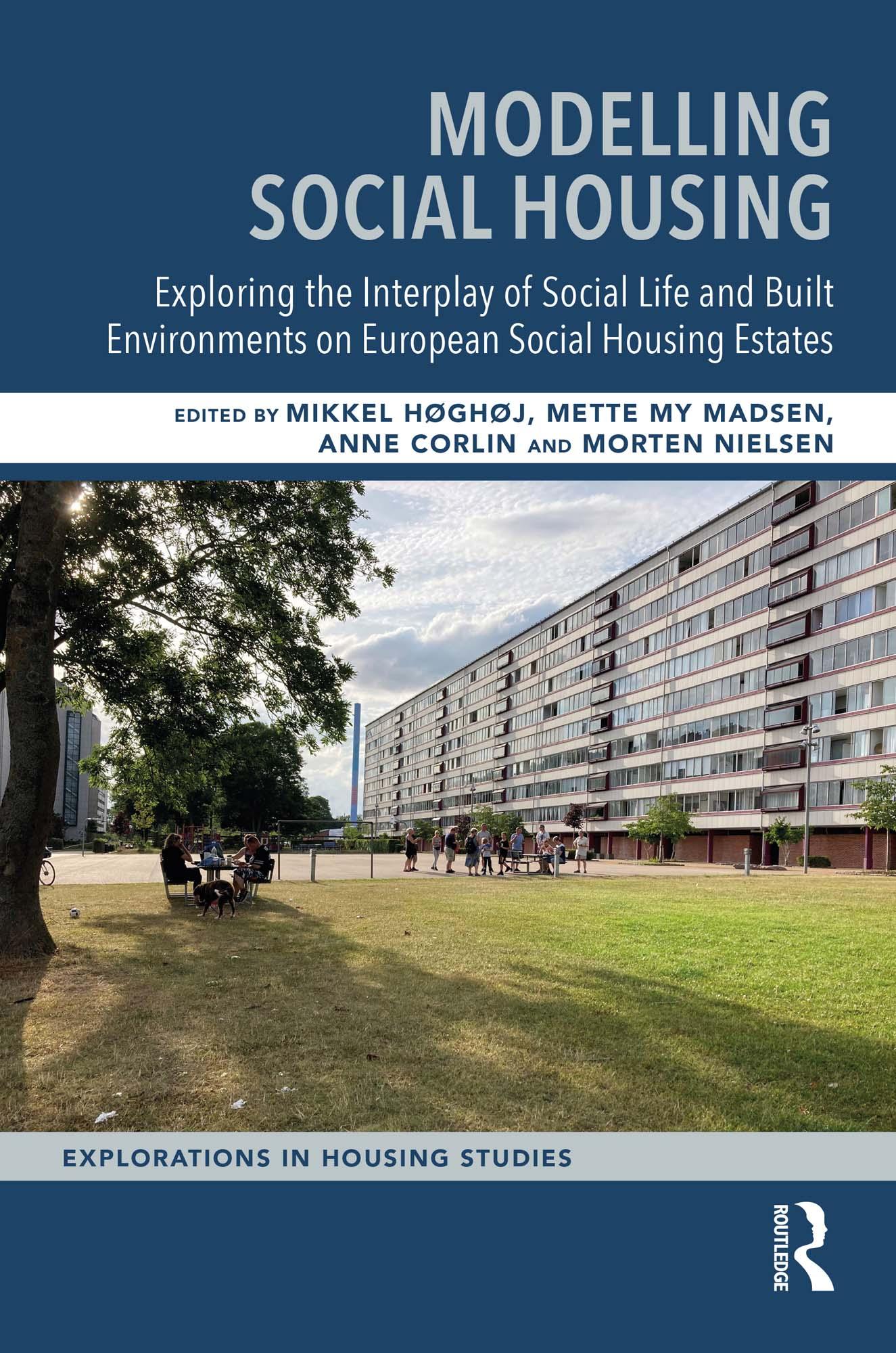
Modelling Social Housing delves into the intricate relationship between everyday social life and the architectural landscapes of social housing across European cities.
Focusing on social housing across multiple temporal and socio-cultural European urban settings, this book traces how the confluence of distributed knowledges, technological resources, and architectural histories may have considerable effects across different scales, ranging from everyday interactions to welfare planning and economic policies. To capture these intricate socio-spatial relations, this book introduces the concept of ‘social urban modelling’ as a novel analytical approach to social housing research. Spanning historical trajectories, contemporary challenges, and future potentials, this book brings together scholars from diverse fields including architecture, history, anthropology, sociology, geography, and art history. Through examinations of architectural designs, urban planning assemblages, contemporary redevelopment projects, and everyday appropriations by residents, this book unveils the intricate layers of social housing dynamics in European cities. From the adoption of Mediterranean and Islamic architectural typologies in mid-twentieth century Denmark to the innovative bureaucratic structures of the London County Council in post-war Britain, each chapter provides new insights into the spatial and social transformations of European social housing. Through empirical cases from across Europe, we ask: How might resident-driven initiatives reshape urban landscapes? What are the implications of densification processes on social housing estates? And how do private investors influence the social fabric of these communities?
With its timely interdisciplinary exploration of the modelling capacities of social housing estates, this book will provide an indispensable resource for scholars, practitioners, and policymakers engaged in housing studies, urban development, and architectural history.
Pay easily by card, Klarna, Apple Pay or Google Pay. Not happy? You always have a 14-day money-back guarantee. Read more in our terms. If you have any questions, email us at hello@memmo.org.
Memmo makes studying easier – wherever you are in the world. We bring your course books and smart study tools together in one place: summaries, quizzes, podcasts and flashcards. Plus Ted, your study buddy who answers anything you wonder. Over 75,000 students already study here – built to help you learn faster and stress less.