
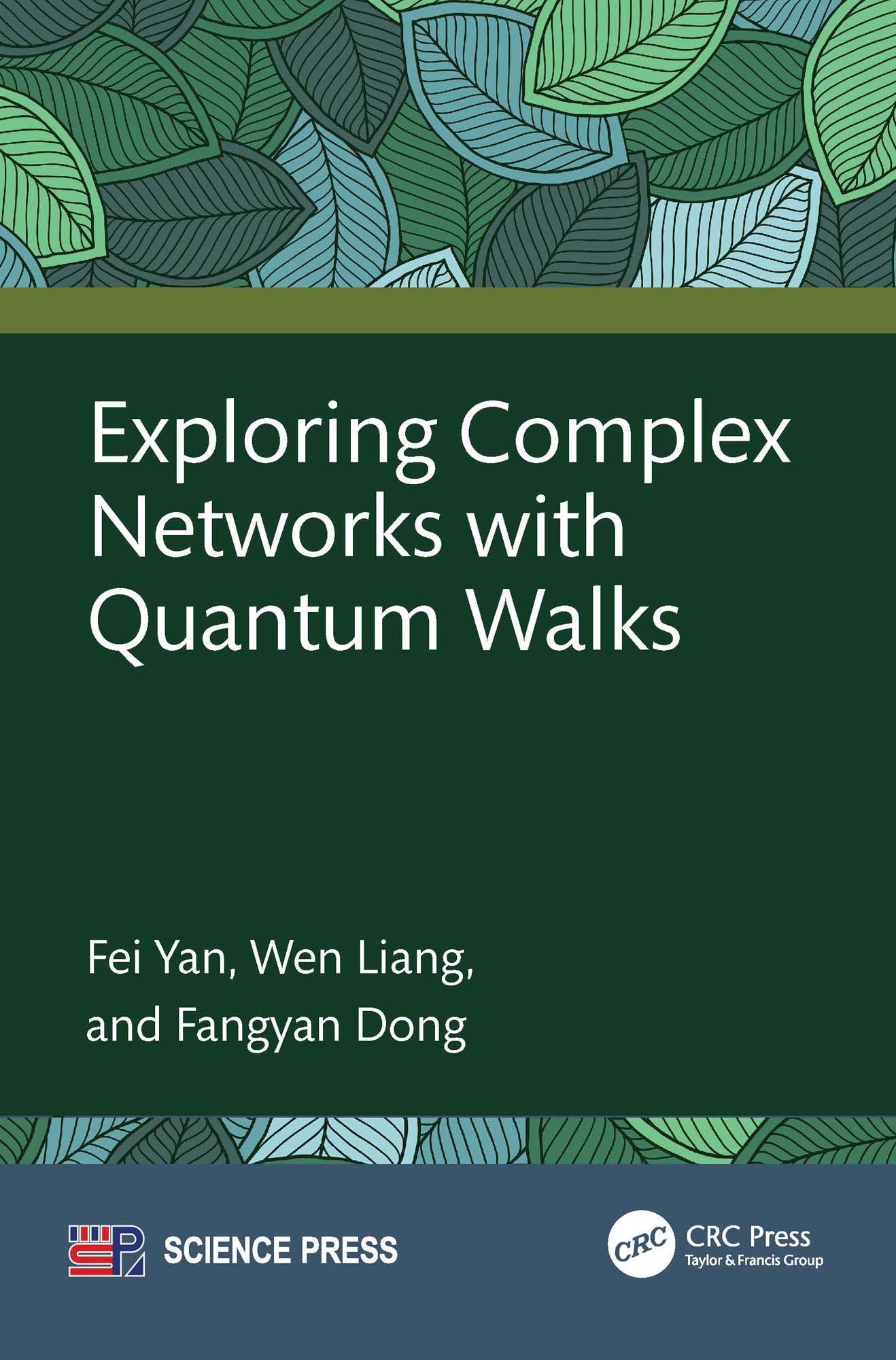
This book explores the intersection of quantum computing and network science. It bridges the theoretical foundations of quantum walk algorithms with their applications in the structural exploration and representation learning of complex networks.
Quantum walks, a technology that is pivotal to universal quantum computational models, examines the movement of particles on a graph composed of nodes and links. Quantum superposition enables these particles to traverse these graphs more quickly, while measurement-induced collapse introduces fluctuations, making the identification of critical nodes challenging yet intriguing. At its core, the book explores how quantum walk algorithms can transform the structural and representational analysis of complex networks. It begins by introducing the fundamental concepts of quantum computing and quantum walks, including generalized definitions and the properties of low-dimensional quantum walks. Then, it discusses the implementation of discrete- and continuous-time quantum walks for mining network nodes, links, and subgraphs, as well as their use in network representation learning and graph neural networks.
The book will serve as a valuable reference for researchers, students, and educators interested in quantum walks, complex networks, quantum mechanics, and information engineering.
Pay easily by card, Klarna, Apple Pay or Google Pay. Not happy? You always have a 14-day money-back guarantee. Read more in our terms. If you have any questions, email us at hello@memmo.org.
Memmo makes studying easier – wherever you are in the world. We bring your course books and smart study tools together in one place: summaries, quizzes, podcasts and flashcards. Plus Ted, your study buddy who answers anything you wonder. Over 75,000 students already study here – built to help you learn faster and stress less.