
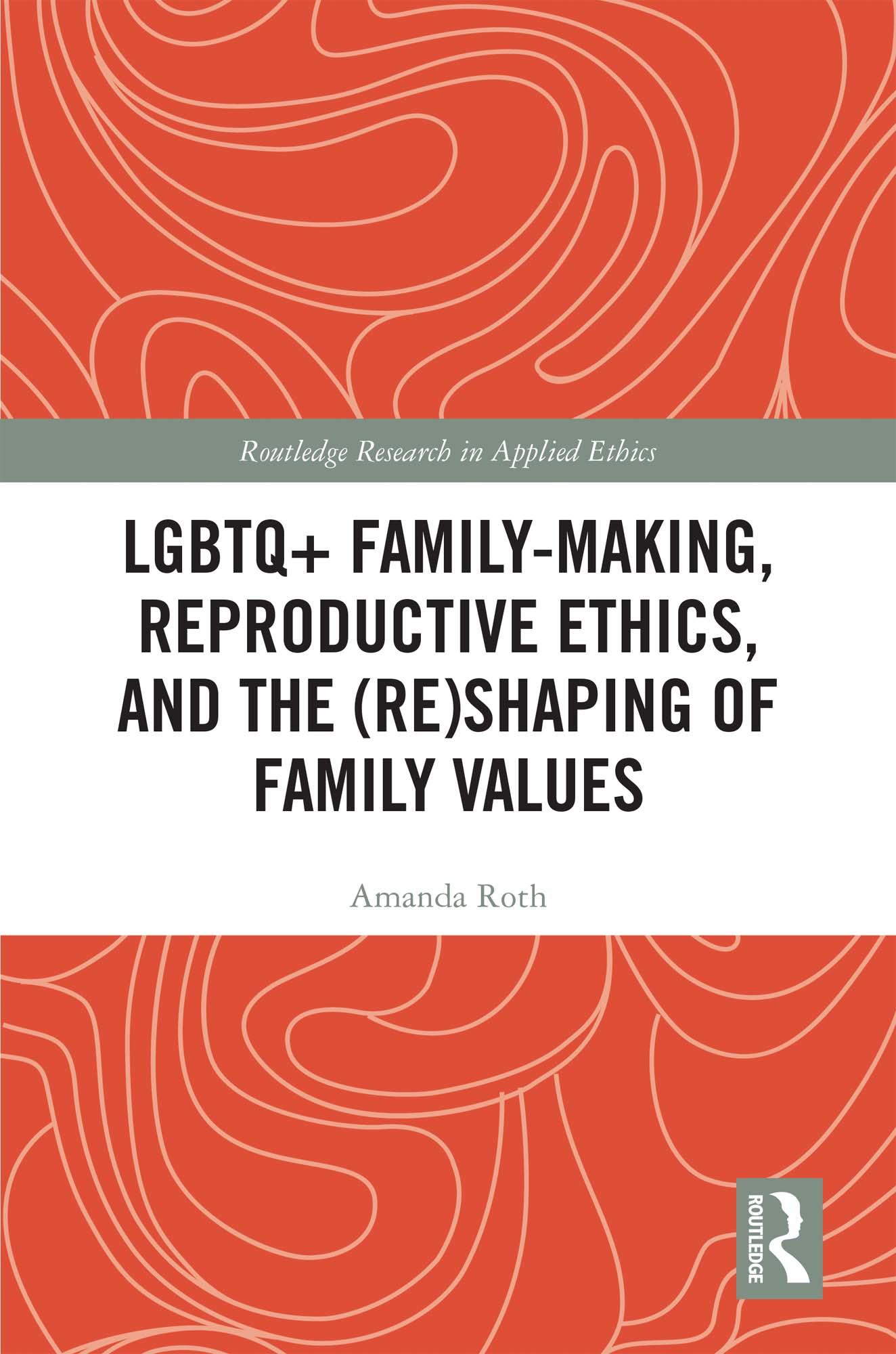
This book examines the ethical issues surrounding assisted reproductive technologies and queer family-making practices. By focusing on LGBTQ+ people and experiences in relation to procreative ethics, this book challenges dominant approaches and views in philosophical bioethics.
In Part 1 of this book, the author introduces the idea of queer epistemic privilege regarding issues of family and reproduction and applies this notion to the bioethical debates around donor conception. In Part 2, the author problematizes the typical philosophical conception of the debate over donor anonymity by centering queer perspectives and experiences. Drawing on social science research, she makes the case for “queer difference” in how donor conception is practiced and then employs this notion to show why the dominant ethical views opposing donor anonymity fail. Whereas most scholars view this issue as an issue of pure procreative/parental ethics, this book instead employs a queer perspective to draw out an alternative framing of the conflict—one between procreative/parental ethics and the moral responsibility to resist unjust social systems and norms, e.g. bionormativity. This broader framing offers a limited defense of some uses of anonymous donor gametes that is tied directly to the nature of ongoing LGBTQ+ family marginalization. Finally, in Part 3, the author draws attention to two aspects of donor conception that are common in the queer community but receive virtually no attention in the bioethical literature—known donation and donor sibling contact/relationships—and shows what we miss philosophically when these queer practices are erased from the bioethical discussions around donor conception.
LGBTQ+ Family-Making, Reproductive Ethics, and the (Re)Shaping of Family Values is an essential resource for researchers or advanced students working in Moral Philosophy—especially Reproductive Ethics, Feminist Philosophy, and LGBTQ+ Philosophy—Bioethics, and Gender, Sexuality, and Women’s Studies.
Pay easily by card, Klarna, Apple Pay or Google Pay. Not happy? You always have a 14-day money-back guarantee. Read more in our terms. If you have any questions, email us at hello@memmo.org.
Memmo makes studying easier – wherever you are in the world. We bring your course books and smart study tools together in one place: summaries, quizzes, podcasts and flashcards. Plus Ted, your study buddy who answers anything you wonder. Over 50,000 students already study here – built to help you learn faster and stress less.