
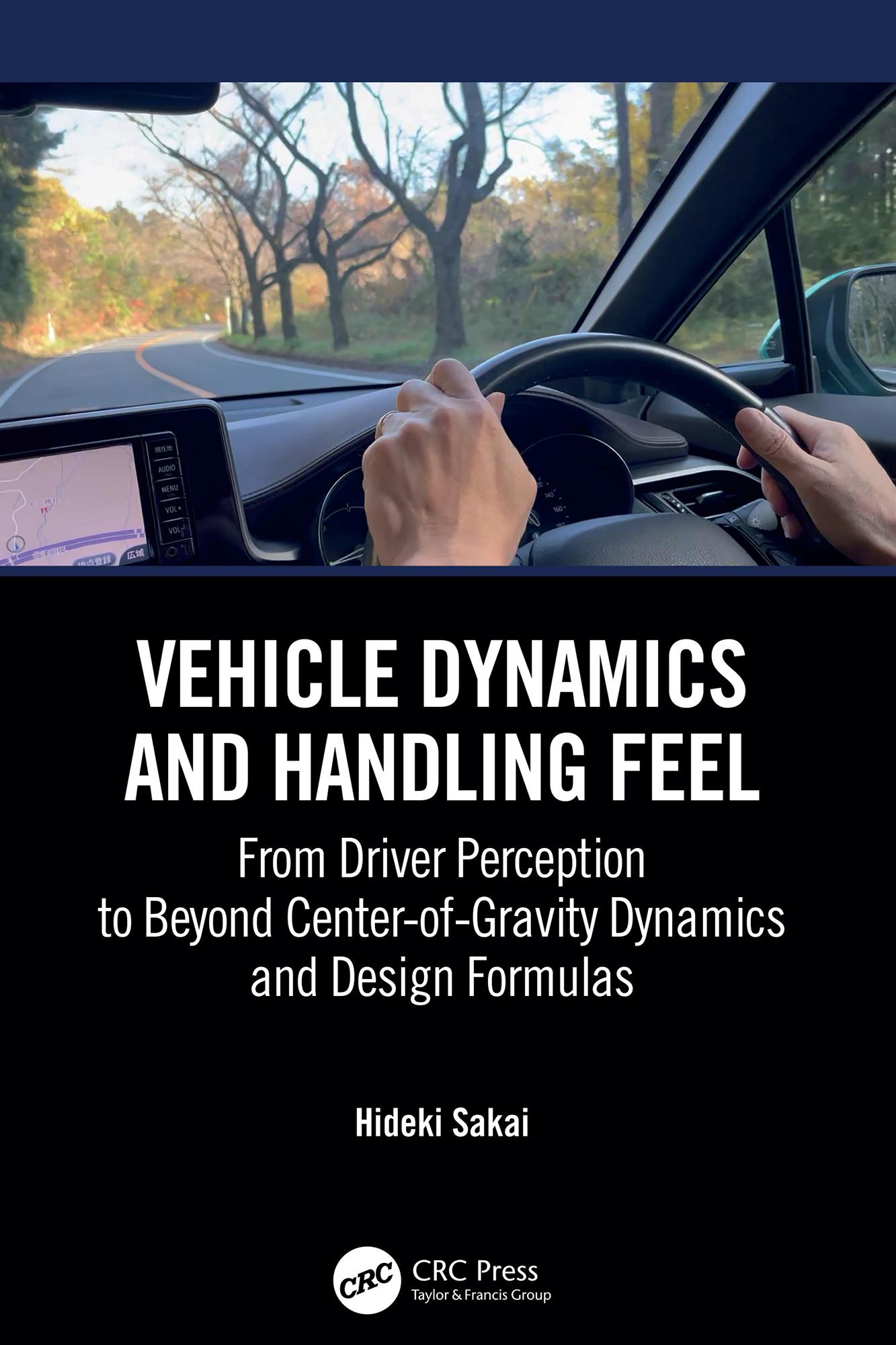
In this book, Sakai provides a comprehensive vehicle dynamics theory that enables engineers to apply drivers’ subjective evaluations of car handling to corresponding vehicle motion equations to develop and ensure engaging and dependable handling characteristics.
In the automobile market, vehicle dynamics is a leading parameter by which a car is judged and rated in comparison to competing models. Magazine test-drive reviews describe vehicle dynamics using terms such as “two-phase yaw motion,” “the pendulum motion of the rear-end,” “feedback,” and “vertical body control,” and refer to the level of grip and handling engagement. Similarly, test drivers provide feedback on car handling using similar terminology. It is therefore necessary for car designers to translate this feedback into quantifiable parameters using appropriate equations. As this feedback usually relates to ten phenomena, this book provides the relevant formulas for these. They include: 1) yaw gain, 2) two-stage motion (delayed turning of the rear-end), 3) the pendulum motion of the rear-end, 4) transmission of vehicle behavior information to steering reaction torque, 5) steering wheel and vehicle response to steering torque input, 6) steering operability in quasi-static maneuvers, 7) roll angle, 8) the dynamic rolling center during driving, 9) illusory pitch and jacking effects in steady cornering, and 10) turn-in feel based on illusory roll–pitch timing. Throughout, the mechanisms by which these phenomena occur, and their formulas’ physical meanings are also explained. Formulas in this book are simplified from traditional models by normalizing the yaw inertia and tire characteristics.
This book is an indispensable resource for engineers working in industry, whether at automobile manufacturers or related suppliers, to design engaging handling based on both mathematical equations and driver feedback.
Pay easily by card, Klarna, Apple Pay or Google Pay. Not happy? You always have a 14-day money-back guarantee. Read more in our terms. If you have any questions, email us at hello@memmo.org.
Memmo makes studying easier – wherever you are in the world. We bring your course books and smart study tools together in one place: summaries, quizzes, podcasts and flashcards. Plus Ted, your study buddy who answers anything you wonder. Over 50,000 students already study here – built to help you learn faster and stress less.