
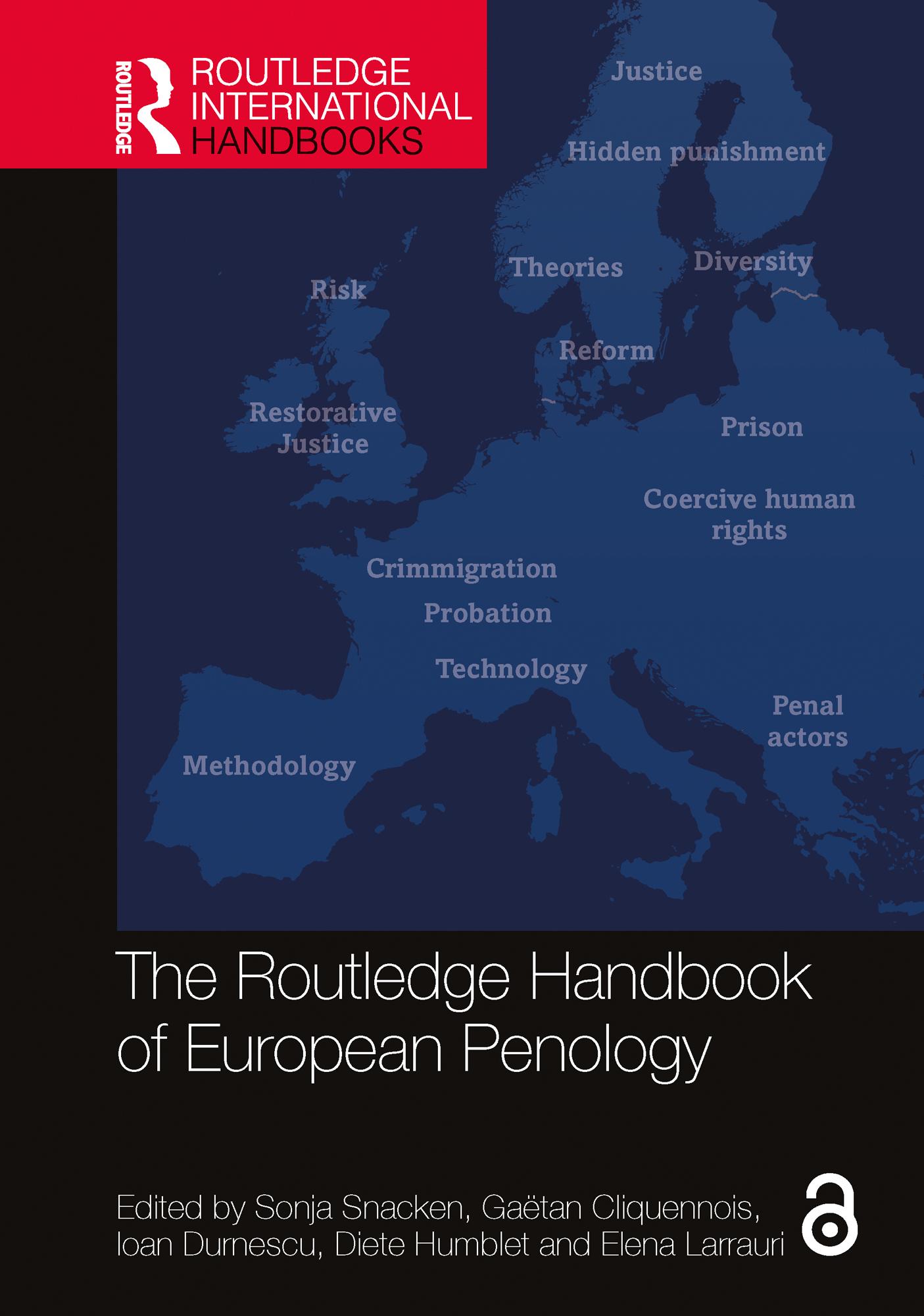
European penology, the multidisciplinary scientific study of punishment carried out on the European continent, is booming. This Handbook aims to offer an overview of the current state of the art and cutting-edge penological research in Europe, covering all the regions (north, south, east, west) and Europe’s institutional organisations – the Council of Europe and the European Union – including research that may hitherto not have been published in English. The Handbook also reflects on whether there is anything distinctive or typically (not necessarily exclusively) European in the ways penology is applied in Europe.
This challenge is taken up by a team of 5 editors and 60 authors from 21 different countries, reflecting a balance of gender, early and promising career, and established researchers.
After the editors’ Introduction, the book is organised into three parts:
Part I: European Penology – Scientific Developments discusses theoretical and methodological developments and important issues within comparative penology.
Part II: European Penality – Developments in Penal Practices focuses on transversal European developments, particular groups of offenders and specific forms of punishment.
Part III offers a reflection on penal policies and practices in Europe as seen from abroad.
The Handbook offers graduate and postgraduate students, postgraduate researchers, academics and other research users, such as governments and NGOs, critical and up-to-date reflections on some of the most prominent discussions on penology in Europe today.
Chapter 17 of this book is freely available as a downloadable Open Access PDF at http://www.taylorfrancis.com under a Creative Commons [Attribution-Non Commercial-No Derivatives (CC BY-NC-ND)] 4.0 license.
Pay easily by card, Klarna, Apple Pay or Google Pay. Not happy? You always have a 14-day money-back guarantee. Read more in our terms. If you have any questions, email us at hello@memmo.org.
Memmo makes studying easier – wherever you are in the world. We bring your course books and smart study tools together in one place: summaries, quizzes, podcasts and flashcards. Plus Ted, your study buddy who answers anything you wonder. Over 50,000 students already study here – built to help you learn faster and stress less.