
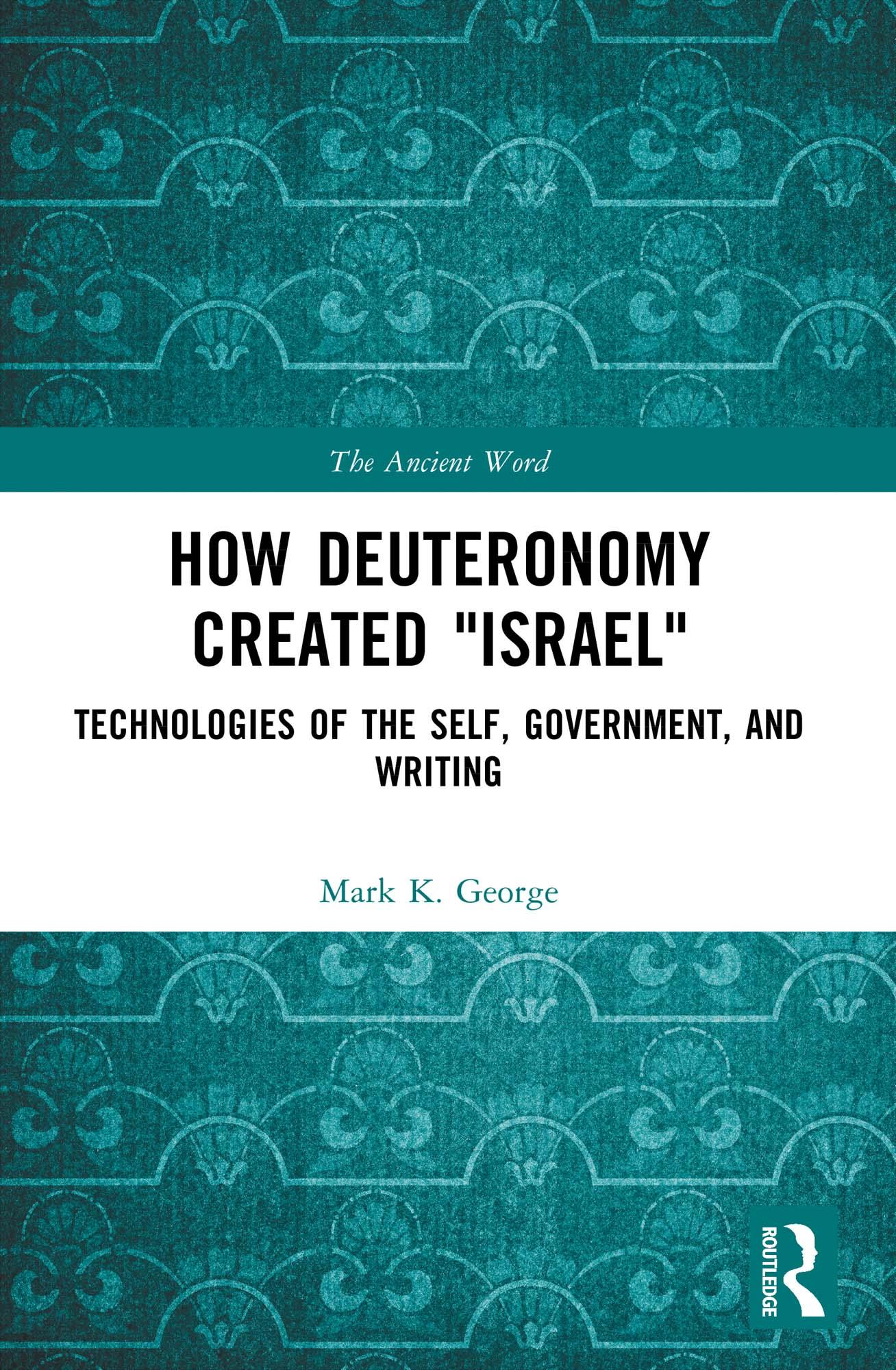
In this book, Mark K. George argues that the goal of Deuteronomy is not merely to provide ancient Judah with another set of laws but to write “Israel” itself into existence. He reads Deuteronomy as a manual for self‑definition with two key aspects: being an Israelite means recognizing oneself as a subject under Yahweh’s control, and Deuteronomy is the handbook of techniques by which one monitors oneself to become Israel.
Scholars have acknowledged the influence of certain literary features of ancient Assyrian imperial treaties on Deuteronomy. In this book, George argues that the key to both Deuteronomy and Assyrian rituals of control is their monitoring mechanism, not only speaking to their audiences but also providing them with new ways to understand themselves and behave. He suggests that Deuteronomy redefines not only Israel but also Yahweh himself according to an Assyrian imperial model—with Israel as the subject, God as a distant imperial ruler, and the text itself as a local monitor. In showing this, he extends the insights of Michel Foucault, who urged us to view power not merely as something imposed from above by force, but as something that can entwine and shape us from below.
This book provides an invaluable exploration of Deuteronomy, of interest to scholars and students working on Deuteronomy itself and biblical studies more generally, as well as on questions of ancient politics and governmentality, Foucault studies, and the history and material culture of the Ancient Near East.
Pay easily by card, Klarna, Apple Pay or Google Pay. Not happy? You always have a 14-day money-back guarantee. Read more in our terms. If you have any questions, email us at hello@memmo.org.
Memmo makes studying easier – wherever you are in the world. We bring your course books and smart study tools together in one place: summaries, quizzes, podcasts and flashcards. Plus Ted, your study buddy who answers anything you wonder. Over 50,000 students already study here – built to help you learn faster and stress less.