
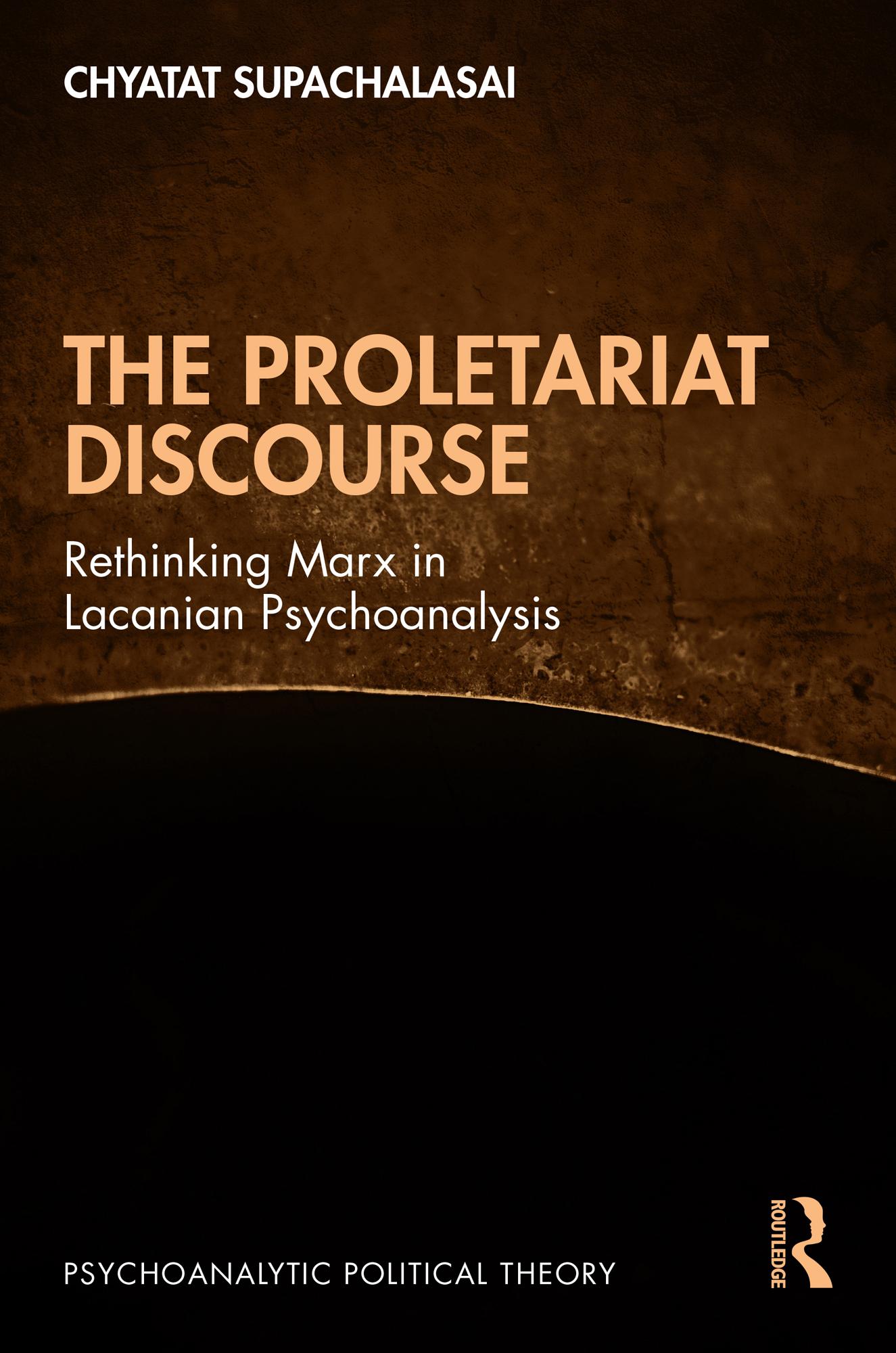
In this book, Chyatat Supachalasai offers a reinterpretation of Marx’s concept of the proletariat through a Lacanian lens, drawing on the works of Karl Marx and Jacques Lacan.
Building on the intellectual connection between Marx and Lacan, Supachalasai proposes “proletariat discourse”, which arises from a re-reading of Marx’s proletariat through Lacanian psychoanalysis, drawing on key concepts such as the hysteric, alienation, enjoyment, anxiety, and trauma. Supachalasai argues that Lacan’s notion of capitalist discourse, developed in the 1970s, reveals an inherent “non-relationship” aspect within this discourse, indicating the position of proletariat discourse. This proletariat discourse encapsulates three essential components. First, it establishes an agreement and disagreement between Marxist political theory and Lacanian psychoanalysis. Second, it posits that Marx’s understanding of the proletariat can be redefined and comprehended through a Lacanian psychoanalytic framework. Lastly, while portraying Marx’s proletariat as a subject of resistance to capitalism, this discussion connects with Lacan’s goal of seeking an “exit from capitalism”. However, from a Lacanian perspective, this connection also highlights the limitations inherent in Marx’s concept of the proletariat.
The Proletariat Discourse will be of great interest to scholars and readers interested in Lacanian-Marxist partnership, psychoanalysis, political thought, Lacanian studies, and critical theory.
Pay easily by card, Klarna, Apple Pay or Google Pay. Not happy? You always have a 14-day money-back guarantee. Read more in our terms. If you have any questions, email us at hello@memmo.org.
Memmo makes studying easier – wherever you are in the world. We bring your course books and smart study tools together in one place: summaries, quizzes, podcasts and flashcards. Plus Ted, your study buddy who answers anything you wonder. Over 50,000 students already study here – built to help you learn faster and stress less.