
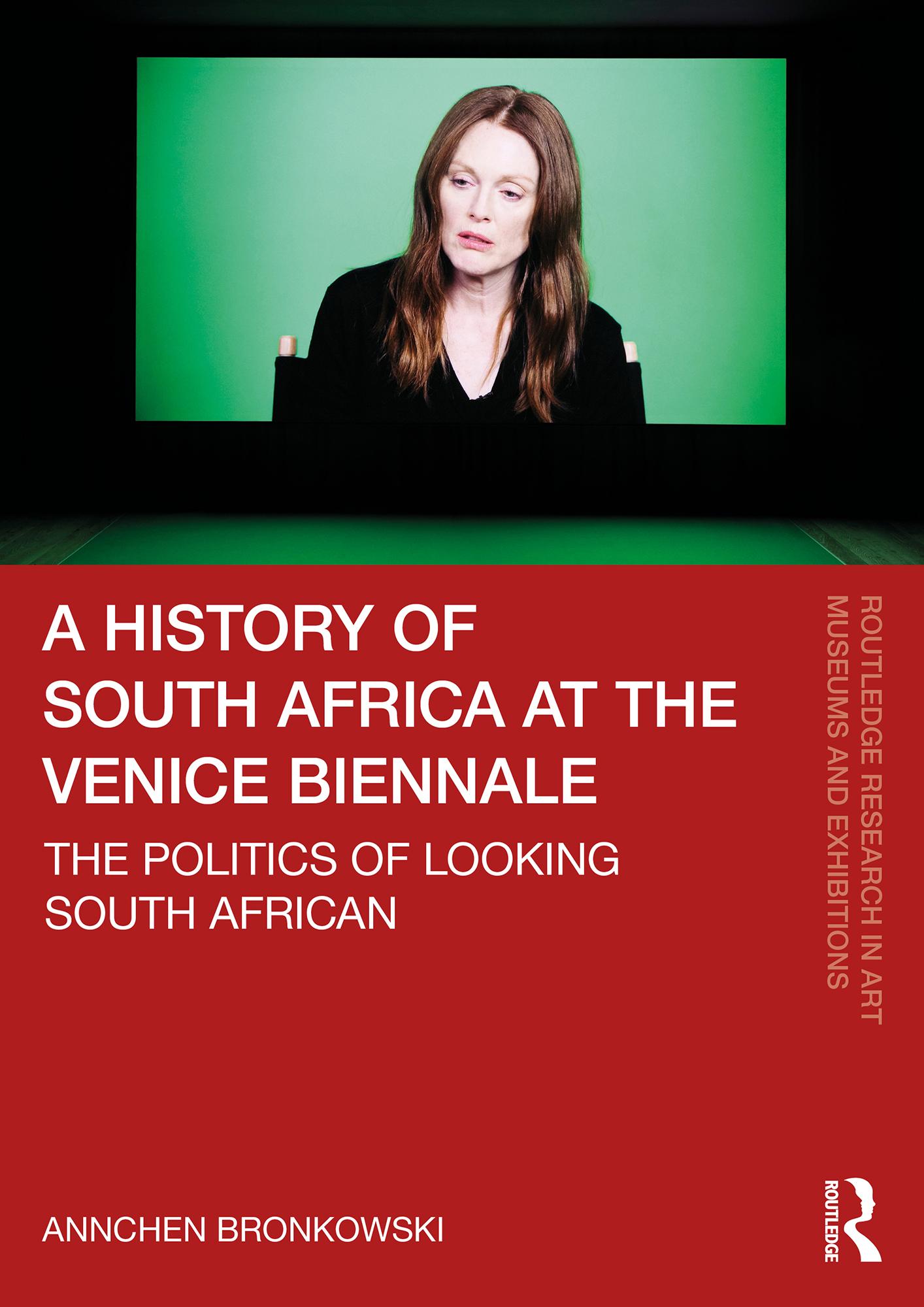
This study presents the first history of the South African national pavilion at the Venice Biennale since it first participated in 1950 up until its contemporary pavilions.
Covering a contentious period in South African history, the pavilion engenders a thought-provoking engagement with questions around national identity and visual representation. What has it meant for a country like South Africa to be at the Venice Biennale? How national is a national pavilion? The book acts as a case study highlighting how this understanding of what is ‘national’ and what is ‘representative’ has changed throughout the decades. At first it was associated with stylistic concerns, evidencing the polemic post-war shift from academic to modern art in the mid-century; towards the 1960s, South African art in Venice sought to capture something of a specific ‘South Africanness’ rather than seeking to emulate the general tendencies of Euramerican modernism; the country’s exclusion from Venice during the boycott years of the 1970s to early 1990s evidences the clear emergence of a politically conscious national aesthetic; South Africa’s re-entry highlights how the tenets of post-apartheid nation-building had to be navigated within a postmodern, globalist art world beset with post-nationalism. This study shows that South Africa has always been caught between national determinations and internationalist aspirations and the contrast of this tension is nowhere more sharply reflected than at the Venice Biennale with its national pavilion structure.
This book is suitable for researchers and students in Art History, African Studies, and Museum Studies.
Pay easily by card, Klarna, Apple Pay or Google Pay. Not happy? You always have a 14-day money-back guarantee. Read more in our terms. If you have any questions, email us at hello@memmo.org.
Memmo makes studying easier – wherever you are in the world. We bring your course books and smart study tools together in one place: summaries, quizzes, podcasts and flashcards. Plus Ted, your study buddy who answers anything you wonder. Over 50,000 students already study here – built to help you learn faster and stress less.