
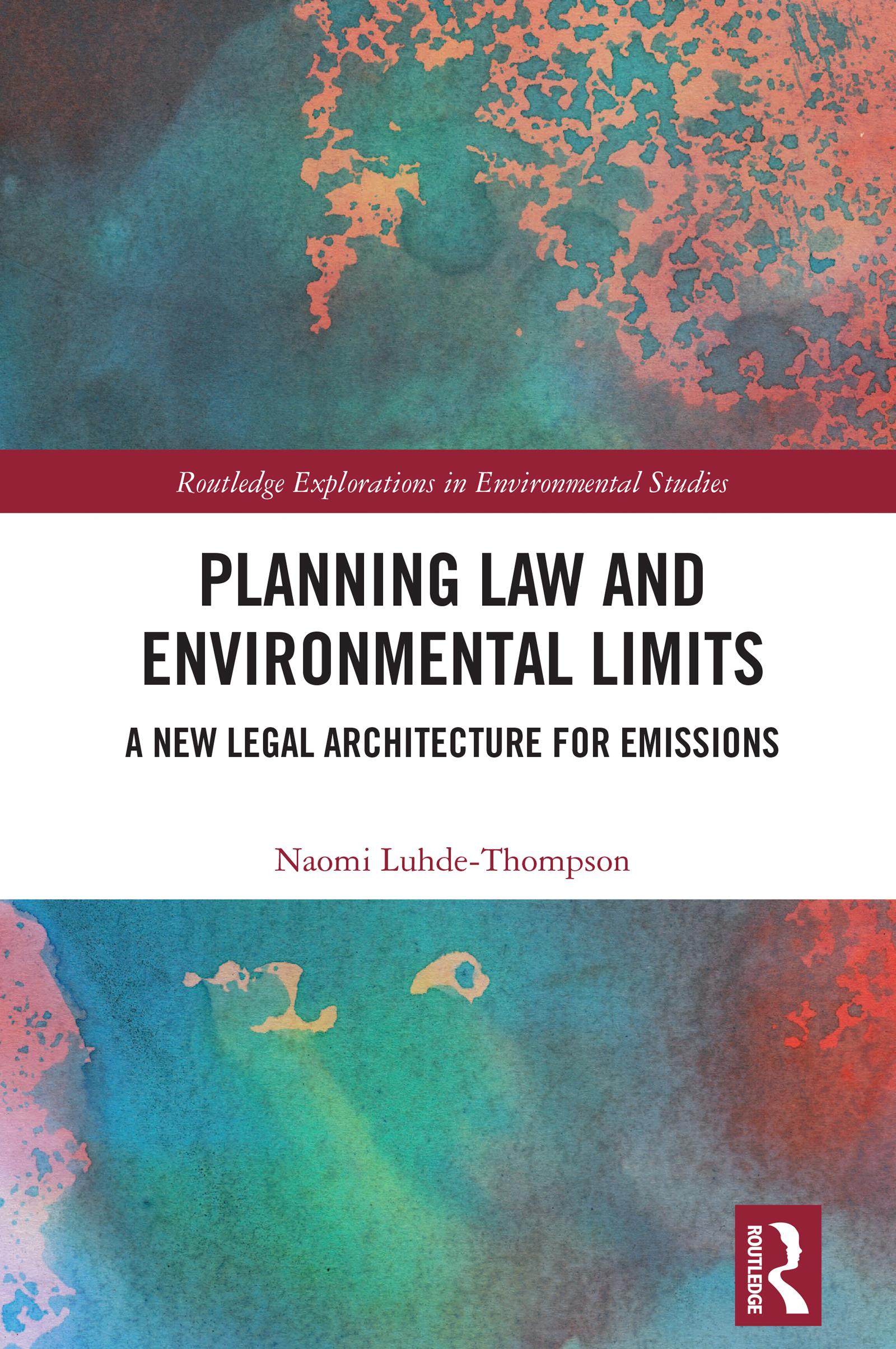
This book explores the role of planning law in balancing the dilemma of resource extraction with the recognition of greenhouse gas emission limits.
Naomi Luhde-Thompson explores how planning law, which is one of the strongest forms of environmental regulation in the UK, has failed to incorporate environmental limits into decisions. Environmental limits are broadly understood as the point at which an irreversible change occurs in a system, providing a measure by which to assess development and to test whether or not these limits might be overrun. Combining theoretical perspectives with experiential practice, the book draws upon hydrocarbon extraction to analyse and interrogate the functionality of current decision-making processes elated to planning law and climate change mitigation. It goes on to propose an amended system that expands the foundational value of public interest in planning law, recommending strategies to incorporate environmental limits, in both strategic planning and decisions.
Planning Law and Environmental Limits will be of use to lawyers and policymakers, as well as to researchers, academics, and students interested in climate change, planning, and environmental law.
Pay easily by card, Klarna, Apple Pay or Google Pay. Not happy? You always have a 14-day money-back guarantee. Read more in our terms. If you have any questions, email us at hello@memmo.org.
Memmo makes studying easier – wherever you are in the world. We bring your course books and smart study tools together in one place: summaries, quizzes, podcasts and flashcards. Plus Ted, your study buddy who answers anything you wonder. Over 50,000 students already study here – built to help you learn faster and stress less.