
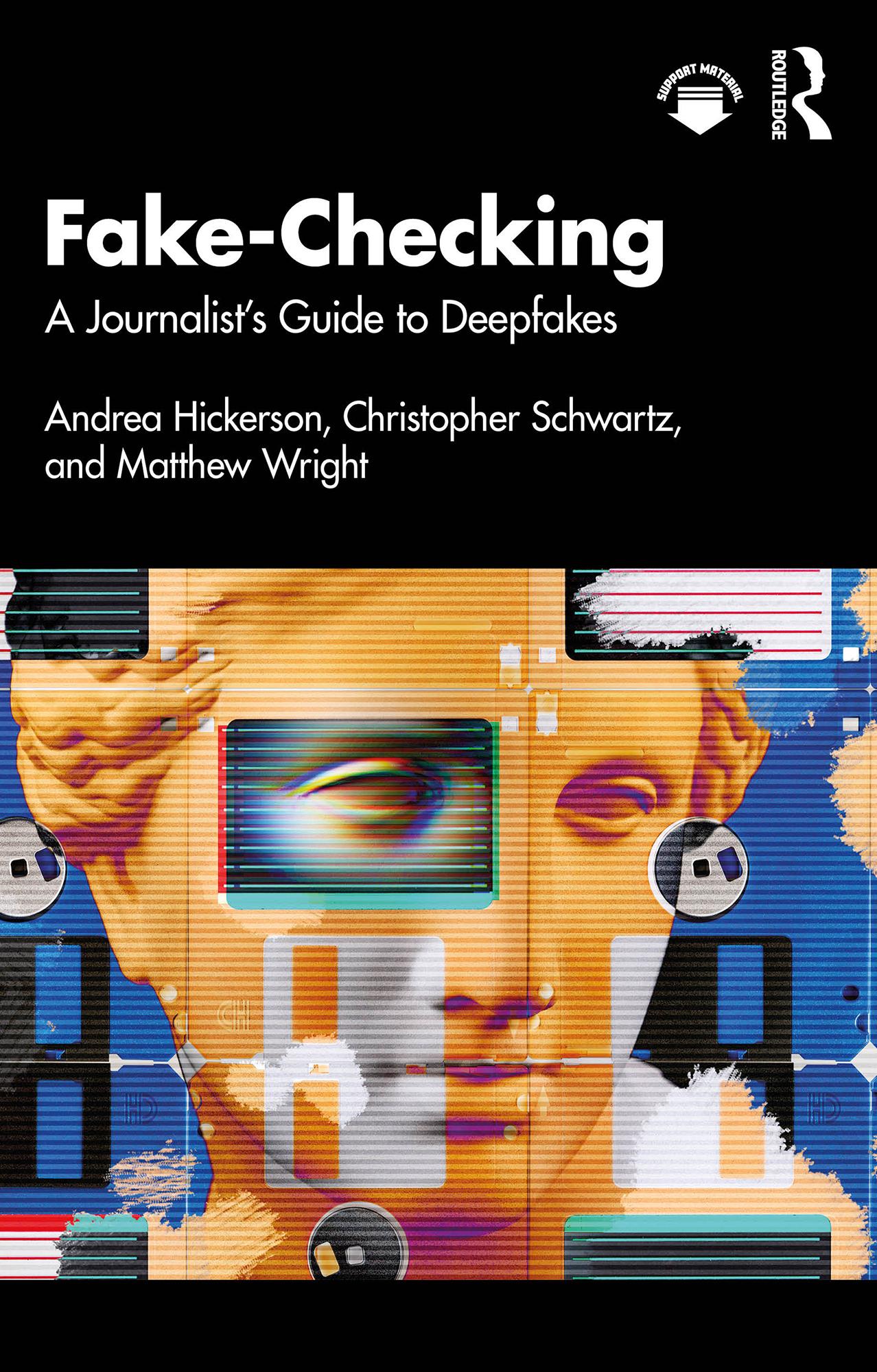
Designed to help journalists keep pace with the rapid evolution of deepfakes as well as integrate ‘fake-checking’ methods into their routine reporting practices, this book offers a concise and accessible guide for reporters navigating this evolving challenge.
This guide aims to assist journalists in understanding the complexities of deepfakes from a number of angles including philosophical, historical, technical, and methodological. Rather than approaching deepfakes as a ‘journalistic apocalypse,’ this book contextualises them in the larger historical practice of fact-checking and on a continuum of technological advances in image and video manipulation. Encouraging readers to view fact-checking as a multimodal process, it stresses the importance of combining philosophical and technical tools, especially ones based in epistemology and artifical intelligence (AI), in addition to the ‘pavement pounding’ essentials of good journalism. The book concludes with a chapter addressing how to explain deepfakes to a public progressively more concerned about the realities and consequences of AI and misinformation.
Fake-Checking serves as a practical reference for journalists and advanced media students who are increasingly required to identify and verify potential deepfakes and their future iterations.
This book is supported by online resources which can be accessed at www.routledge.com/9781032741321.
Pay easily by card, Klarna, Apple Pay or Google Pay. Not happy? You always have a 14-day money-back guarantee. Read more in our terms. If you have any questions, email us at hello@memmo.org.
Memmo makes studying easier – wherever you are in the world. We bring your course books and smart study tools together in one place: summaries, quizzes, podcasts and flashcards. Plus Ted, your study buddy who answers anything you wonder. Over 75,000 students already study here – built to help you learn faster and stress less.