
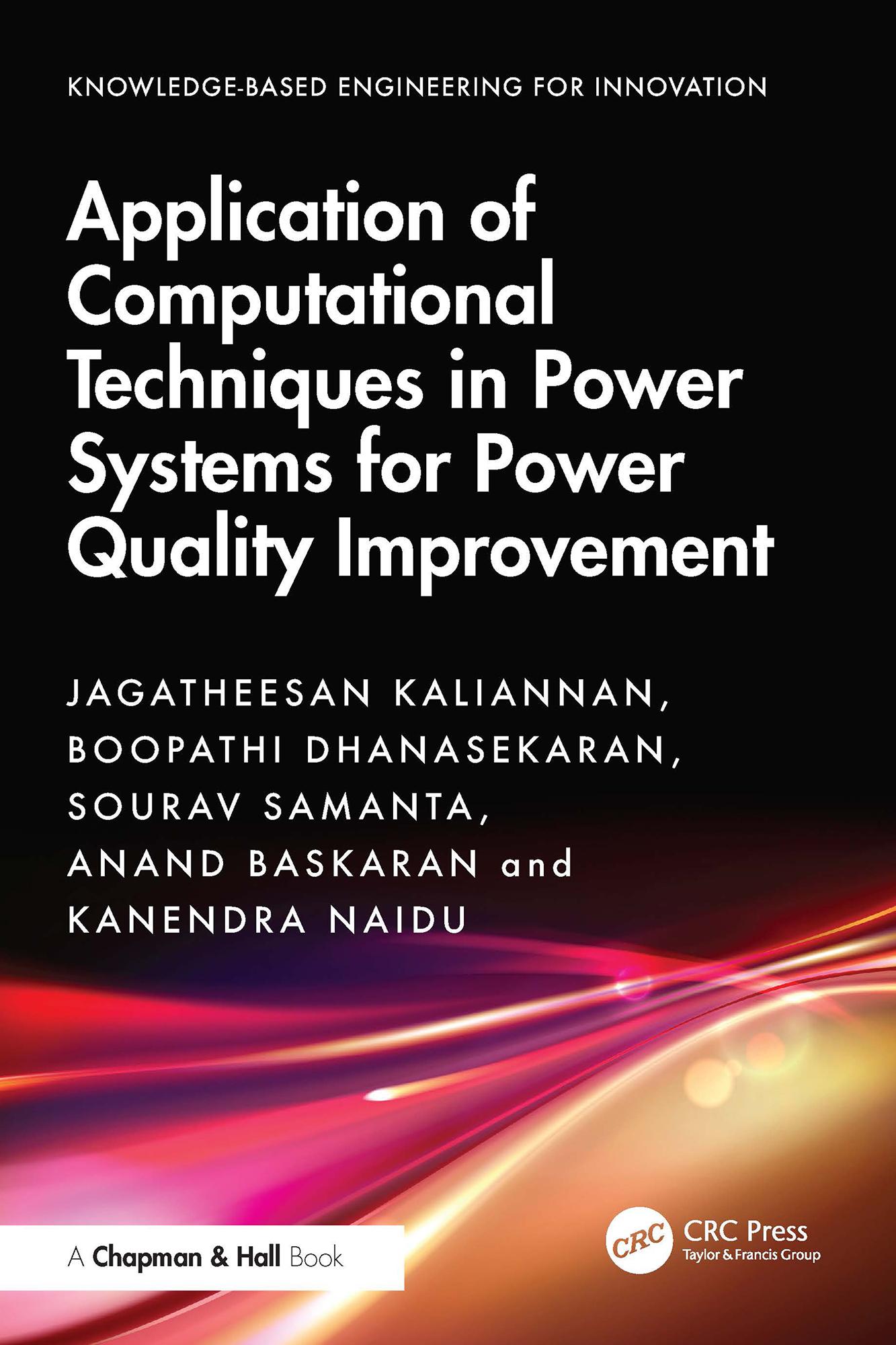
This book explores the role of computational intelligence techniques in addressing power quality challenges in modern power systems. It examines the integration of multiple energy sources, renewable energy systems, and energy storage units while analyzing nonlinearities in power plants. The book introduces optimization methods, including machine learning, genetic algorithms, and neural networks, to enhance power system stability, reliability, and efficiency. It bridges theoretical insights with real-world applications in modern power networks.
• Explores the use of AI techniques, including genetic algorithms and fuzzy logic, for power system analysis and optimization.
• Examines power quality issues such as frequency deviations, tie-line power flow variations, and area control errors
• Discusses the tuning of secondary controllers, including PID controllers, using advanced optimization algorithms
• Addresses PQ challenges posed by renewable energy integration and energy storage units
• Covers real-time system monitoring and control for maintaining power quality under nonlinear operating conditions
• Provides a structured approach to analysing system behaviour using mathematical modeling and time-domain simulations
This book serves as a valuable resource for researchers, professionals, and students in power system engineering, computational intelligence, and smart grid technologies.
Pay easily by card, Klarna, Apple Pay or Google Pay. Not happy? You always have a 14-day money-back guarantee. Read more in our terms. If you have any questions, email us at hello@memmo.org.
Memmo makes studying easier – wherever you are in the world. We bring your course books and smart study tools together in one place: summaries, quizzes, podcasts and flashcards. Plus Ted, your study buddy who answers anything you wonder. Over 50,000 students already study here – built to help you learn faster and stress less.