
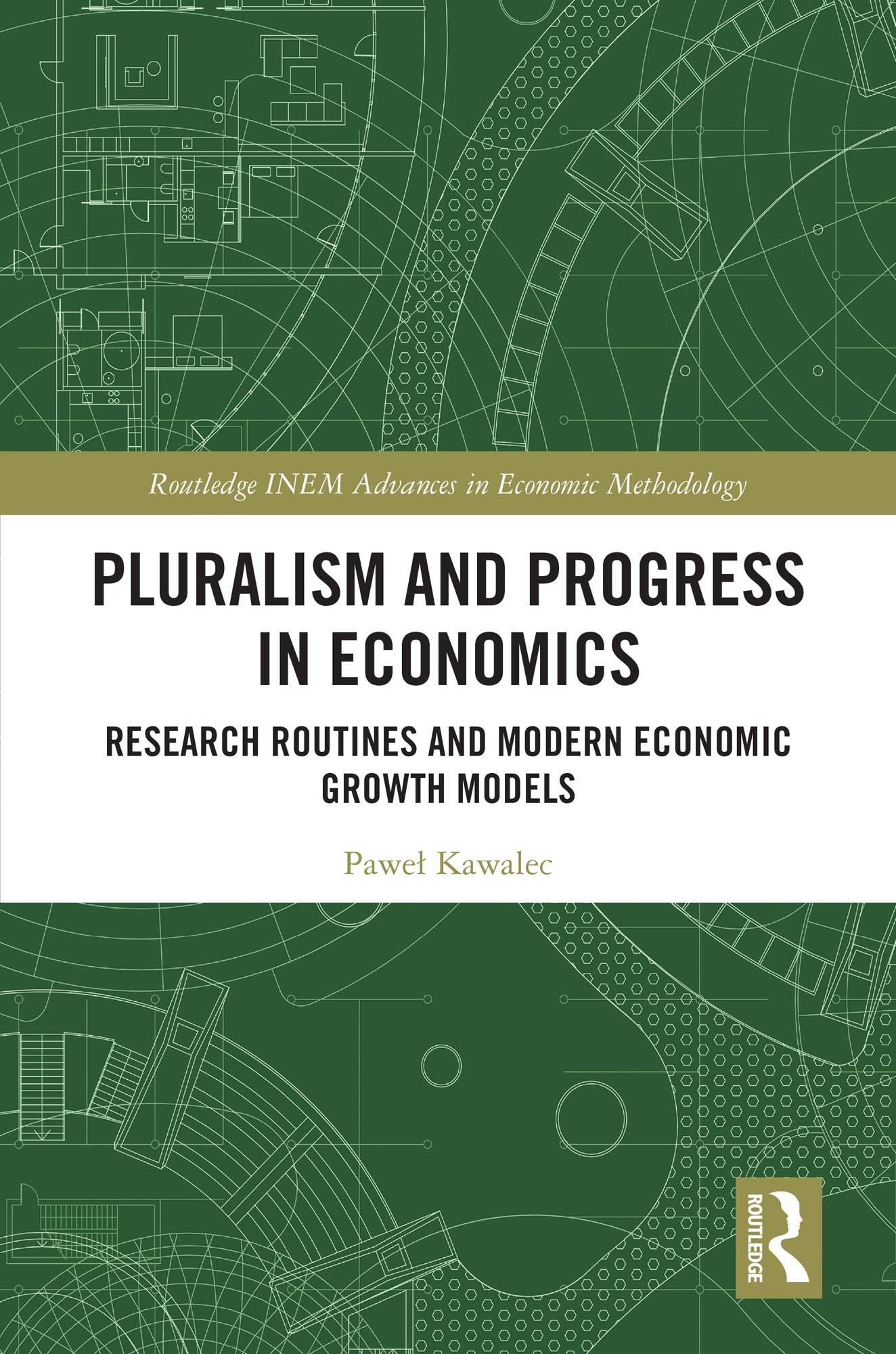
Pluralism and Progress in Economics analyzes the dynamics of growth research by introducing the concept of research routines – meso-level patterns of communal practice functionally coordinated by symbolic representations.
This book tracks the development of neoclassical growth theory through four distinct stages: exploration, extension, elaboration, and exploitation. It argues that scientific change in growth research is a processual development driven by diaphoric learning, where a community of researchers creatively uses existing conceptual tools to grasp previously unrecognized causal dependencies in data. This book further evaluates the conceptions of scientific progress, identifying the limitations of conventional criteria in distinguishing genuine advancement in economics from analytical “game-playing.” Paweł Kawalec proposes an ontic criterion of intensive progress, which validates an emergent research routine based on its isolation of ontologically novel causal structures. By distinguishing between derivational and ontological unification, and drawing on Robert Solow’s criteria of model choice, this book defends progressive pluralism and piecemeal realism. It concludes that the coexistence of diverse models is not a sign of relativism but a mature response to the world’s ontic complexity, providing a robust “library of models” essential for contextualized economic applications.
This book will be of interest to experts and graduate students specializing in economic growth models, the history of twentieth-century economics, the history and philosophy of science, and science and technology studies.
Pay easily by card, Klarna, Apple Pay or Google Pay. Not happy? You always have a 14-day money-back guarantee. Read more in our terms. If you have any questions, email us at hello@memmo.org.
Memmo makes studying easier – wherever you are in the world. We bring your course books and smart study tools together in one place: summaries, quizzes, podcasts and flashcards. Plus Ted, your study buddy who answers anything you wonder. Over 50,000 students already study here – built to help you learn faster and stress less.