
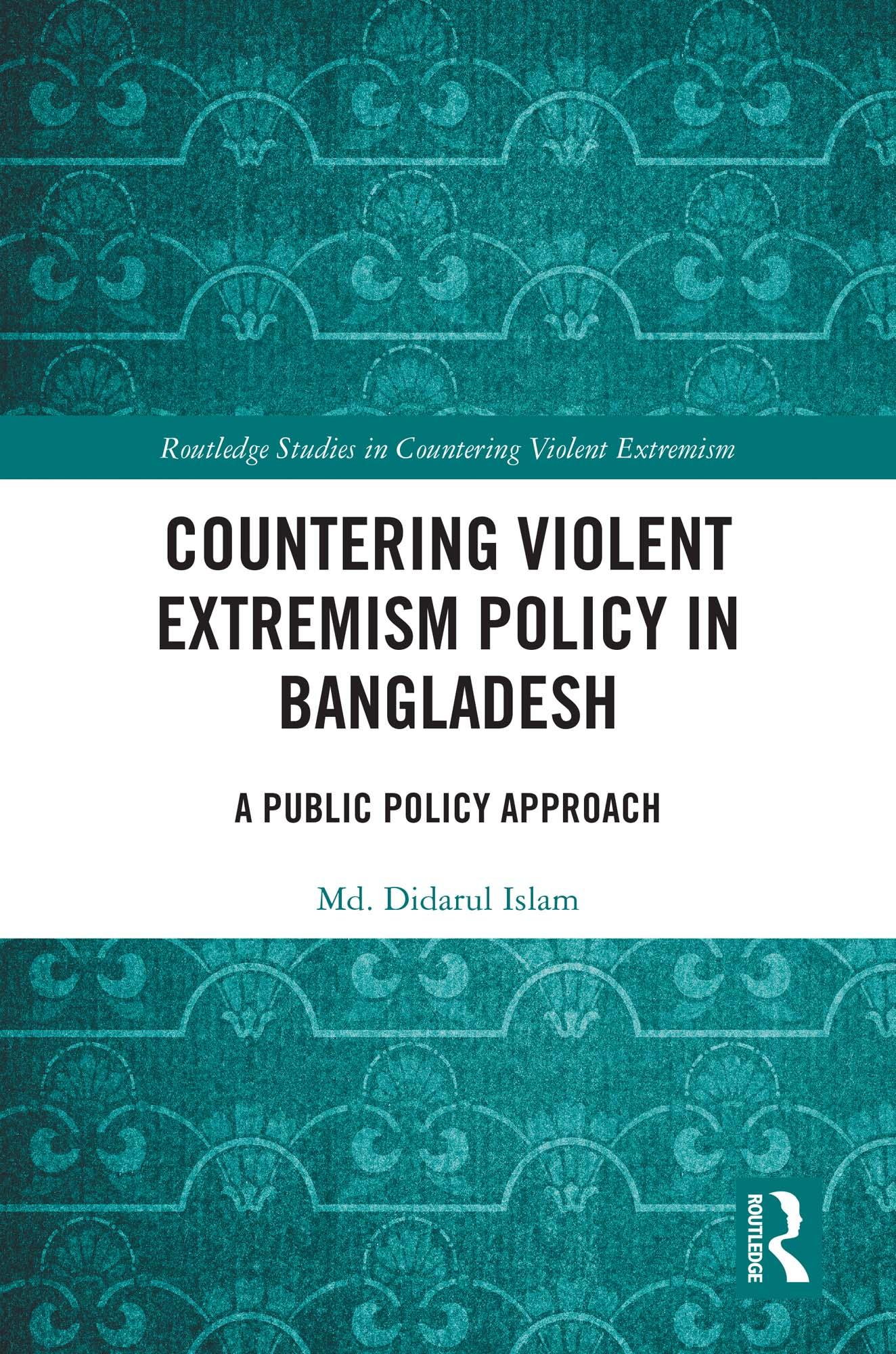
This book investigates how Bangladesh formulates its Countering Violent Extremism (CVE) policy as a norm-receiving country.
Norm-producing institutions and countries, such as the United Nations, the European Union, the UK, Australia, and Saudi Arabia, have diffused CVE norms in numerous countries through various mechanisms. Consequently, countries such as Bangladesh, Nigeria, Greece, Kenya, and many others, who initiated CVE policy late, became norm receivers. Despite widespread adoption and criticism of CVE policies globally, Bangladesh has shifted from traditional counterterrorism to CVE. This book provides the first comprehensive account of CVE policy formulation in Bangladesh through policy actor interviews. It offers a public policy perspective, integrating three theoretical dimensions: drivers of public policy; ideology, learning, and policy diffusion; and localisation. Through interviews with CVE policymakers, the book navigates policy actors’ understanding of effective CVE practices, contributing factors, and the diffusion and localisation of external policies and norms in Bangladesh.
This book will be of interest to students of CVE, counterterrorism, South Asian politics, and international relations.
Pay easily by card, Klarna, Apple Pay or Google Pay. Not happy? You always have a 14-day money-back guarantee. Read more in our terms. If you have any questions, email us at hello@memmo.org.
Memmo makes studying easier – wherever you are in the world. We bring your course books and smart study tools together in one place: summaries, quizzes, podcasts and flashcards. Plus Ted, your study buddy who answers anything you wonder. Over 50,000 students already study here – built to help you learn faster and stress less.