
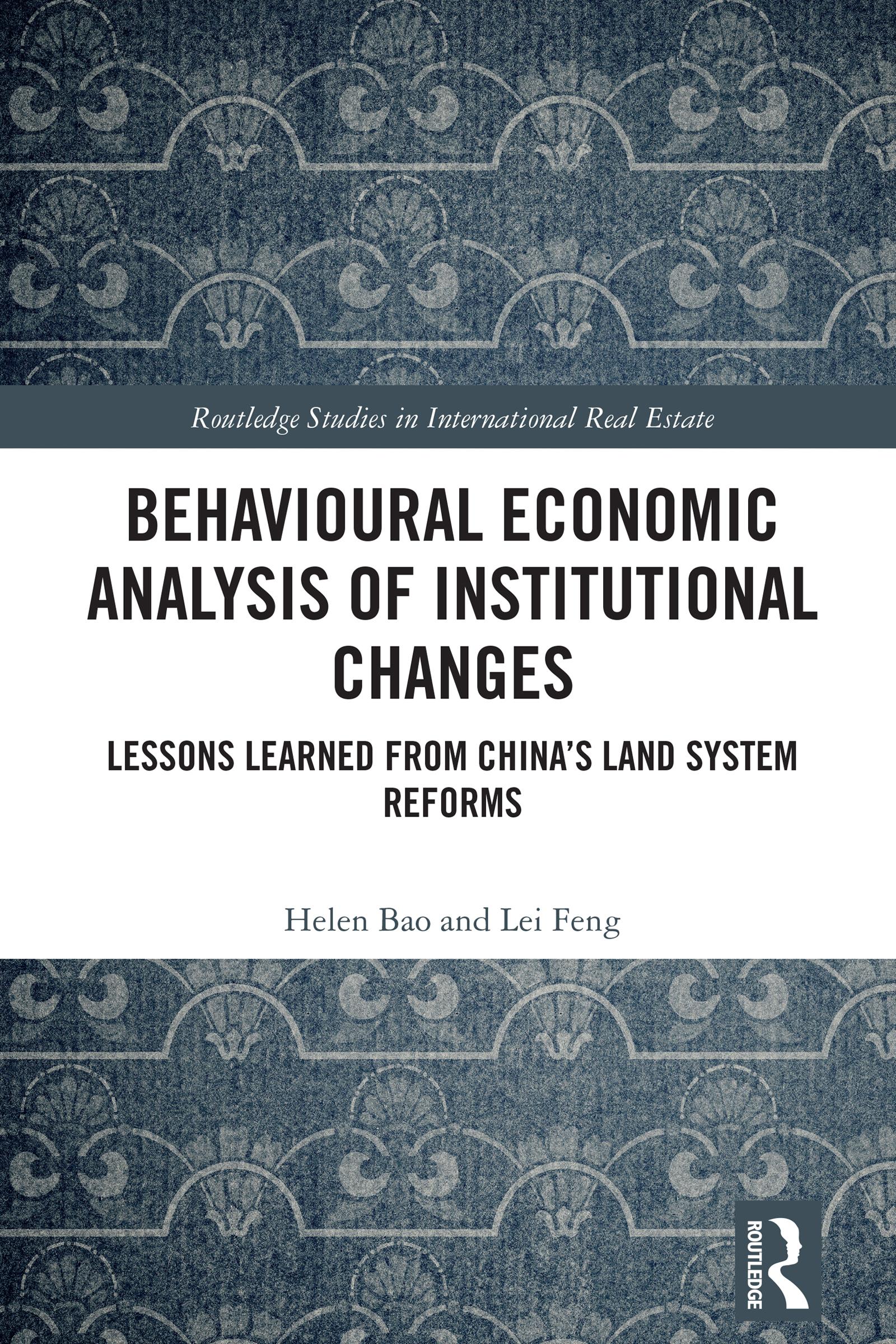
This book examines the evolution of China’s rural land system through an integrated lens of institutional and behavioural economics. It traces seventy years of reform, from collective farming to market-oriented land transfers, to explain how central policy, local implementation and farmers’ responses interact to shape institutional change. Moving beyond standard accounts focused on property rights and transaction costs, the book introduces a dynamic framework based on Prospect Theory, incorporating cognitive biases, social norms and bounded rationality. Drawing on two large-scale rural household surveys, the book combines empirical analysis with historical case studies to explore how reforms were received, adapted and resisted.
This book will benefit researchers, policymakers and graduate students interested in institutional change, land policy or Chinese rural development. It offers new tools to understand policy implementation in environments marked by uncertainty, decentralisation and informal constraints. By highlighting how behavioural factors mediate formal rules, the book provides insights that extend beyond China, informing the design of effective land and property rights reforms globally.
Pay easily by card, Klarna, Apple Pay or Google Pay. Not happy? You always have a 14-day money-back guarantee. Read more in our terms. If you have any questions, email us at hello@memmo.org.
Memmo makes studying easier – wherever you are in the world. We bring your course books and smart study tools together in one place: summaries, quizzes, podcasts and flashcards. Plus Ted, your study buddy who answers anything you wonder. Over 50,000 students already study here – built to help you learn faster and stress less.