
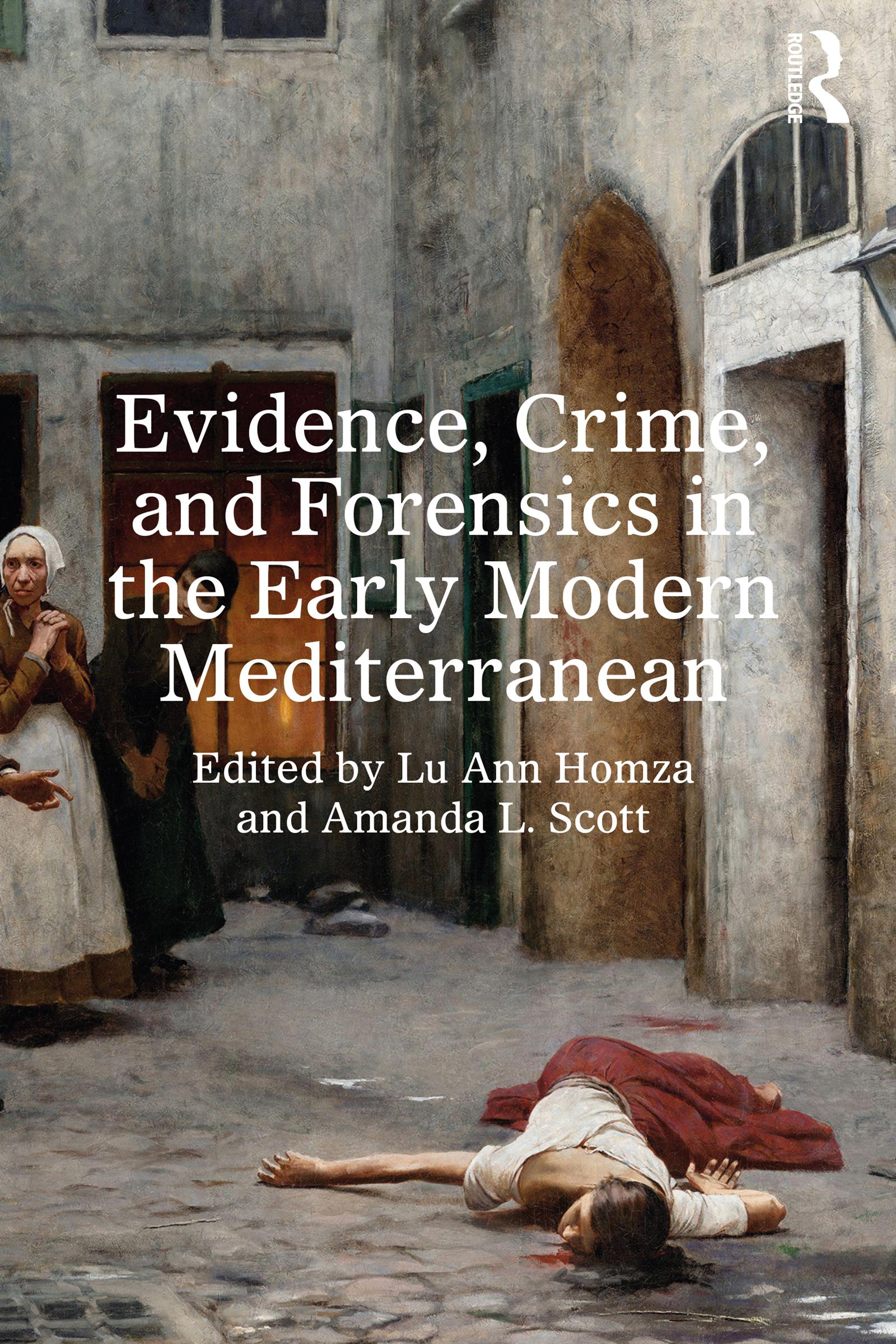
Recent historians have pinpointed the ways in which legal systems in early modern Europe were improvisational, flexible, and contingent rather than immovable, hierarchical, and gendered. Evidence, Crime, and Forensics in the Early Modern Mediterranean amplifies such findings by looking at law and its consumers in the Mediterranean, broadly imagined, between 1500 and 1750. The volume’s essays enhance our awareness of how crimes were defined, evidence was offered, and forensic awareness appeared in secular, inquisitorial, and specially commissioned courts in Spain, Italy, and the Hapsburg Balkans.
This collection threads an important needle: our authors recognize formal chains of command and legal commonplaces but nonetheless emphasize how such factors could be challenged, manipulated, or ignored by illiterate and vulnerable populations. It turns out that ordinary individuals in the early modern Mediterranean did not find themselves limited in their legal options, and their degree of sophistication in court speaks volumes about networks of legal knowledge. Furthermore, in no way does the use of the courts between 1500 and 1750 imply more “rational” ways of seeking justice, since emotions were always firmly on display, even if rage and regret were being deployed for performative reasons.
Evidence, Crime, and Forensics in the Early Modern Mediterranean illustrates the range of questions we can put to archival sources from the early modern Mediterranean, with plentiful insights as to how legal sources can illuminate history from below. This collection will be a welcome addition for undergraduate and graduate courses on European history, as well as a provocative resource for more general audiences.
Pay easily by card, Klarna, Apple Pay or Google Pay. Not happy? You always have a 14-day money-back guarantee. Read more in our terms. If you have any questions, email us at hello@memmo.org.
Memmo makes studying easier – wherever you are in the world. We bring your course books and smart study tools together in one place: summaries, quizzes, podcasts and flashcards. Plus Ted, your study buddy who answers anything you wonder. Over 50,000 students already study here – built to help you learn faster and stress less.