
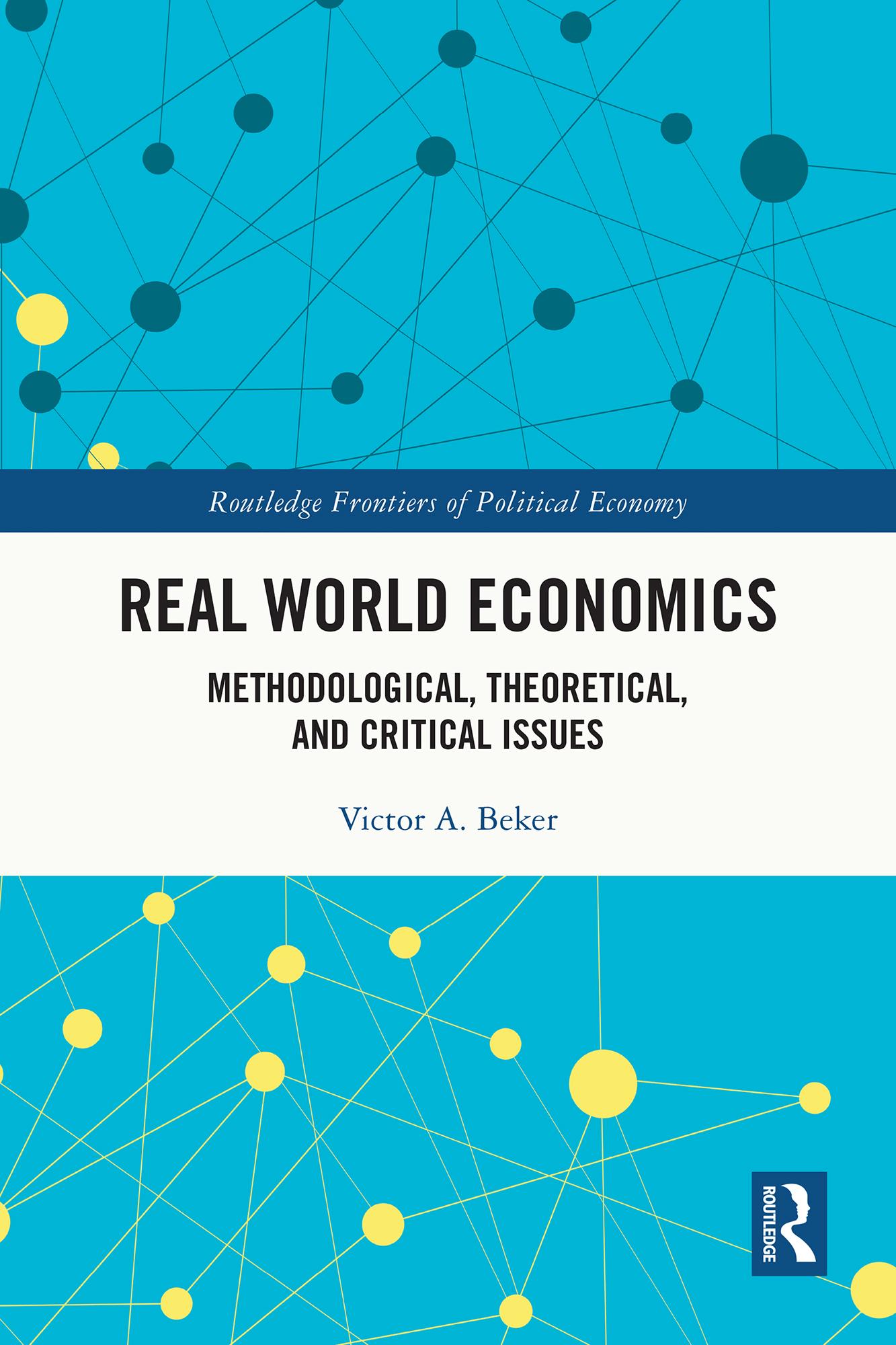
The starting point of this book is that economics is an applied science: a tool to understand the real-world economy and a guide for economic policy. In contrast to the unrealistic and artificial models of neoclassical economics, the book argues that the point of departure for economic theory should be the real world with realistic assumptions being made. The book explores the theoretical underpinnings of this real-world economics including the concepts of similarity (the relationship between economic models and real-world phenomena), evolution (economic change is a historical process in which recurrent patterns of growth, maturation, and decline exist), and uncertainty (the absence of knowledge of the full set of circumstances faced and the probabilities associated with them). Adopting a real-world approach also means accepting that human beings are cognitively constrained. They do not optimize, they satisfy and, thus, a real-world economic theory should incorporate bounded rationality. This book is essential reading for anyone seeking a deeper understanding of the economy, including readers from economics and across the social sciences. In this respect, it also includes some reflections on the failure of Third Way ideas to deliver on their promises. Having been incapable of changing the course impressed on the economy by the neoliberal experiment, that failure paved the way for a resurgence of nationalism, populism, and alternatives to liberal democracy, subjects analyzed in the last section of the volume.
Pay easily by card, Klarna, Apple Pay or Google Pay. Not happy? You always have a 14-day money-back guarantee. Read more in our terms. If you have any questions, email us at hello@memmo.org.
Memmo makes studying easier – wherever you are in the world. We bring your course books and smart study tools together in one place: summaries, quizzes, podcasts and flashcards. Plus Ted, your study buddy who answers anything you wonder. Over 50,000 students already study here – built to help you learn faster and stress less.