
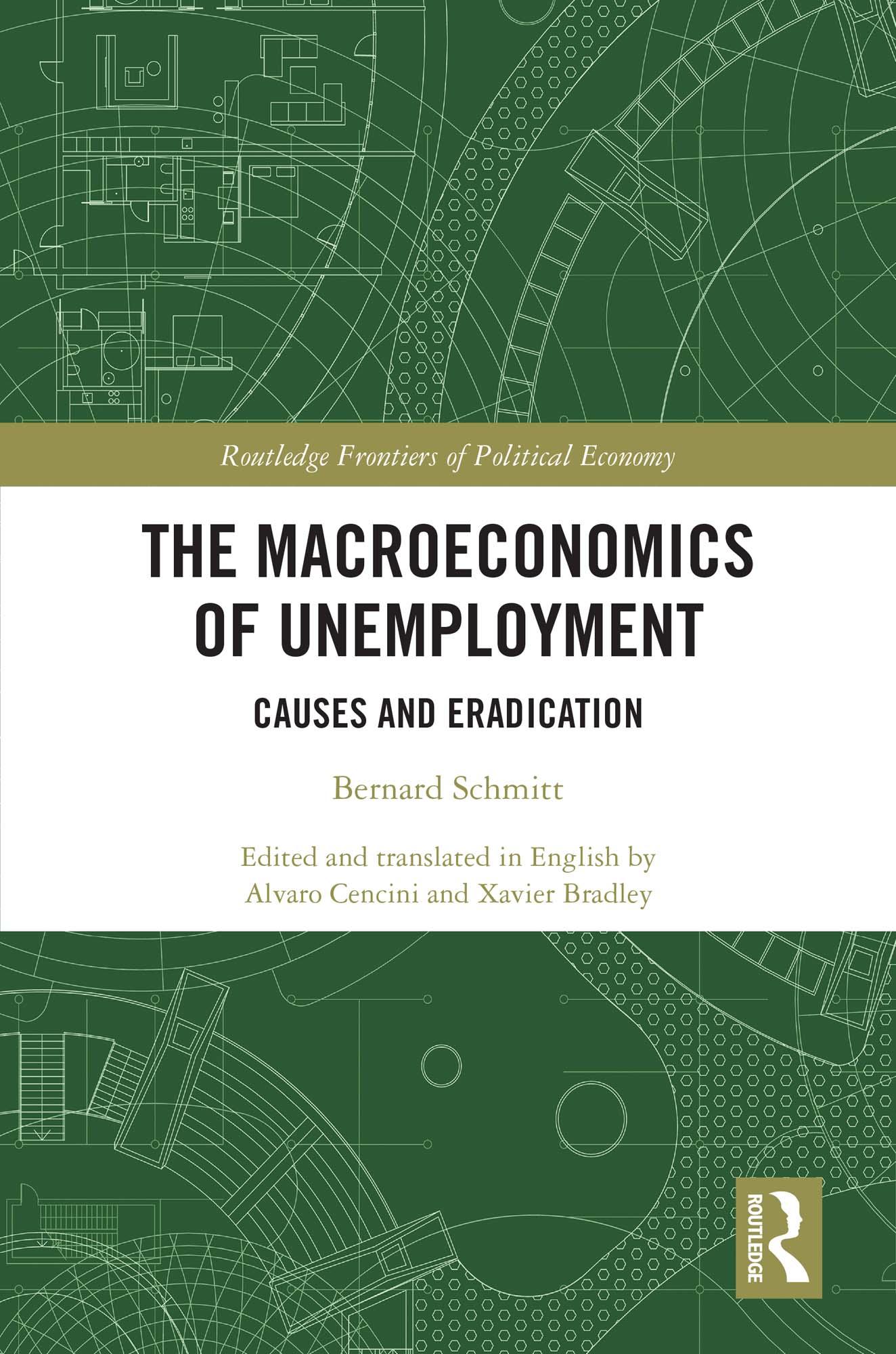
This book explores unemployment from a monetary macroeconomics perspective, identifying the pathology at the origin of unemployment and the principles of reform that will enable a passage from capitalism to post‑capitalism.
Bernard Schmitt explores the problem of involuntary unemployment by developing his quantum monetary macroeconomic analysis, demonstrating that the presence of fixed capital increases both physical productivity and the production of economic value. Money is at the core of Schmitt’s analysis because the relation between money and output is what makes it difficult to explain the origin of involuntary unemployment. Schmitt shows that unemployment is formally impossible in any economy producing wage‑, interest‑, and investment‑goods. It is only when the economic system includes fixed capital amortization that the conditions for the formation of unemployment are met. The determining role is played by the natural rate of interest: when this rate falls below the market rate of interest, unemployment sets in. Schmitt provides a new explanation of the mechanism leading to unemployment and advocates a reform that, if implemented, would break any link between capital accumulation and unemployment.
This book is essential reading for those interested in issues around unemployment and post‑capitalism as well as the fields of political economy, macroeconomics, economic theory, and heterodox economics more broadly.
Pay easily by card, Klarna, Apple Pay or Google Pay. Not happy? You always have a 14-day money-back guarantee. Read more in our terms. If you have any questions, email us at hello@memmo.org.
Memmo makes studying easier – wherever you are in the world. We bring your course books and smart study tools together in one place: summaries, quizzes, podcasts and flashcards. Plus Ted, your study buddy who answers anything you wonder. Over 50,000 students already study here – built to help you learn faster and stress less.