
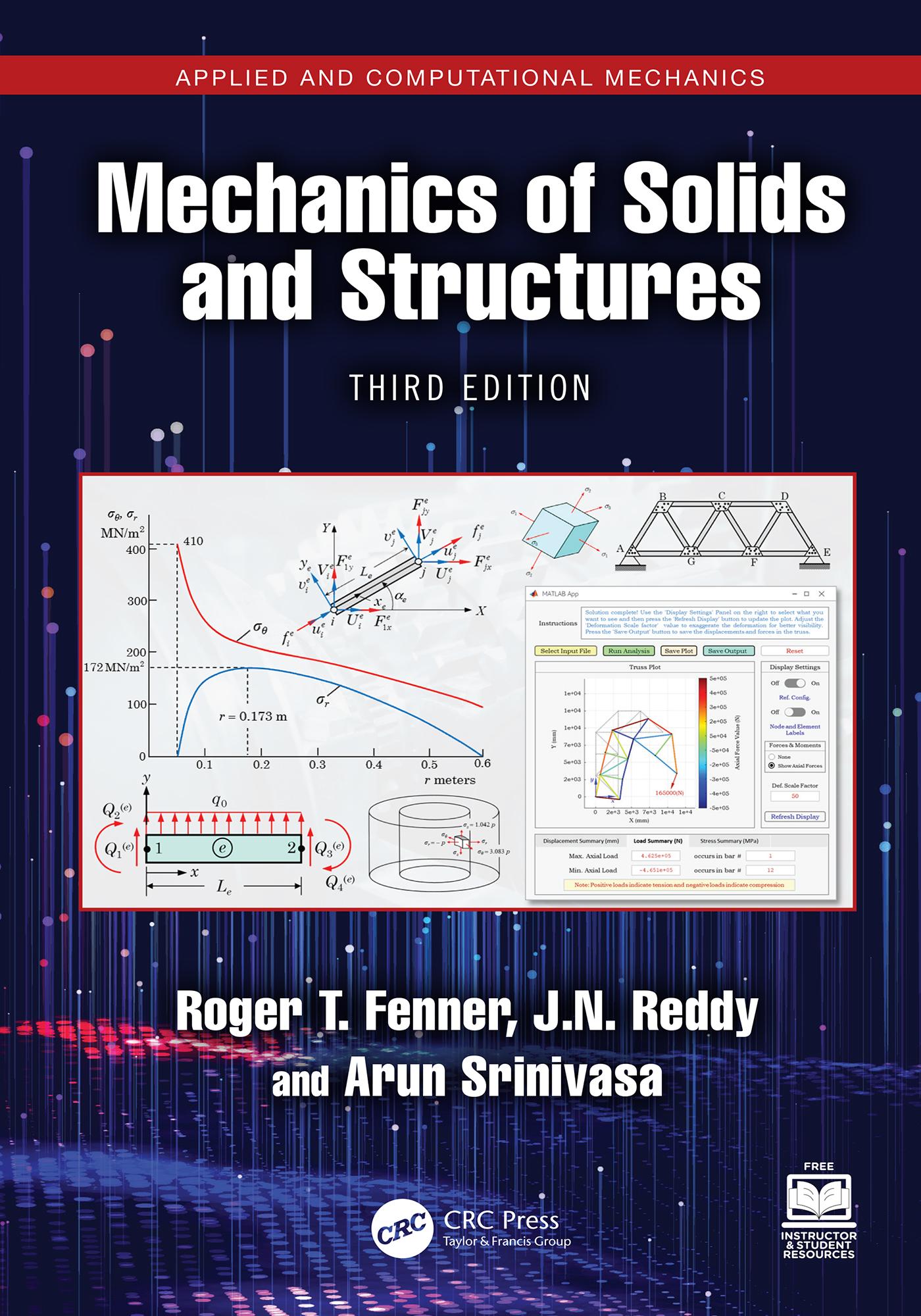
The third edition of Mechanics of Solids and Structures makes use of computational methods such as the finite element method that has revolutionized the field to solve problems while retaining all the basic principles and foundational information needed for mastering advanced engineering mechanics principles and acquiring problem-solving skills. The authors have updated the text to include the integration of numerical approaches and MATLAB® computer programs into the body of the text for carrying out analysis of truss, beam, and frame structures. The third edition also offers an update to Chapters 1 through 4 as follows. All material related to determinate trusses and cables is moved to Chapter 1, as most students most likely were introduced to these topics in a course on statics. Thus, Chapter 1 of the current edition is a review of statics. The concepts of stress and strain and associated examples were moved from Chapter 1 to Chapter 2, with additional discussion of concepts and examples. Chapter 3 in the new edition deals with stress-strain relations with applications to determinate systems, including trusses and thin-walled pressure vessels. Indeterminate trusses and associated computer implementation have been moved from Chapter 4 of the second edition to Chapter 7 of the current edition. Other indeterminate systems from old Chapter 4 have been retained in new Chapter 4. The second major change is the updating of all the computational tools from FORTRAN to MATLAB and providing interactive tools (i.e., APPs) in Chapters 7, 10, and 12 of the new edition. All computational examples from Chapters 4 and 6 on trusses and beams of the second edition are consolidated into a new chapter, Chapter 7 with numerous examples and applications of newly included TRUSS2d, BEAM, and FRAME2d APPs. Chapter 7 also introduces finite element analysis of plane frames (a new topic). The authors have also added new examples and exercise problems throughout the book that allow students to practice and apply the concepts and formulas to solve problems.
Pay easily by card, Klarna, Apple Pay or Google Pay. Not happy? You always have a 14-day money-back guarantee. Read more in our terms. If you have any questions, email us at hello@memmo.org.
Memmo makes studying easier – wherever you are in the world. We bring your course books and smart study tools together in one place: summaries, quizzes, podcasts and flashcards. Plus Ted, your study buddy who answers anything you wonder. Over 50,000 students already study here – built to help you learn faster and stress less.