
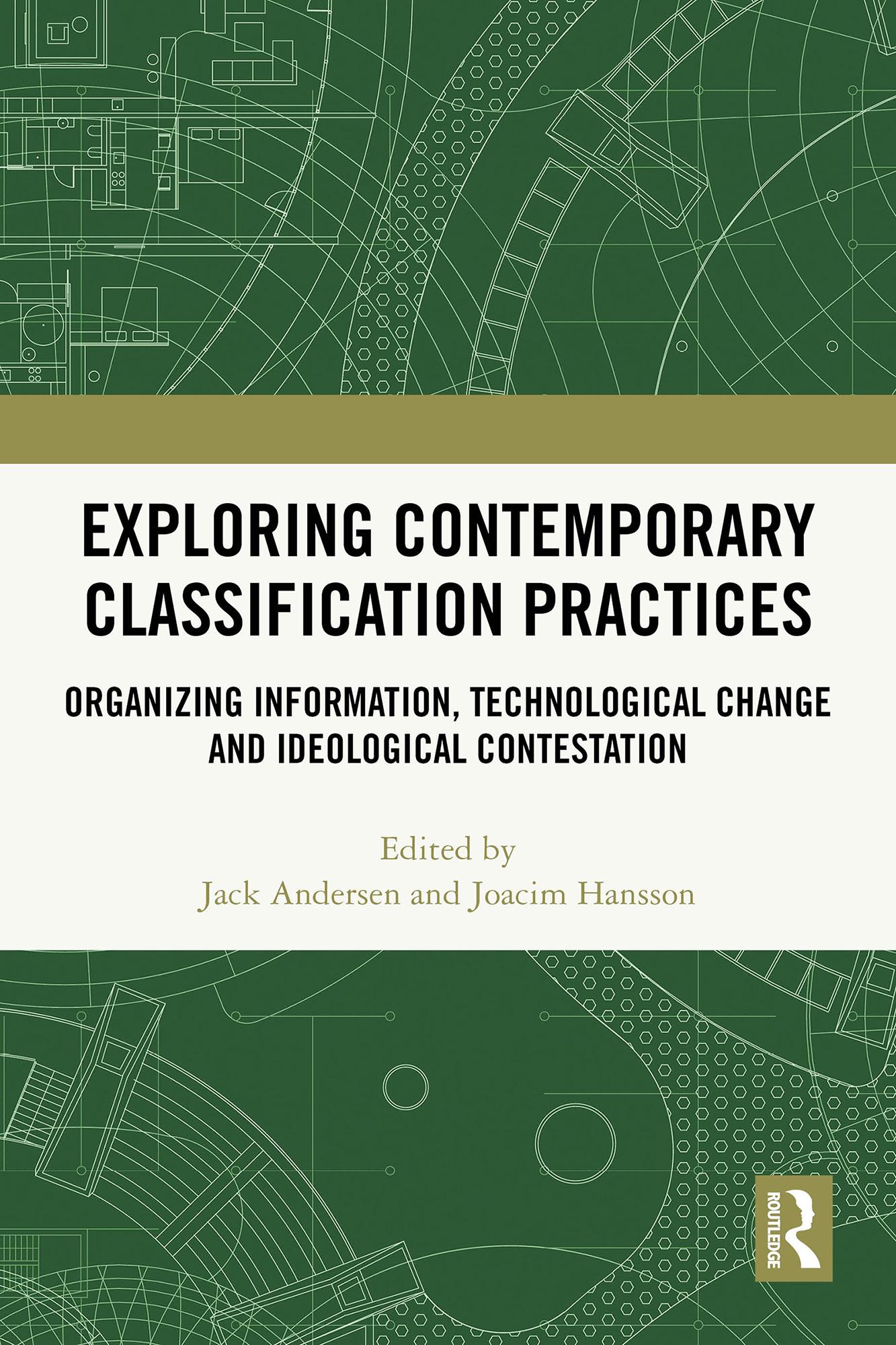
The contributions in Exploring Contemporary Classification Practices analyse various aspects of classification and their importance to contemporary debates surrounding cultural heritage and information access.
Specific focus is on systems of classification, media technologies, and cultural institutions (such as libraries, archives, and museums) and how they respond to challenges, including classificatory bias, truth, neutrality, institutional tradition, and technological innovation. Raising awareness of classification practices in modern culture serves to emphasize how sorting things into categories is both an everyday accomplishment and a highly cultural and political activity with consequences for those who are classified and for those who classify. Throughout this book, ‘classification’ is defined as the practice and activity of systematically ordering and categorizing entities to bring structure and understanding to diverse contexts. This book addresses several timely issues both in terms of theoretical advancement and empirical diversity. The scholarly discussion on the classification and organization of knowledge has developed with digital technologies from a bibliographic paradigm into something much wider, as the need for metadata and classification has become critical for usability and legitimacy. This development has also led research on classification and knowledge organization to confront a new, post-humanist reality with not only emerging varieties of information currents in society, but also the development of new theoretical and methodological strands, such as post-colonial and intersectional perspectives, and digital humanities methodologies. In doing so, this book seeks to address critical questions for the archives, library, and museum sectors concerning the organization of information.
Exploring Contemporary Classification Practices will, therefore be of interest to academics, researchers, and practitioners with interests in library and information science, archives, cultural heritage, and digital heritage.
Pay easily by card, Klarna, Apple Pay or Google Pay. Not happy? You always have a 14-day money-back guarantee. Read more in our terms. If you have any questions, email us at hello@memmo.org.
Memmo makes studying easier – wherever you are in the world. We bring your course books and smart study tools together in one place: summaries, quizzes, podcasts and flashcards. Plus Ted, your study buddy who answers anything you wonder. Over 50,000 students already study here – built to help you learn faster and stress less.