
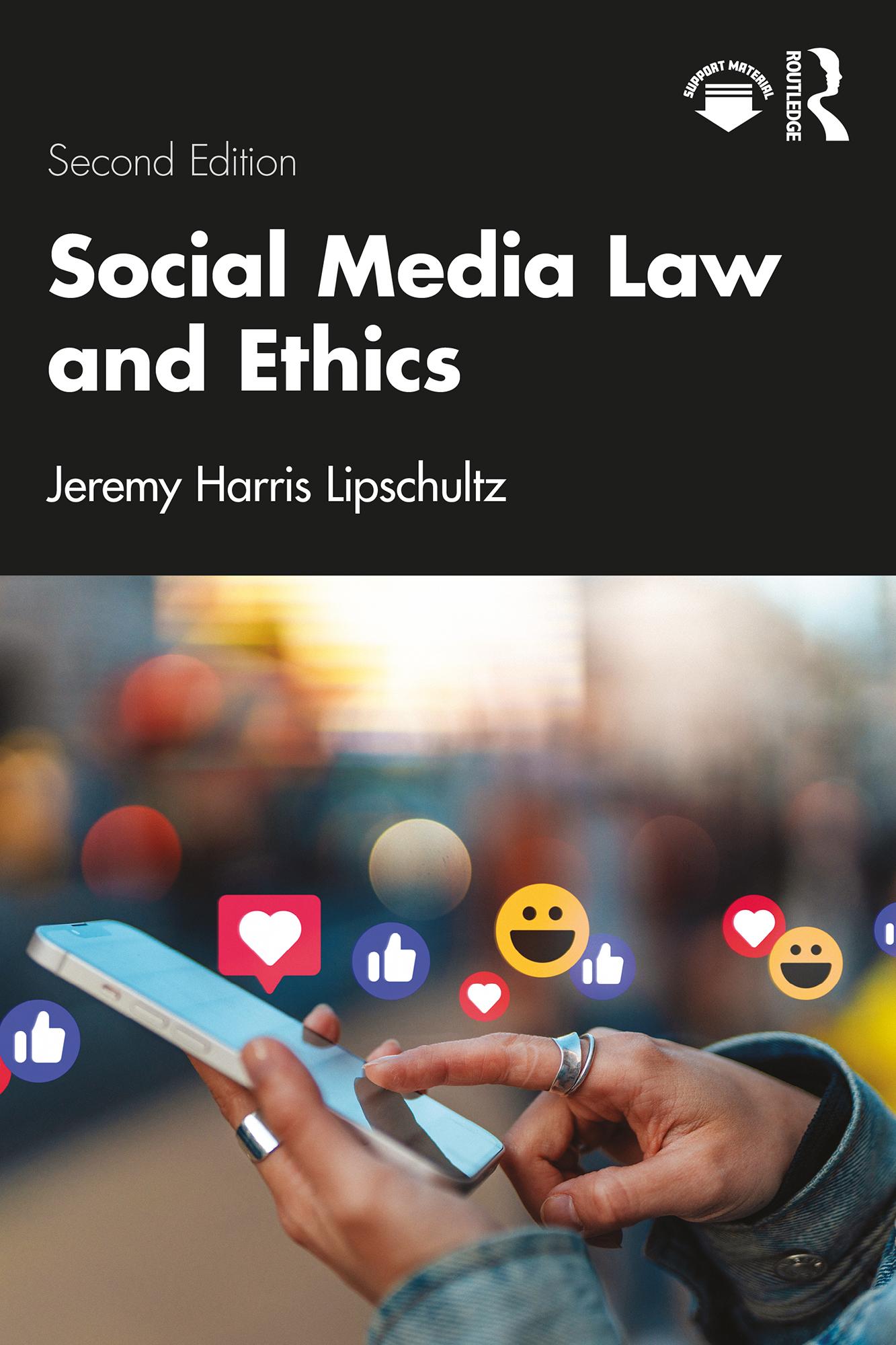
In this textbook, social media professor Jeremy Harris Lipschultz introduces students to the study of social media law and ethics, integrating legal concepts and ethical theories.
This second edition explores freedom of expression, as it applies to students, media industry professionals, content creators and audience members. Key issues and practices covered include copyright law, data privacy, defamation, global law and ethics, generative AI, government censorship, social media platform rules and employer policies. The book also addresses the U.S. government's TikTok law and other recent regulations. Research techniques are also used to suggest future trends in social media law and ethics. Touching on themes and topics of significant contemporary relevance, this accessible textbook can be used in standalone law and ethics courses, as well as emerging social media courses that are disrupting traditional public relations, advertising, marketing and journalism curricula.
Case studies, discussion questions, and online resources help students engage with the practicalities, complexities and ambiguities of this future-oriented area of media law, making this an ideal textbook for students of media law, policy and ethics, mass media, and communication studies.
Pay easily by card, Klarna, Apple Pay or Google Pay. Not happy? You always have a 14-day money-back guarantee. Read more in our terms. If you have any questions, email us at hello@memmo.org.
Memmo makes studying easier – wherever you are in the world. We bring your course books and smart study tools together in one place: summaries, quizzes, podcasts and flashcards. Plus Ted, your study buddy who answers anything you wonder. Over 75,000 students already study here – built to help you learn faster and stress less.