
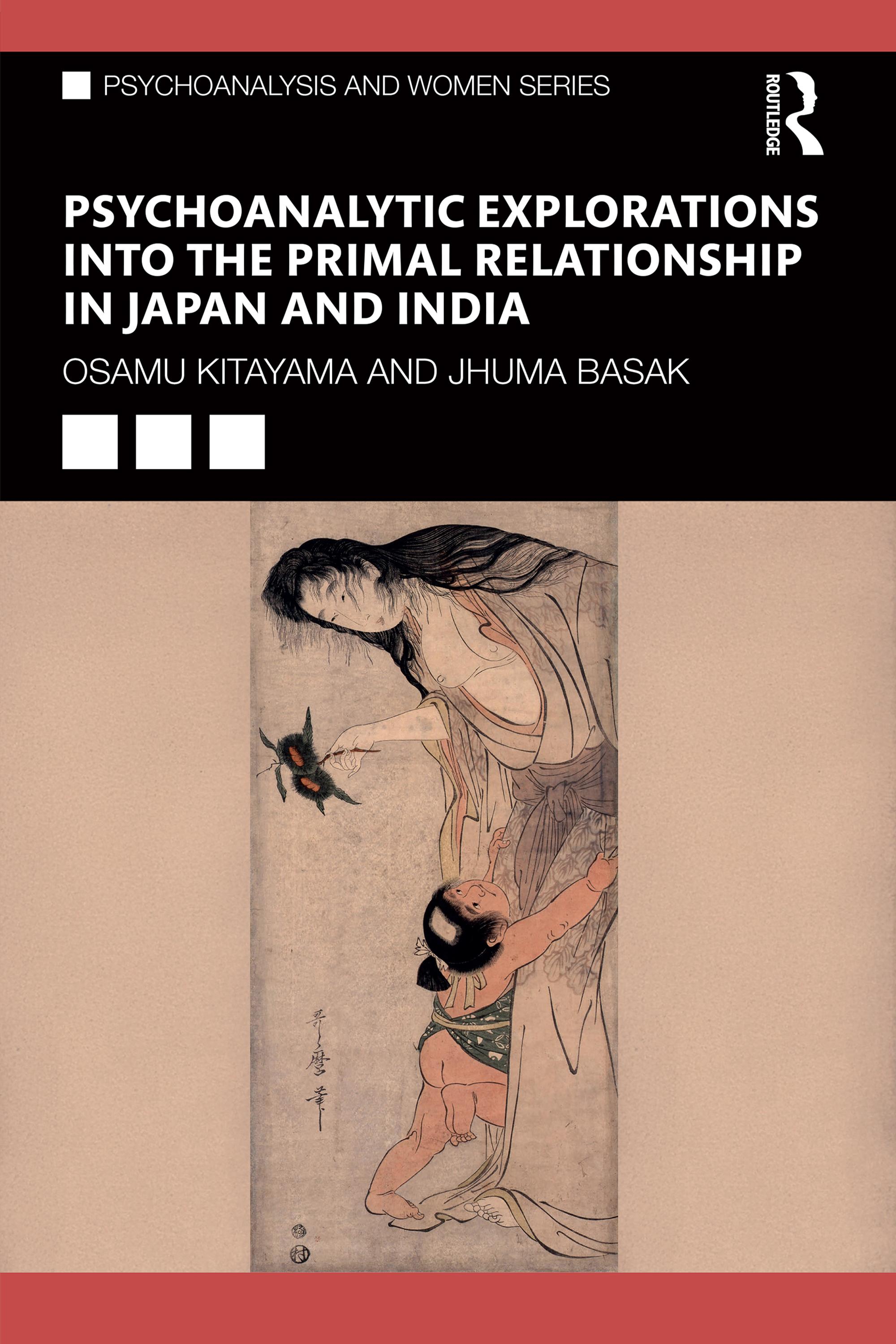
In this landmark collaboration, Osamu Kitayama and Jhuma Basak chronical their long-standing collaboration and cultural exchange to survey the importance of familial relationships in Japan and India, exploring primal relations through a cross-cultural psychoanalytic lens.
Divided into three sections, Psychoanalytic Explorations into the Primal Relationship in Japan and India looks at each country’s perception of parenthood and approach to raising children in turn before concluding in an illuminating dialogue between the two authors. Kitayama explores the maternal figure within the mother-child relationship, with a focus on the mother-son dyad, as well as relationships between parents. He considers, in depth, how Japanese culture can often exclude what is perceived as alien, delving into its rich tapestry of folklore to understand underlying ‘mental scripts’ which can shape collective perceptions, societal norms and expectations, each of which can pose an issue to healthy familial relationships. Basak’s response draws from Indian socio-cultural and mythological contexts, as well as clinical applications, to provide psychoanalytic insight into the stark differences and similarities between attitudes in Japan, India and the eastern culture at large. Both authors join together to highlight different child rearing practises such as co-sleeping and how they can shape human sexuality-subjectivity. Challenging the standardisation of the Oedipal myth, the book draws from literary and clinical examples in Japan and India to invite the reader into another world of parenting style and another idiom of psychoanalysis.
Uniquely positioned to develop understanding of how psychoanalysis has developed in non-Western countries, this book is an essential resource for psychoanalysts in training and in practice.
Pay easily by card, Klarna, Apple Pay or Google Pay. Not happy? You always have a 14-day money-back guarantee. Read more in our terms. If you have any questions, email us at hello@memmo.org.
Memmo makes studying easier – wherever you are in the world. We bring your course books and smart study tools together in one place: summaries, quizzes, podcasts and flashcards. Plus Ted, your study buddy who answers anything you wonder. Over 50,000 students already study here – built to help you learn faster and stress less.