
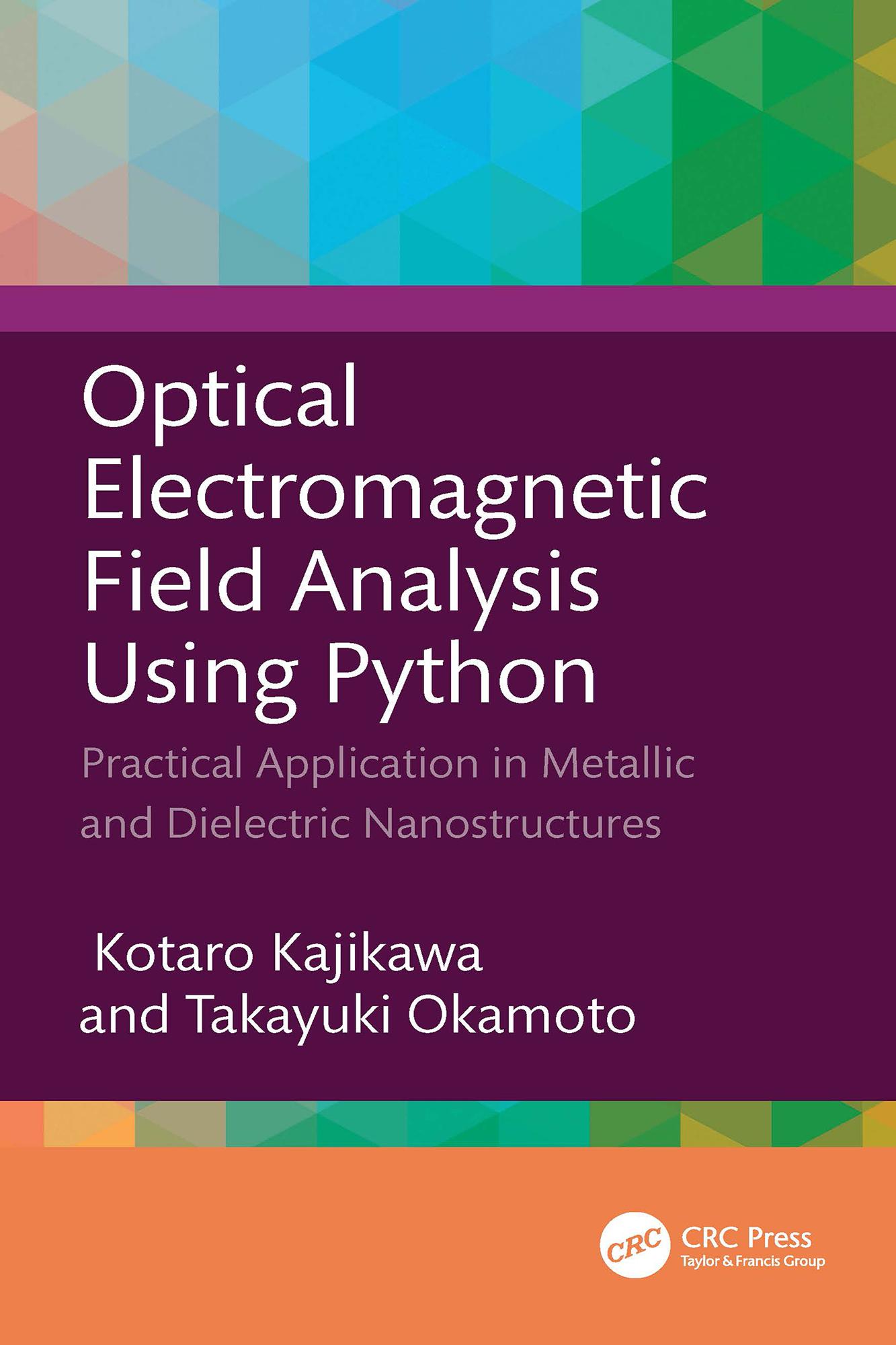
In this book, Kajikawa and Okamoto explain how to use Python to calculate and visualize the optical response of microscopic structures and systems. Throughout, the authors provide varied examples to instruct readers in the application of theoretical knowledge to real-world scenarios.
Electromagnetic field analysis is often necessary to determine the optical response of materials with microscopic structures. Although the principles are widely described, the manual calculation and visualization of results are not and remain challenging. Python is the ideal language to use for this as it has a large functional library for visualizing analysis results and is suitable for programming beginners to use at low cost, so it has many advantages over languages like Fortran, BASIC, and C. Here, the authors introduce the application of Python to various electromagnetic field analysis scenarios in the field of nanophotonics. The first half of the book describes cases in which there is an analytical solution for the structure and addresses scenarios such as scattering and absorption in spherical and cylindrical structures and complex structures such as rotating ellipsoids, sphere-aggregated structures, and hemispherical structures. The second half describes methods including rigorous coupling wave analysis, finite-difference time-domain method and discrete dipole approximation for numerically solving varied structures. This book enables readers to conduct their own electromagnetic field analysis quickly, cheaply, and accurately without in-depth study of other complicated and time-consuming approaches or programs.
This book is invaluable for researchers and postgraduate students working in the fields of optics and photonics. Additionally, the contents are useful not only for those conducting electromagnetic field analysis but also those simulating physical, chemical, and biological phenomena.
Pay easily by card, Klarna, Apple Pay or Google Pay. Not happy? You always have a 14-day money-back guarantee. Read more in our terms. If you have any questions, email us at hello@memmo.org.
Memmo makes studying easier – wherever you are in the world. We bring your course books and smart study tools together in one place: summaries, quizzes, podcasts and flashcards. Plus Ted, your study buddy who answers anything you wonder. Over 50,000 students already study here – built to help you learn faster and stress less.