
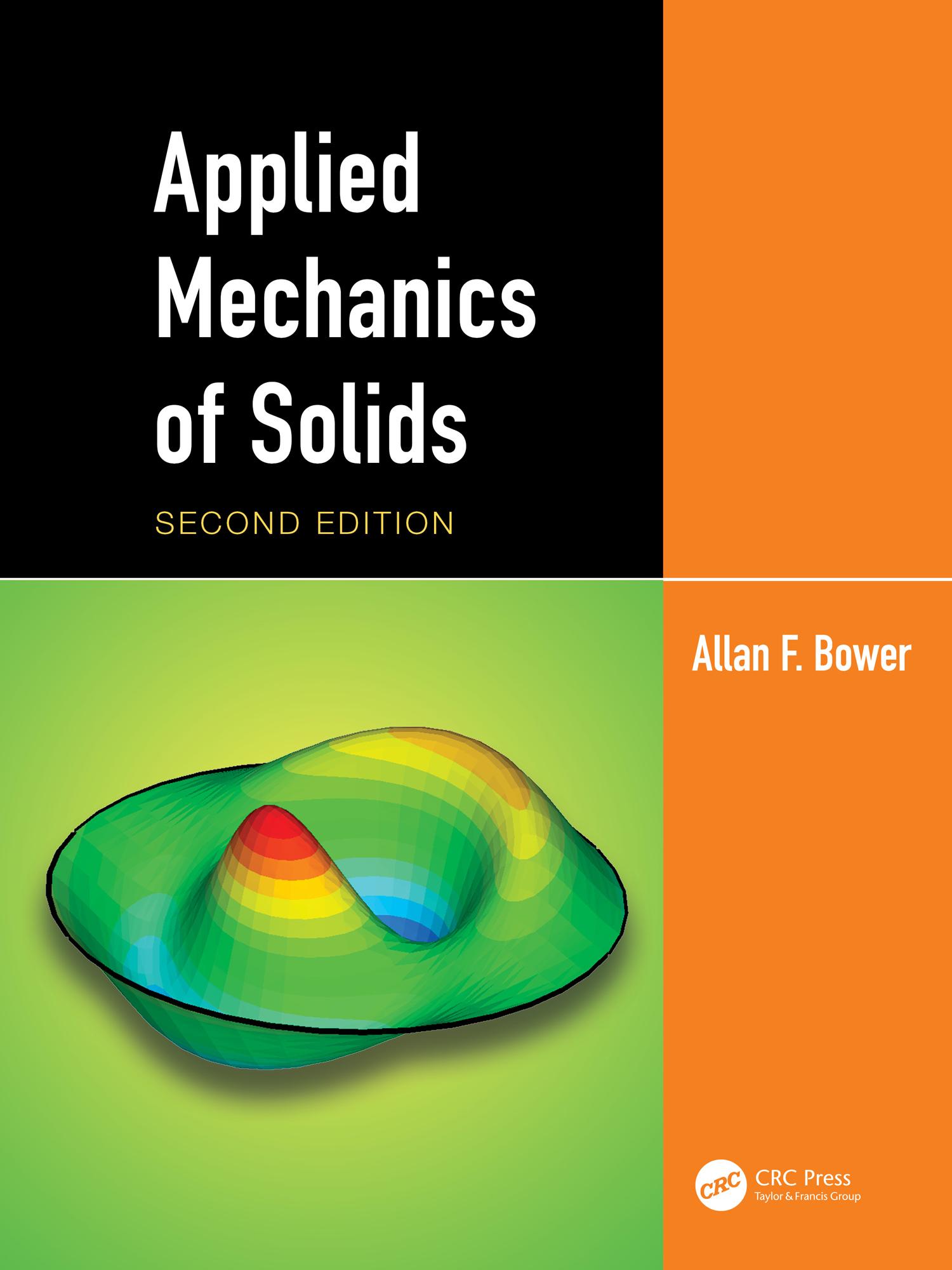
The second edition of Applied Mechanics of Solids provides a concise description of all the concepts needed to predict how solid materials deform and fail under stress. With its companion volume of solved example problems, it is an invaluable class textbook or reference for personal study or review.
With the aid of computer simulations, design engineers can predict stresses, deformation, and failure in structural, mechanical, and bio-mechanical components with a few keystrokes. But simulations are built on sophisticated mathematics, physics, and numerical methods, and always involve some judicious approximations. Engineers need a thorough grasp of these concepts to know how to set up their simulations correctly and to interpret their predictions. This book contains all the theory they need to make the best use of their simulations.
Beginning with a description of the physical and mathematical laws that govern deformation in solids, the text presents models of material behavior; solutions to important boundary value problems using classical methods of analysis; a detailed description of the finite element method; fracture mechanics and failure analysis; as well as structural theories of rods, plates and shells.
All chapters in this new edition contain additional material, but the most substantial changes are to Chapter 8: “Finite Element Analysis: Theory and Implementation,” which now covers topics such as locking-resistant finite elements for simulations of solids subjected to large deformations; structural elements (trusses, beams, and plates); as well as methods for enforcing constraints in finite element simulations, cohesive zone models of interface fracture, and contact elements. In addition, a new companion volume provides over 400 example problems with their solutions. The text is supplemented by example finite element codes posted on GitHub, which demonstrate all the finite element algorithms described in the text.
Pay easily by card, Klarna, Apple Pay or Google Pay. Not happy? You always have a 14-day money-back guarantee. Read more in our terms. If you have any questions, email us at hello@memmo.org.
Memmo makes studying easier – wherever you are in the world. We bring your course books and smart study tools together in one place: summaries, quizzes, podcasts and flashcards. Plus Ted, your study buddy who answers anything you wonder. Over 50,000 students already study here – built to help you learn faster and stress less.