
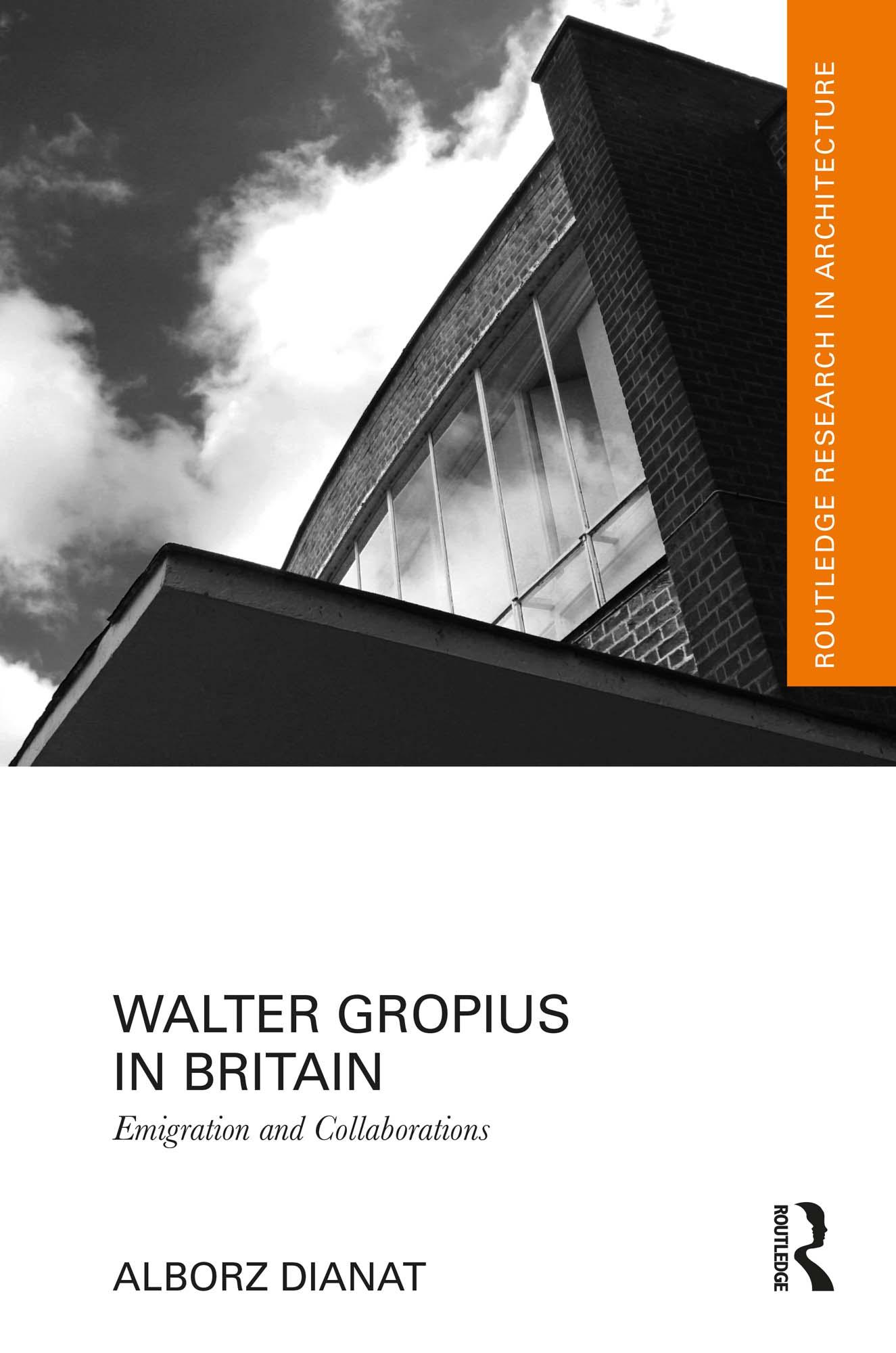
As the first monograph dedicated to Walter Gropius’s activity in Britain, this book provides a comprehensive account of the Bauhaus founder’s contributions to architecture and design while living in London between 1934 and 1937. Drawing on earlier and later decades, this reveals the close contact between British, German and American design circles, with Gropius bridging parallel developments.
In its approach, this book concentrates on the individuals working to aid Gropius in Britain and spurring the architect’s enduring dominance in English‑language histories. This includes his architectural partner Maxwell Fry, his translator P. Morton Shand, his employer Jack Pritchard and many other prominent figures such as Frank Pick, Herbert Read, Elizabeth Denby and Henry Morris. The vital role of Gropius’s wife Ise is also highlighted, particularly as her English‑language capabilities far exceeded his. By uncovering this wider network, the collaborative nature of his success is demonstrated. Such an approach reveals Gropius’s contributions beyond buildings to various debates in the period. These spanned subjects including standardisation, prefabrication, democratisation, the planning of high rises, the influence of commercialism, and the reform of architectural education and practice. Beyond design discourse, the broader impact of nationalism is considered, with the support Gropius received contrasted against the attacks Jewish émigrés endured.
This book will appeal to those interested in the Bauhaus, interwar Britain, architectural media and emigration studies. By applying revisionist approaches and highlighting the importance of discourse beyond built forms, this book advances our knowledge of the period. The transnational focus holds significance for architectural developments in Germany, Britain and America, following Gropius’s trajectory. While concentrated primarily on the interwar period, the postwar impact of exchanges is revealed, leading up until Gropius’s death in 1969.
Pay easily by card, Klarna, Apple Pay or Google Pay. Not happy? You always have a 14-day money-back guarantee. Read more in our terms. If you have any questions, email us at hello@memmo.org.
Memmo makes studying easier – wherever you are in the world. We bring your course books and smart study tools together in one place: summaries, quizzes, podcasts and flashcards. Plus Ted, your study buddy who answers anything you wonder. Over 50,000 students already study here – built to help you learn faster and stress less.