
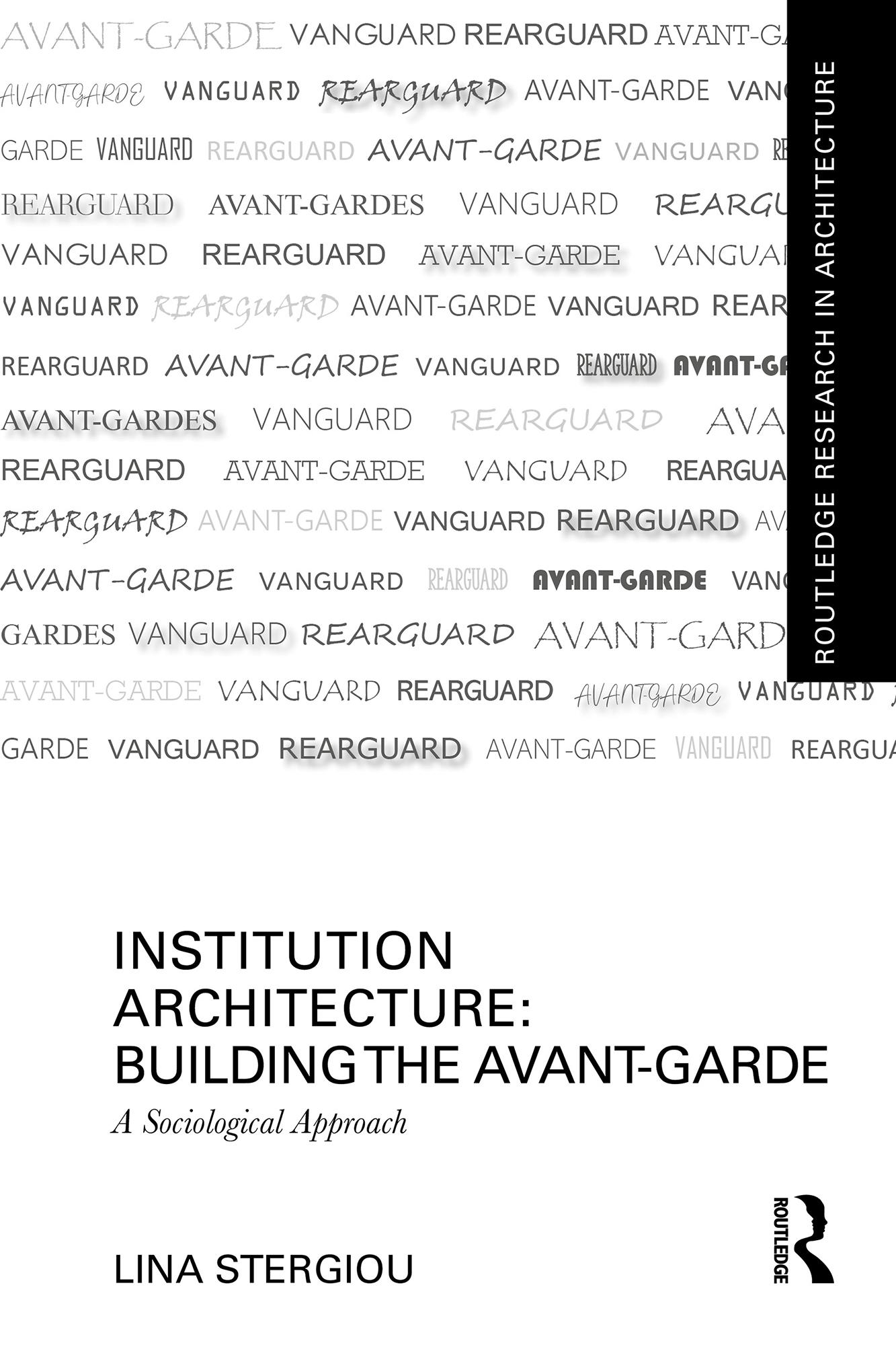
Institution Architecture: Building the Avant-Garde takes a terminological, sociological, and semiological approach that develops by tracing the ‘avant-garde’ in a century span of literatures for a textual analysis, unpacking the text, and in a process analysis, interpreting it.
The sources consist of 825 well-known, globally influential European, including Russian, architectural literatures of the extended 1920s, and of Anglo-Saxon literatures of the extended 1960s to the 2010s. The book traces the connotations that the term ‘avant-garde’ acquired in them and shows the different notions under the ‘avant-garde’ signifier, directing attention to the term’s early twentieth-century roots and modes; its 1960s rising usage, modes, and function; and its post–1960s to 2010s developments. It sheds light on the sociological topography of the avant-garde, and through the writings, on the ways in which the term and avant-gardism connected, the actors, agencies, and mediators therein, on the terms’ techniques and modes, indicating the reasons for its heretofore limited systematic inquiry. The book aims at unravelling a century-old ‘avant-garde’ mystic function for unlocking horizontal, plural, and transparent conversations about interdisciplinary futures of architecture, cross-disciplinary dialogues, and liberatory dynamics. The book will therefore be relevant to scholars and researchers interested in the avant-garde in architecture, and the avant-garde as a transdisciplinary subject.
Pay easily by card, Klarna, Apple Pay or Google Pay. Not happy? You always have a 14-day money-back guarantee. Read more in our terms. If you have any questions, email us at hello@memmo.org.
Memmo makes studying easier – wherever you are in the world. We bring your course books and smart study tools together in one place: summaries, quizzes, podcasts and flashcards. Plus Ted, your study buddy who answers anything you wonder. Over 75,000 students already study here – built to help you learn faster and stress less.