
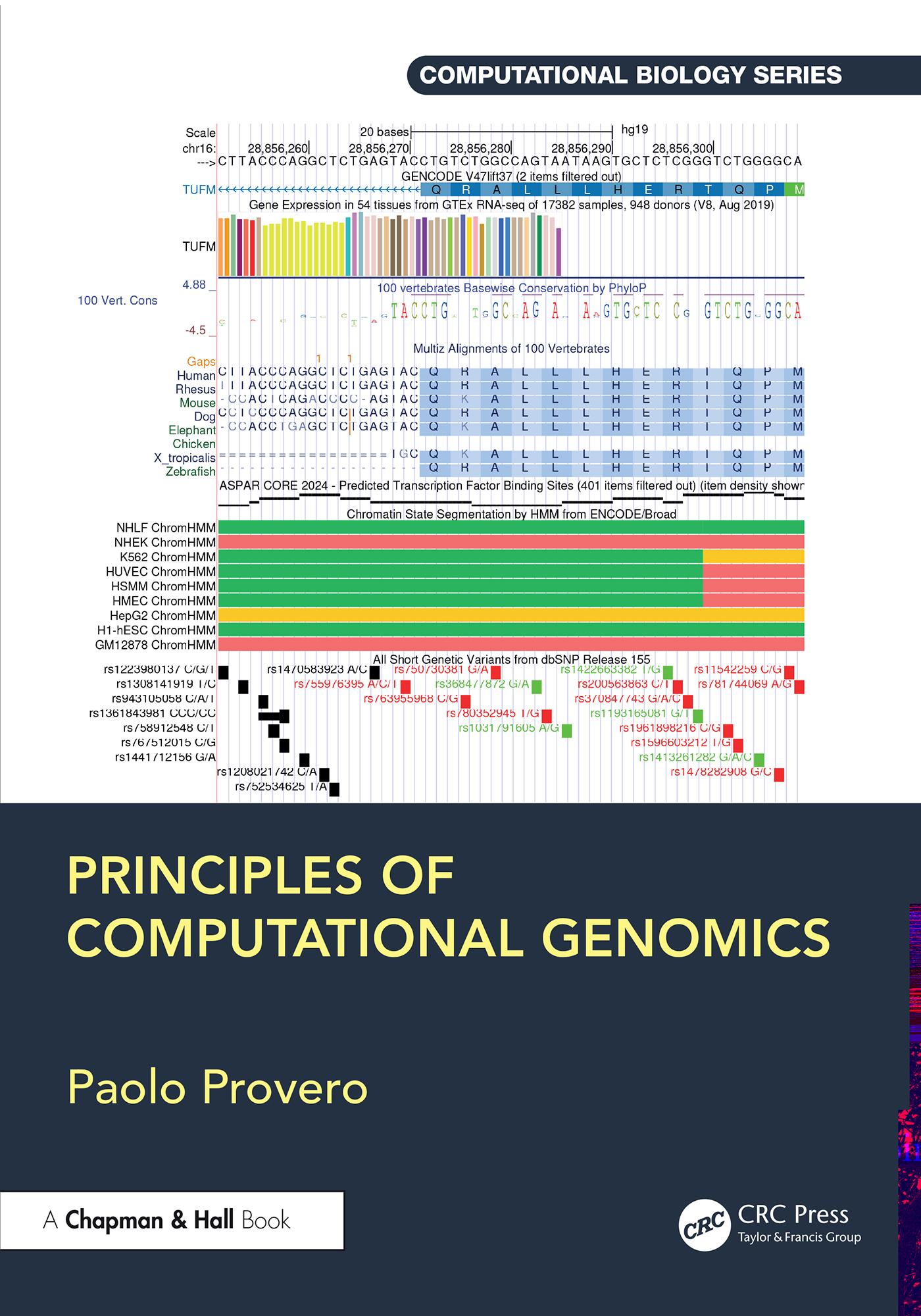
The advent of high-throughput experimental assays, and in particular of next-generation sequencing, has revolutionized life sciences by enabling the generation of data at the scale of the whole genome. Extracting biologically useful or clinically actionable information from this data requires analytical methods quite different from the ones used to analyze low-throughput experimental results. The development of these methods is the goal of computational biology.
Understanding the principles on which these methods are based is thus necessary for all students and researchers in life sciences. This book provides the conceptual framework needed to understand computational genomics enough to be able to follow the arguments in recent papers, or to collaborate with computational scientists in research projects. In particular, it introduces the mathematical and statistical basis of the methods in some depth. The main focus is on the analysis of next-generation-sequencing assays, both for the interpretation of the DNA sequence per se (sequence alignment, phylogenetic tree reconstruction, genetic variants) and for the study of gene regulation and epigenomics (gene expression, transcription factor binding, chromatin states, 3D structure of the genome). The final chapter discusses the associations of genetic variants with phenotypes and diseases, and their biological interpretation.
Principles of Computational Genomics provides a solid foundation for understanding the many parts of computational genomics, including those not treated directly in the book. It will be of great benefit to students and researchers across the life sciences.
Pay easily by card, Klarna, Apple Pay or Google Pay. Not happy? You always have a 14-day money-back guarantee. Read more in our terms. If you have any questions, email us at hello@memmo.org.
Memmo makes studying easier – wherever you are in the world. We bring your course books and smart study tools together in one place: summaries, quizzes, podcasts and flashcards. Plus Ted, your study buddy who answers anything you wonder. Over 50,000 students already study here – built to help you learn faster and stress less.