
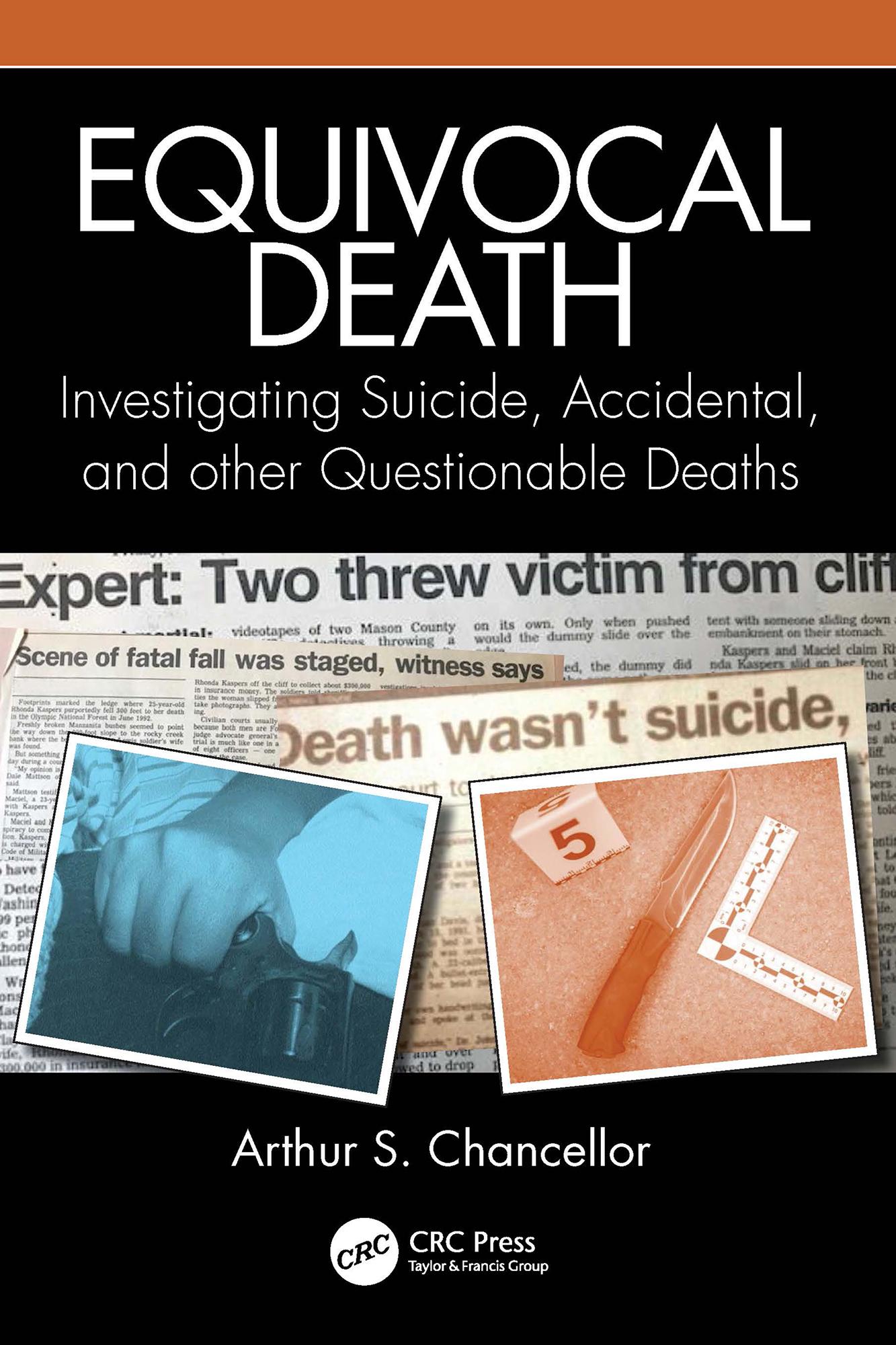
Equivocal Death: Investigating Suicide, Accidental, and other Questionable Deaths refocuses the attention of first responders and investigative personnel to the concept of treating every death as a homicide, until sufficient evidence is discovered to validate another manner of death and eliminate the possibility of a staged homicide.
All death investigations should include a well-documented and examined crime scene and a thorough preliminary investigation. It is a well-established, unwritten “rule” when conducting death investigations to initially treat every death as a possible homicide. This includes the examination of the body, the recovery scene, the autopsy, collection of forensic evidence, and subsequent laboratory analysis. Police and investigators are often confronted with a death scene that they cannot initially determine the manner of death; these instances are known as equivocal death.
Coverage focuses on the basics of death investigation and the how to’s rather than dwelling on extraneous and unnecessary detail. By example, it is generally more important for the detective or CSI to understand how to properly pick up forensic evidence at the scene, and how the resulting analysis relates to their investigation, rather than the mechanics of how the evidence is extracted and analyzed at the lab. For suicide and equivocal deaths, it is likewise important that detectives also understand the importance of such things as a victimology assessment, risk factors, and/or ante mortem behaviors of the victim, cues that may provide clues that would be consistent with someone contemplating suicide. The book also features several aspects of criminal investigation that are not found in similar books, including coverage of victimology, including crime scene staging, the notion of psychology autopsy, and how to identify those risk factors or behaviors that are consistent with suicide including motive, intent, and ability.
Equivocal Death: Investigating Suicide, Accidental, and other Questionable Deaths serves as an essential reference for the detective, crime scene investigators, coroners and medical examiners, medicolegal investigators, and prosecutors actively involved in these types of cases.
Pay easily by card, Klarna, Apple Pay or Google Pay. Not happy? You always have a 14-day money-back guarantee. Read more in our terms. If you have any questions, email us at hello@memmo.org.
Memmo makes studying easier – wherever you are in the world. We bring your course books and smart study tools together in one place: summaries, quizzes, podcasts and flashcards. Plus Ted, your study buddy who answers anything you wonder. Over 50,000 students already study here – built to help you learn faster and stress less.