
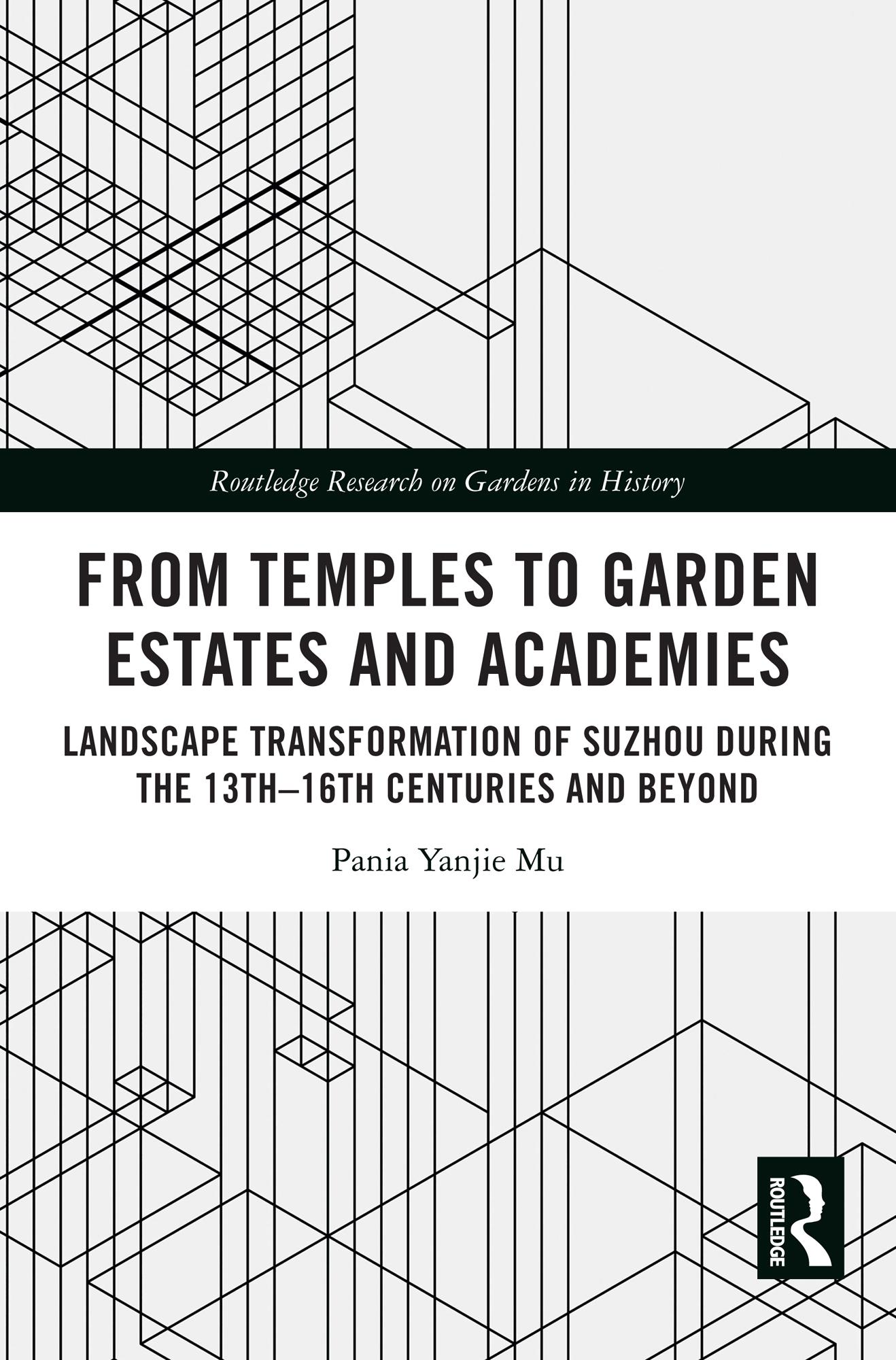
How did the temple-scape of Suzhou transform into garden-scape during the 13th to 16th centuries? This book investigates the landscape evolution of China during the Yuan-Ming socio-political transformation and provides a previously unrepresented Buddhist and hydraulic history of Chinese gardens.
Utilising historical GIS mapping and 3D architectural modelling, the research uncovers spatial strategies employed by monks, the gentry, and the government. It argues that by seizing hydraulic estates from Buddhists, the gentry and government rose as a landed class and cultural elites, establishing the literati garden. Yuan temples featured a mound-field-river topography which reclaimed urban wetlands. In temples such as Shizi Lin, scenes were crafted as Chan gong’ans to support Buddhist practice towards enlightenment, underpinning a monastic architectural transformation in the 14th century. In the Ming dynasty, the gentry and government exploited the hydro-topography while erasing Buddhist traces by converting temples into gardens. The book forms a theoretical model of triangulating the garden practice with socio-hydro spaces and advocates a new garden history enabled by historical mapping and modelling.
This book is aimed at students and scholars of East Asian history, temples and gardens, and landscape architecture and design.
Pay easily by card, Klarna, Apple Pay or Google Pay. Not happy? You always have a 14-day money-back guarantee. Read more in our terms. If you have any questions, email us at hello@memmo.org.
Memmo makes studying easier – wherever you are in the world. We bring your course books and smart study tools together in one place: summaries, quizzes, podcasts and flashcards. Plus Ted, your study buddy who answers anything you wonder. Over 50,000 students already study here – built to help you learn faster and stress less.