
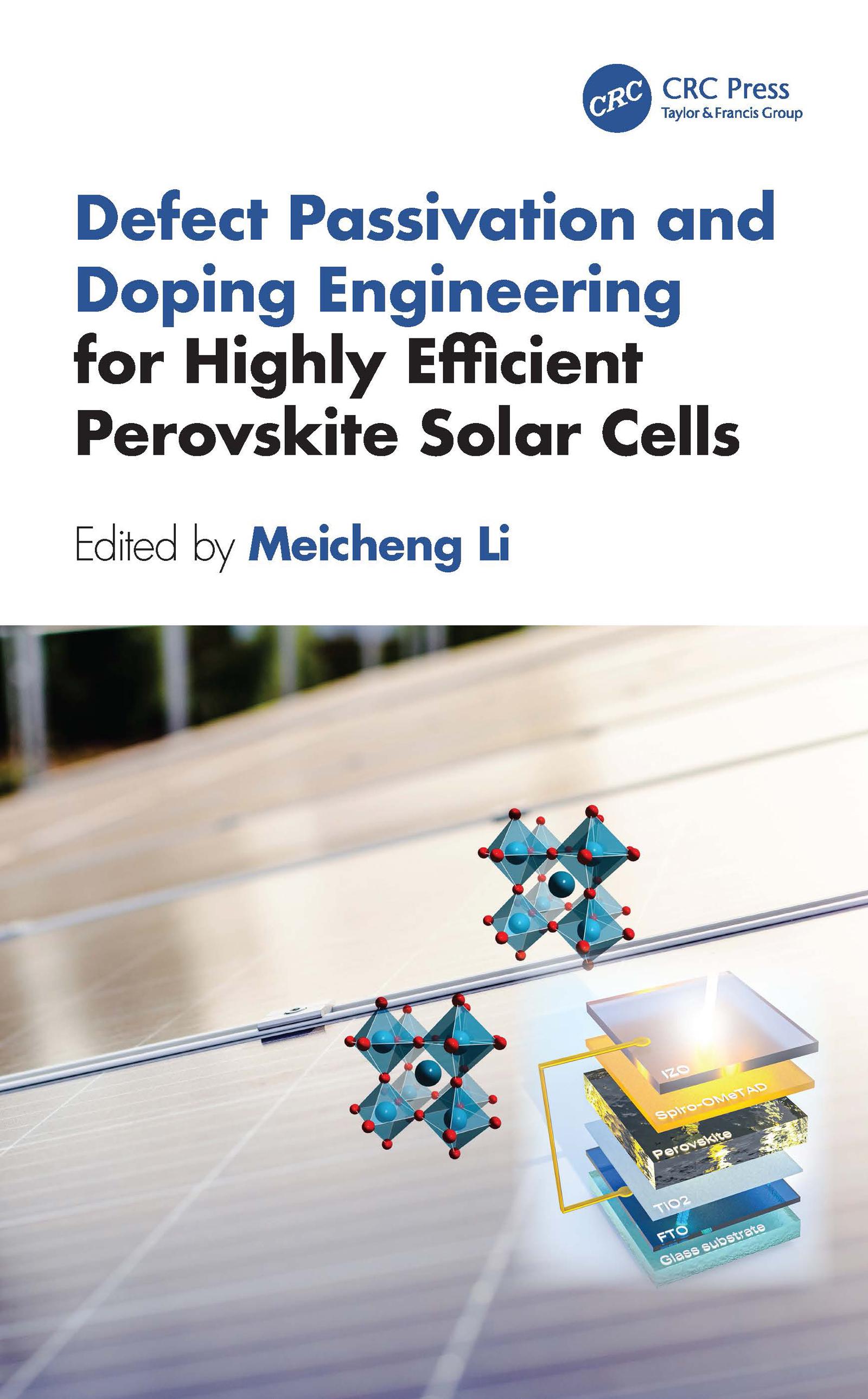
Perovskite solar cells (PSCs) have attracted increasing interest from researchers due to their superb power conversion efficiencies. The intrinsic trap defects, unavoidably formed in the fabrication process, can induce nonradiative recombination, ion migration, I-V hysteresis, and instability of PSCs. However, trap defects are not always harmful. Fully understanding the fundamentals of trap defects as well as the passivation and doping strategies is helpful for further improving device efficiency and stability. This book summarizes the methods and strategies of defect passivation and material doping aiming to clearly describe the underlying mechanisms for high-efficiency and stable PSCs.
• Introduces the fundamental characteristics of perovskite material defects
• Discusses the main strategies, principles, and applications of defect passivation
• Describes defect passivation consequences and characterization methods
• Covers principles, methods, and applications of doping engineering in perovskites
• Explores the structural design, advantages, characteristics, fabrication methods, and future development of perovskite homojunction
Engineers and researchers working with photovoltaic generation, solar cells, semiconductors, and related topics will find this book to be an invaluable resource.
Pay easily by card, Klarna, Apple Pay or Google Pay. Not happy? You always have a 14-day money-back guarantee. Read more in our terms. If you have any questions, email us at hello@memmo.org.
Memmo makes studying easier – wherever you are in the world. We bring your course books and smart study tools together in one place: summaries, quizzes, podcasts and flashcards. Plus Ted, your study buddy who answers anything you wonder. Over 50,000 students already study here – built to help you learn faster and stress less.