
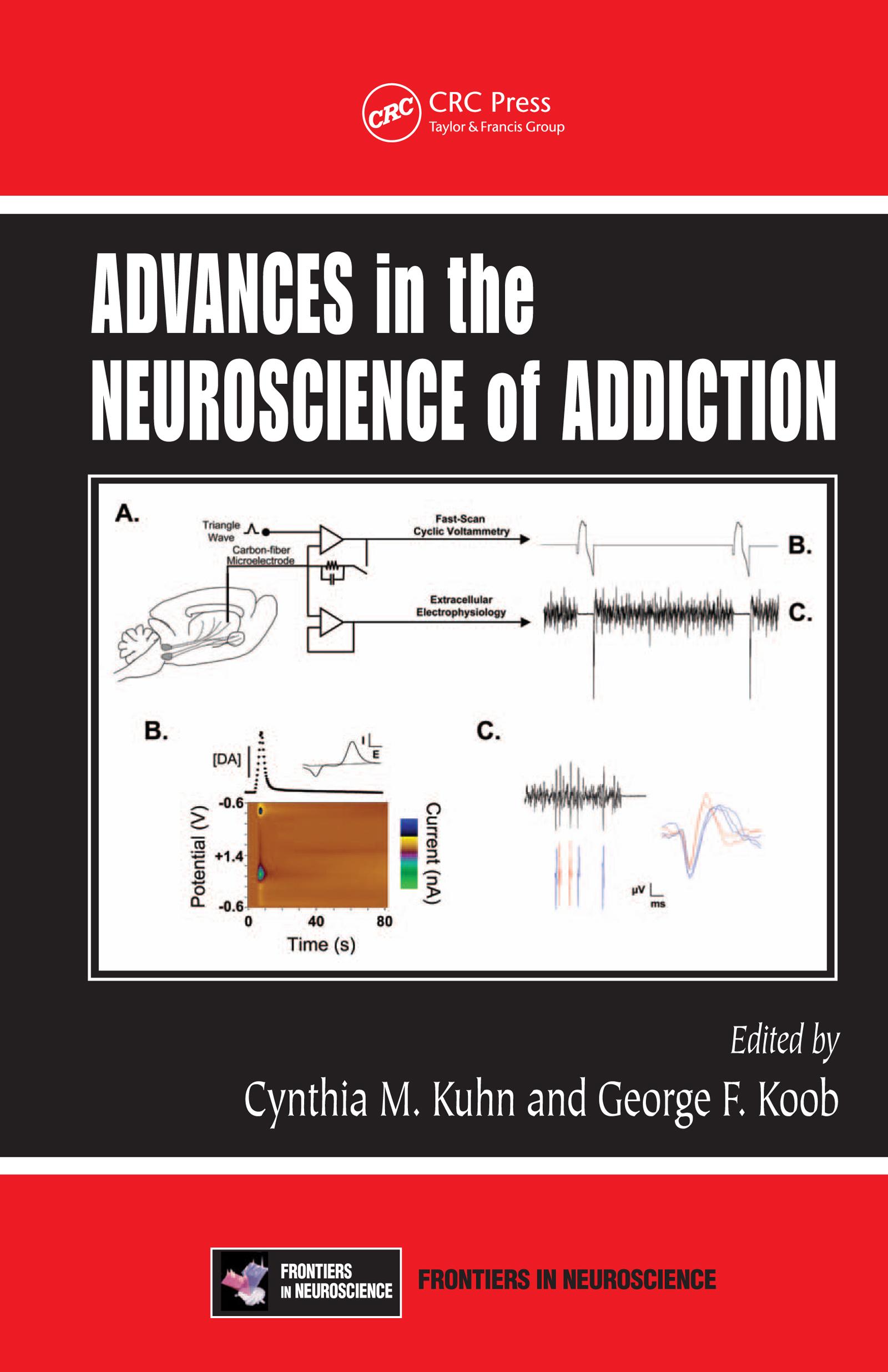
Understanding the phenomenon of long-lasting vulnerability to addiction is essential to developing successful treatments. Written by an international team of authorities in their respective fields, Advances in the Neuroscience of Addiction provides an excellent overview of the available and emerging approaches used to investigate the biologic mechanisms of drug addiction. It also delineates the promising research discoveries being made in relapse prevention.
The book begins with current animal models of addiction, which mimic the state of humans entering treatment: recently-abstinent animals that receive common triggers for relapse (classical conditioning, stress, and neuroadaptive dysregulation). Coverage then shifts to the use of electrophysiologic approaches, which enable researchers to characterize the discharge patterns of single neurons during drug self-administration. After exploring advances in voltammetry and enzyme-linked biosensors for measuring glutamate, the book discusses the theoretical background and results of neuroimaging studies related to neuronal networks that are activated by drug-specific cues. It then describes modern genetic approaches to manipulate target proteins that influence addictive behavior.
The book rounds out its coverage by illustrating how a neuroeconomic approach can inform studies of reward processing in general and addiction in particular. It is a comprehensive introduction to the methodologies of the field for students and beginning researchers and an essential reference source for established investigators.
Pay easily by card, Klarna, Apple Pay or Google Pay. Not happy? You always have a 14-day money-back guarantee. Read more in our terms. If you have any questions, email us at hello@memmo.org.
Memmo makes studying easier – wherever you are in the world. We bring your course books and smart study tools together in one place: summaries, quizzes, podcasts and flashcards. Plus Ted, your study buddy who answers anything you wonder. Over 75,000 students already study here – built to help you learn faster and stress less.