
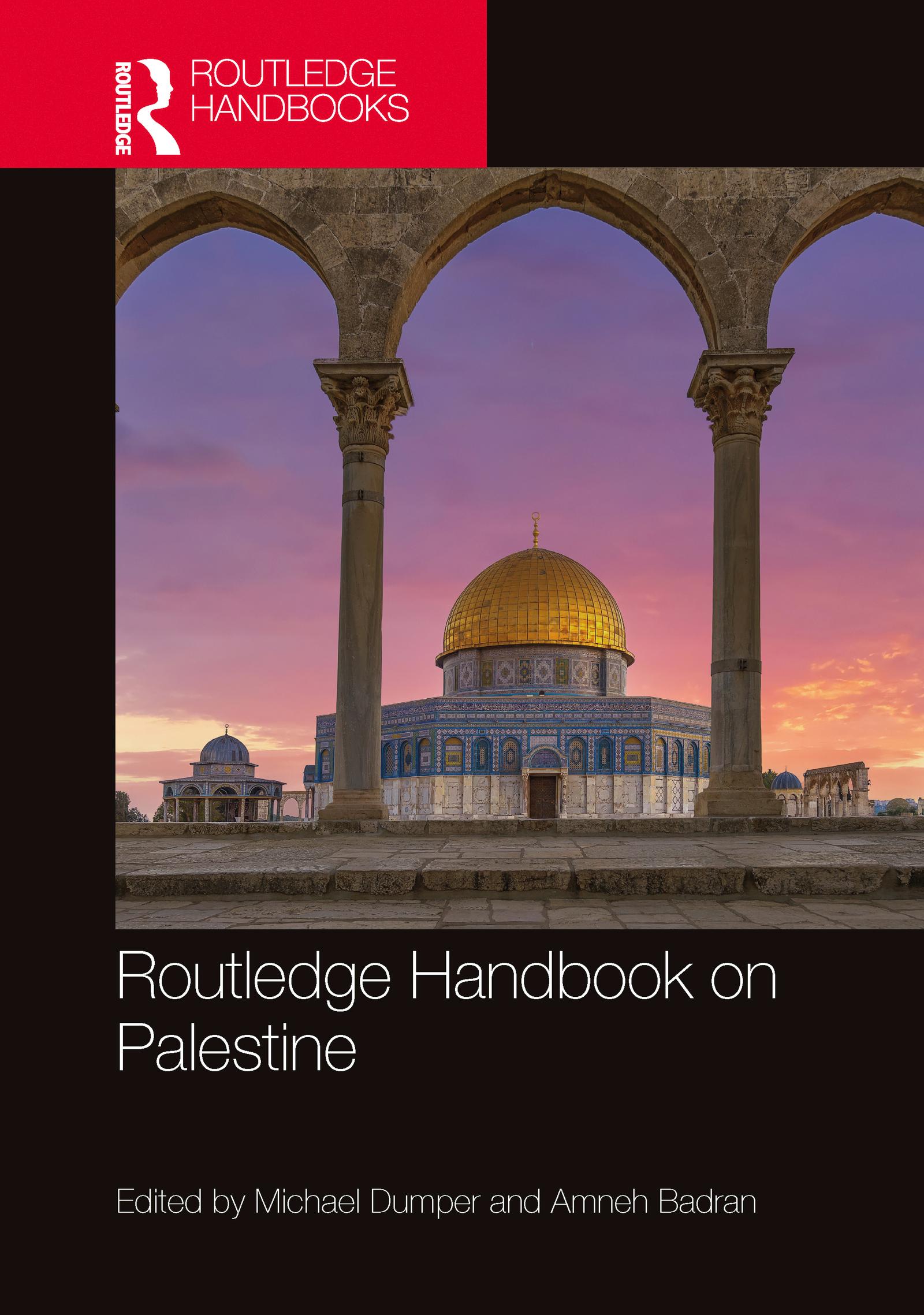
This Handbook provides a broad overview of Palestinian history, society, politics, and culture across different contexts and periods, revealing the rich and varied dimensions of Palestine.
To capture the diversity of Palestinian scholarship and to introduce readers to a mix of approaches and perspectives, both internationally established and emerging Palestinian scholars have contributed. The Handbook attempts to avoid narrowly framing Palestine around the Israeli-Palestinian conflict, incorporating postcolonial approaches attentive to a broader range of (hitherto overlooked) actors. While a significant proportion of the Handbook examines the contemporary period, it is divided up into four sections that together provide a detailed overview of the main developments in the region:
- A historical section that contextualizes the complex historical formation of contemporary Palestine – perhaps best regarded as a country but not yet a state
- A section exploring the society, geography, economy, and identity of Palestine
- A section on the political significance of Palestine, covering the dynamics between Jewish nationalism (Zionism) and Palestinian nationalism
- A final section on culture, touching on architecture, literature, music, cuisine, education, and contemporary art
Providing a deep analysis of the Palestinian perspective, the Handbook will prove valuable reading for anyone interested in the history, politics and society of Palestine and the Middle East.
Pay easily by card, Klarna, Apple Pay or Google Pay. Not happy? You always have a 14-day money-back guarantee. Read more in our terms. If you have any questions, email us at hello@memmo.org.
Memmo makes studying easier – wherever you are in the world. We bring your course books and smart study tools together in one place: summaries, quizzes, podcasts and flashcards. Plus Ted, your study buddy who answers anything you wonder. Over 50,000 students already study here – built to help you learn faster and stress less.