
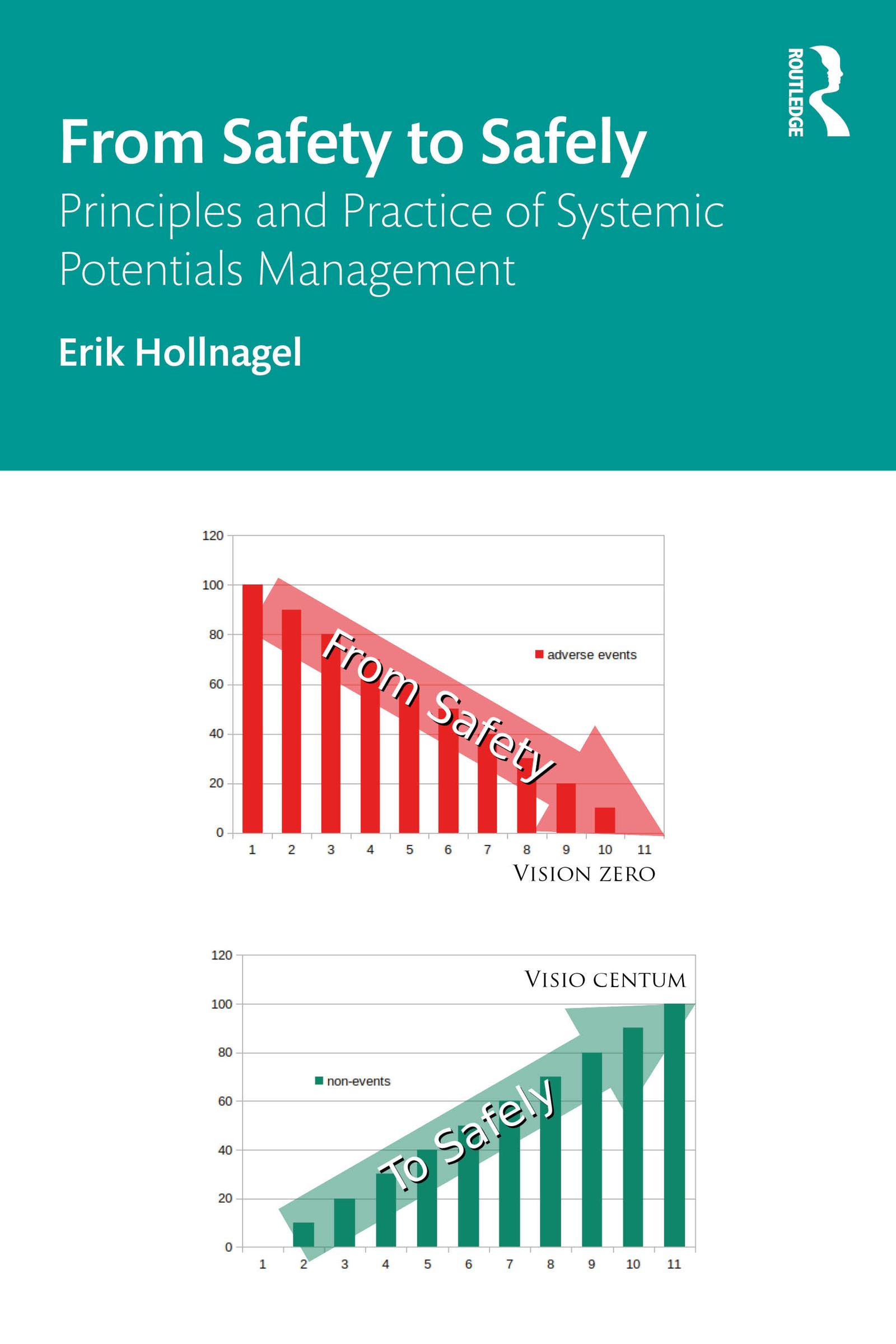
The conventional interpretation of safety, known as Safety-I, denotes a condition where as little as possible goes wrong, and the focus of practical efforts in management or analysis is on the occurrence of unacceptable outcomes and on how to reduce their number to an acceptable level, ideally zero. The emphasis is therefore on how to manage safety as such, as seen in the ubiquitous safety management systems (SMS). As Professor James Reason astutely points out, this raises the interesting question of how it is possible to learn about something, let alone manage it, if it is studied only in situations in which it is absent. The solution proposed by and described in this book is to stop using safety as a noun and instead use it as an adverb: safely.
Now often referred to as Safety-II, this solution is the logical consequence of resilience engineering and will require new methods, several of which already exist and have proved their worth in practice for years. The question ceases being what to manage and becomes how to manage. Managing safety is protective, hence a non-productive cost, which at best avoids a loss. Conversely, managing safely is productive and can generate revenue in addition to preventing or avoiding losses; aviation and mining are prime examples.
From Safety to Safely provides a practical perspective on managing safely, illustrating a practical form of synesis. It offers a new understanding of safety, combining concerns for productivity and safety rather than juxtaposing them, and it shows how to manage complex industrial and social systems in the spirit of resilience engineering and synesis. It is the first book to completely dispense with the loaded term "safety" while offering a practical and viable alternative. Spoiler alert: this book does not mention or analyse any celebrated accidents.
This book is for all middle and senior managers, board members, and independent consultants seeking to ensure safe, revenue-generating operations.
Pay easily by card, Klarna, Apple Pay or Google Pay. Not happy? You always have a 14-day money-back guarantee. Read more in our terms. If you have any questions, email us at hello@memmo.org.
Memmo makes studying easier – wherever you are in the world. We bring your course books and smart study tools together in one place: summaries, quizzes, podcasts and flashcards. Plus Ted, your study buddy who answers anything you wonder. Over 50,000 students already study here – built to help you learn faster and stress less.