
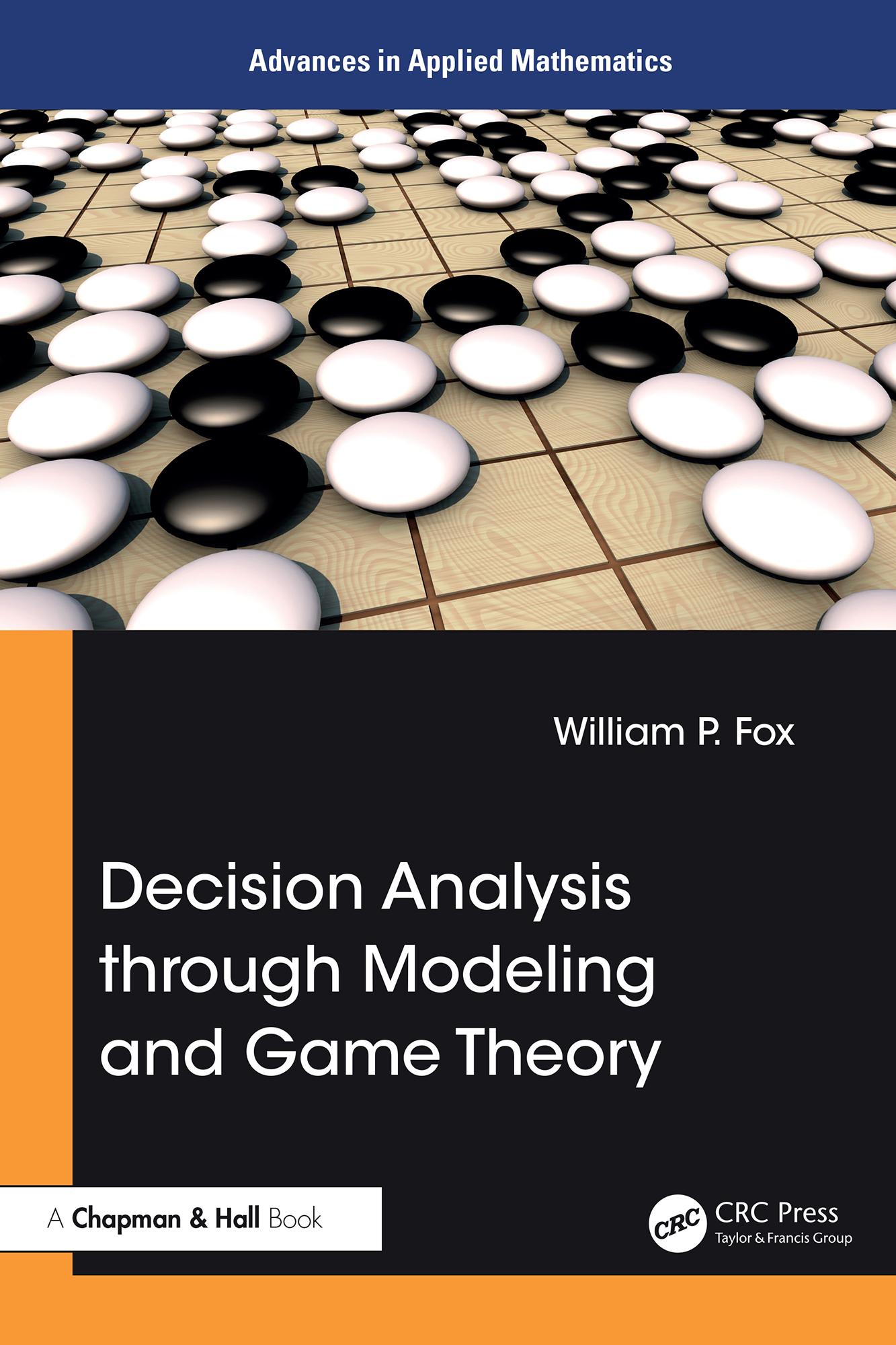
This unique book presents decision analysis in the context of mathematical modeling and game theory. The author emphasizes and focuses on the model formulation and modeling-building skills required for decision analysis, as well as the technology to support the analysis.
The primary objective of Decision Analysis through Modeling and Game Theory is illustrative in nature. It sets the tone through the introduction to mathematical modeling. The text provides a process for formally thinking about the problem and illustrates many scenarios and illustrative examples.
These techniques and this approach center on the fact (a) decision makers at all levels must be exposed to the tools and techniques available to help them in the decision process, (b) decision makers as well as analysts need to have and use technology to assist in the entire analysis process, (c) the interpretation and explanation of the results are crucial to understanding the strengths and limitations of modeling, and (d) the interpretation and use of sensitivity analysis is essential.
The book begins with a look at decision-making methods, including probability and statistics methods under risk of uncertainty. It moves to linear programming and multi-attribute decision-making methods with a discussion of weighting methods. Game theory is introduced through conflict games and zero-sum or constant-sum games. Nash equilibriums are next, followed by utility theory. Evolutionary stable strategies lead to Nash arbitration and cooperation methods and N-person methods presented for both total and partial conflict games.
Several real-life examples and case studies using game theory are used throughout. This book would be best used for a senior-level course in mathematics, operations research, or graduate-level courses or decision modeling courses offered in business schools. The book will be of interest to departments offering mathematical modeling courses with any emphasis on modeling for decision making.
Pay easily by card, Klarna, Apple Pay or Google Pay. Not happy? You always have a 14-day money-back guarantee. Read more in our terms. If you have any questions, email us at hello@memmo.org.
Memmo makes studying easier – wherever you are in the world. We bring your course books and smart study tools together in one place: summaries, quizzes, podcasts and flashcards. Plus Ted, your study buddy who answers anything you wonder. Over 75,000 students already study here – built to help you learn faster and stress less.